The Tale of the Tape
The ACC enters 2026 with Miami sitting as the clear favorite to run away with the conference… and after last year’s run to the national championship game, I believe the Hurricanes are positioned to take the next step and finally capture their first ACC title. With Darian Mensah now leading an offense featuring Malachi Toney, Miami has the combination of quarterback play and overall roster talent to separate itself from the rest of the conference.
Behind Miami, however, the conference gets much more interesting. Louisville and SMU are my biggest challengers, with Jeff Brohm’s Cardinals projected to finish 10–2 and Kevin Jennings giving SMU a legitimate chance to reach Charlotte. Clemson remains formidable, but I have the Tigers taking another step back from their traditional place atop the ACC, while Virginia, Cal, Georgia Tech and Virginia Tech make up an intriguing second tier. The middle of the conference is incredibly difficult to separate, and programs like NC State, Duke and Pitt are good enough to upset almost anyone despite sitting outside my top eight.
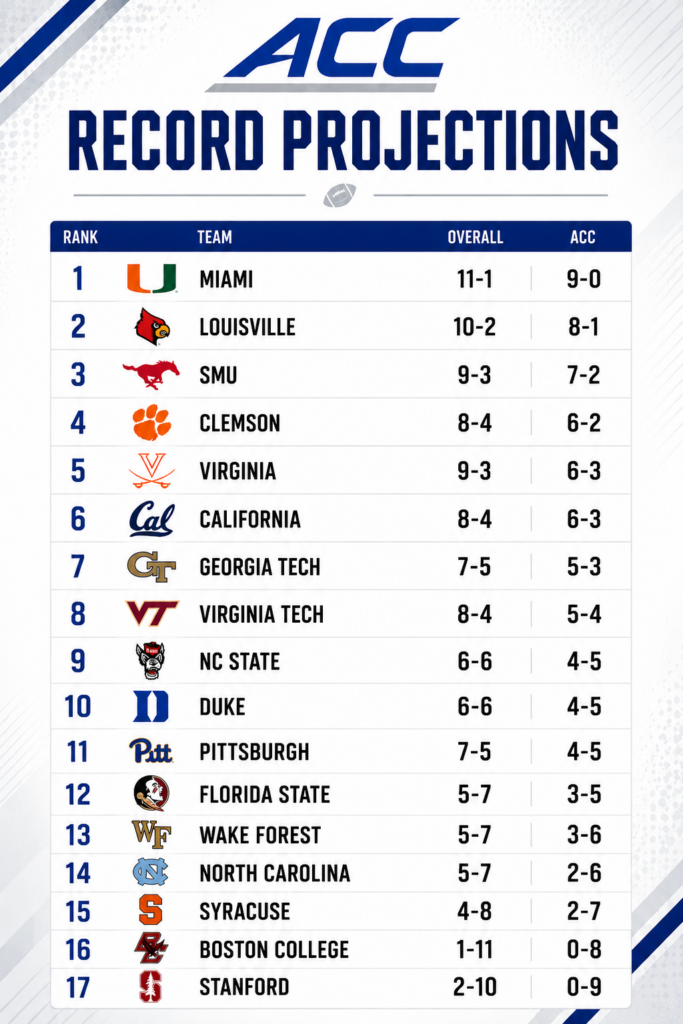
There are several fascinating storylines toward the bottom of the conference, from Florida State trying to regain its footing to Bill Belichick attempting to turn things around at North Carolina. After Duke stunned the conference by winning the championship last season, dismissing any ACC team entirely feels dangerous. But entering the year, I see a clear favorite followed by a wide-open race behind it: Miami is the team to beat, Louisville and SMU are its strongest challengers, and everything after that could get chaotic.
Miami Hurricanes
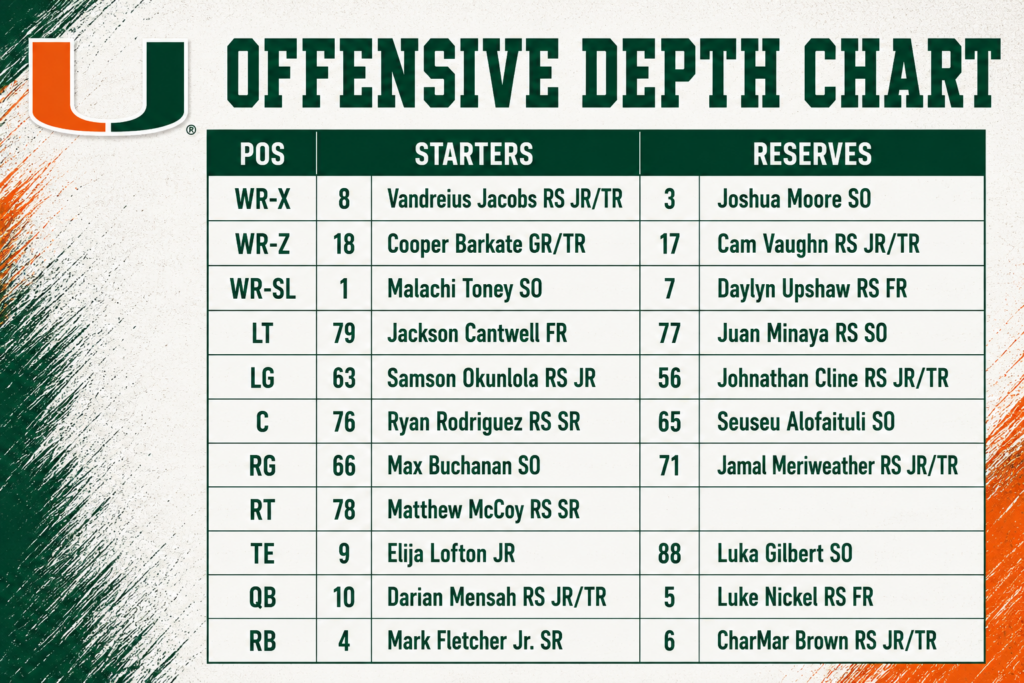
Offensive Outlook
Miami enters 2026 coming off a 13–3 season and a run all the way to the national championship game, where the Hurricanes fell 27–21 to Indiana. The offense averaged 30.9 points and 405.0 yards per game last season, but Mario Cristobal once again has to replace his starting quarterback. After successfully transitioning from Cam Ward to Carson Beck, Miami now turns to former Duke quarterback Darian Mensah.
Mensah is one of the biggest reasons I’m so high on Miami. He threw for 3,973 yards and 34 touchdowns at Duke in 2025, leading the ACC in passing yards and touchdowns, and now steps into a substantially more talent loaded situation in Coral Gables. He’s already been named the ACC Preseason Player of the Year. I think he’s a legitimate Heisman candidate and a substantial upgrade over Beck in terms of fit for Shannon Dawson’s offense.
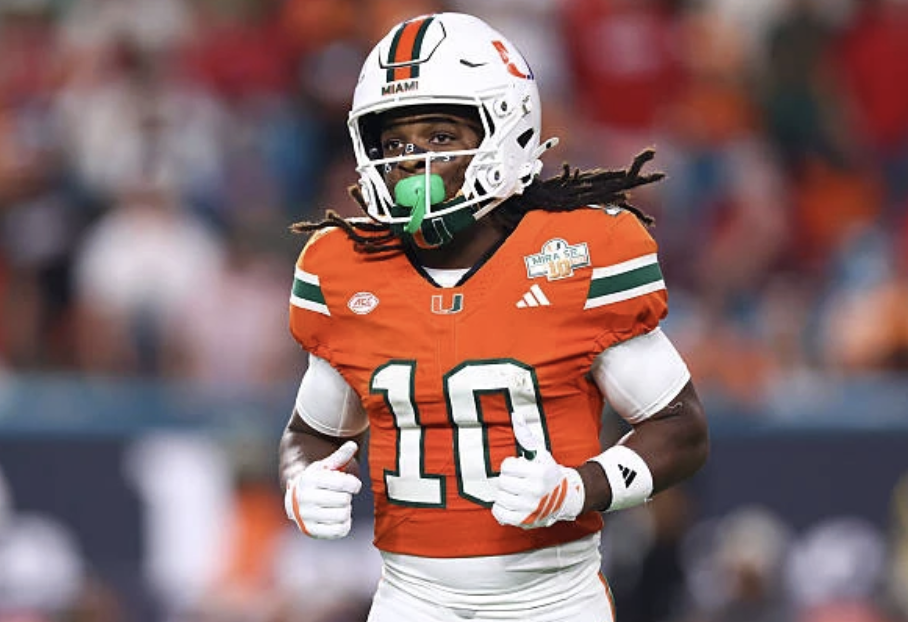
His best weapon is sophomore Malachi Toney, who emerged as one of college football’s most dynamic players as a true freshman and earned first-team All-ACC honors. Miami can move him around the formation and manufacture touches for him in a variety of ways. Mensah also brought former Duke receiver Cooper Barkate with him, giving Miami another established target. In the backfield, Mark Fletcher Jr. returns to lead a loaded running-back room.
The biggest offensive question is up front. Miami is replacing four starters along the offensive line, which is unusual for a Cristobal team built around dominance in the trenches. Still, Samson Okunlola earned preseason All-ACC recognition, and Cristobal and offensive line coach Alex Mirabal have recruited enough talent that I expect the group to improve substantially as the season progresses. If that line comes together, Mensah, Toney, Barkate and Fletcher give Miami everything it needs to field one of the country’s best offenses.
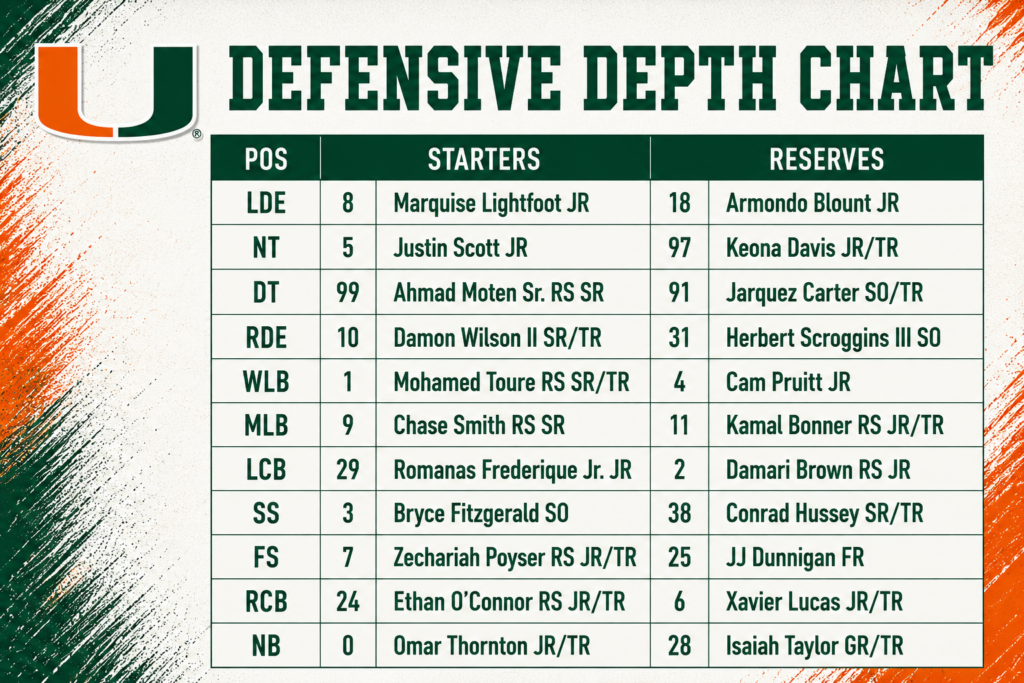
Defensive Outlook
Miami’s defense was outstanding during last year’s championship run. The Hurricanes allowed only 14.8 points and 294.1 yards per game, including an exceptional 89.3 rushing yards per game at just 3.0 yards per carry. That ability to control the line of scrimmage was a major reason Miami survived three consecutive playoff games before finally falling to Indiana.
There are significant departures, but defensive coordinator Corey Hetherman still has an impressive collection of talent. Defensive tackle Ahmad Moten Sr., linebacker Mohamed Toure and safety Bryce Fitzgerald were all named to the preseason All-ACC team. Moten should anchor another talented defensive front alongside Justin Scott, while Fitzgerald gives Miami a legitimate difference-maker in the secondary.
The portal provided reinforcements as well. Former Georgia edge Damon Wilson II gives the Hurricanes another explosive pass rusher, while Boston College transfer Omar Thornton adds help to a defense that lost several important contributors from last year’s team. The linebacker group is probably my biggest question, but Toure’s experience helps stabilize it.
I don’t necessarily expect Miami to duplicate last year’s defensive numbers—allowing fewer than 15 points per game is an extremely high bar—but I don’t anticipate a major drop-off either. The defensive line and secondary are talented enough for this to remain the ACC’s best defense, and Miami possesses more high-end defensive talent than anyone else in the conference.
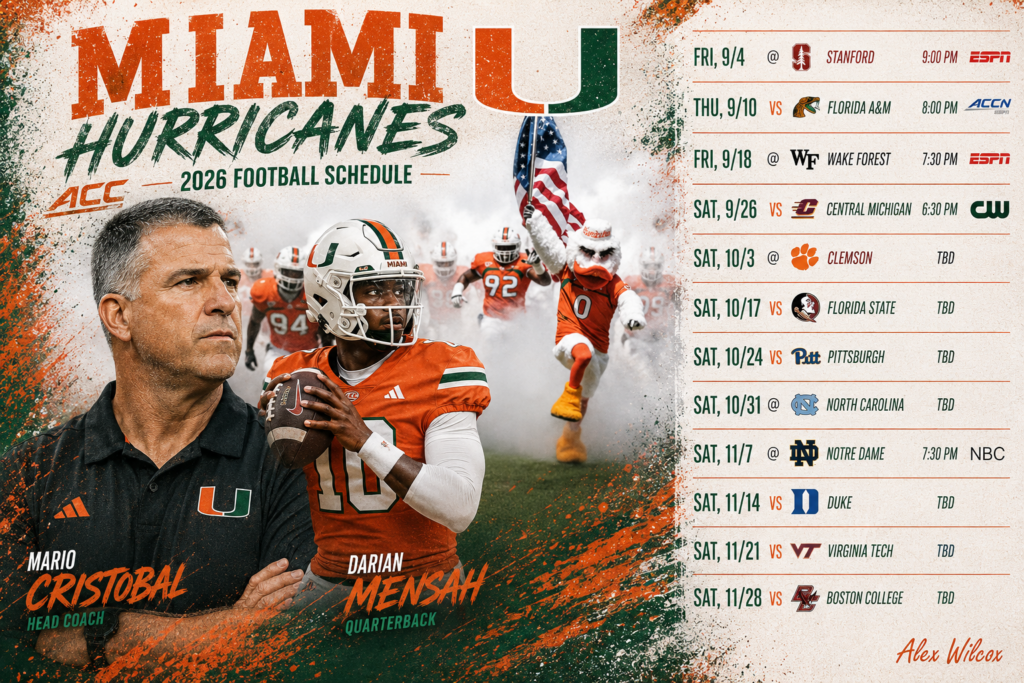
Overview and Projection
My final projection for the Canes is 11–1 overall and 9–0 in the ACC. I think Miami is clearly the most complete team in the conference entering the season. Mensah gives the Hurricanes elite quarterback play, Toney is one of the country’s most dangerous offensive weapons, and the defense should remain excellent.
After coming within one game of winning the national championship last year, Miami isn’t rebuilding—it is reloading for another run at it. I expect the Hurricanes to win the ACC regular-season race, win the conference championship game and return to the College Football Playoff. Whether they can finish the job this time will depend on how quickly the offensive line develops, but 11–1 feels like the right projection for a Miami team that I believe is firmly among the best teams in college football.
Projected Record: 11-1 (9-0)
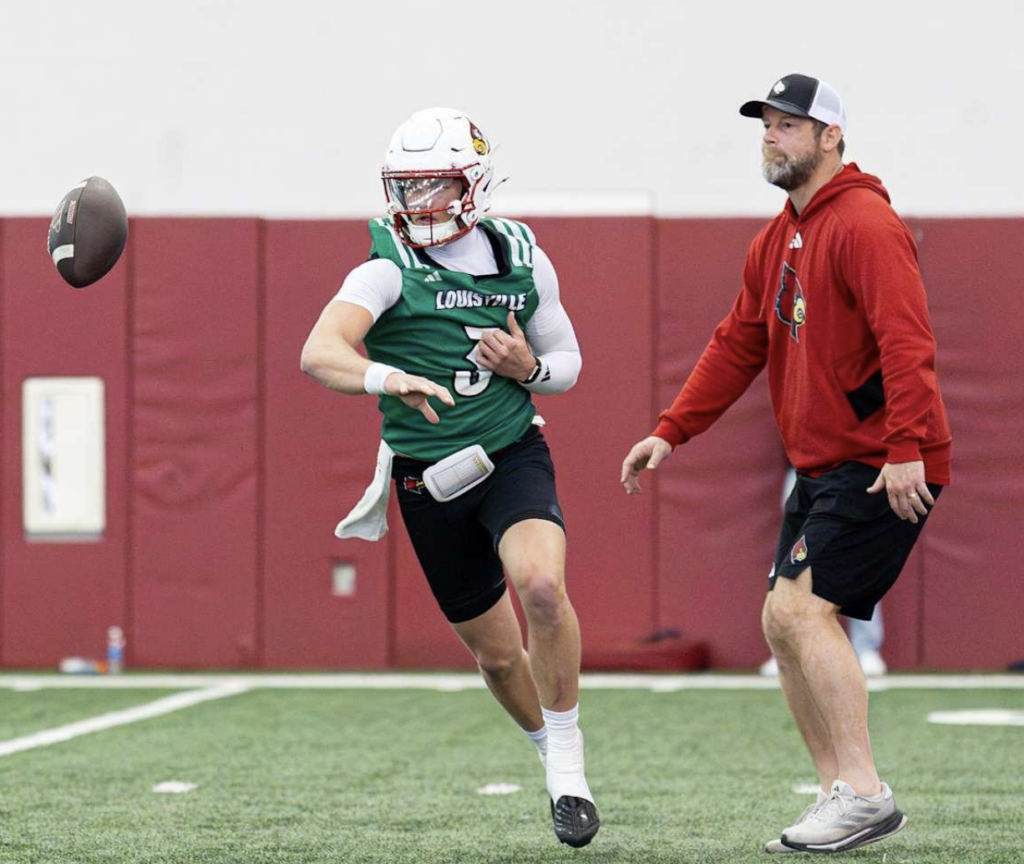
Louisville Cardinals
Offensive Outlook
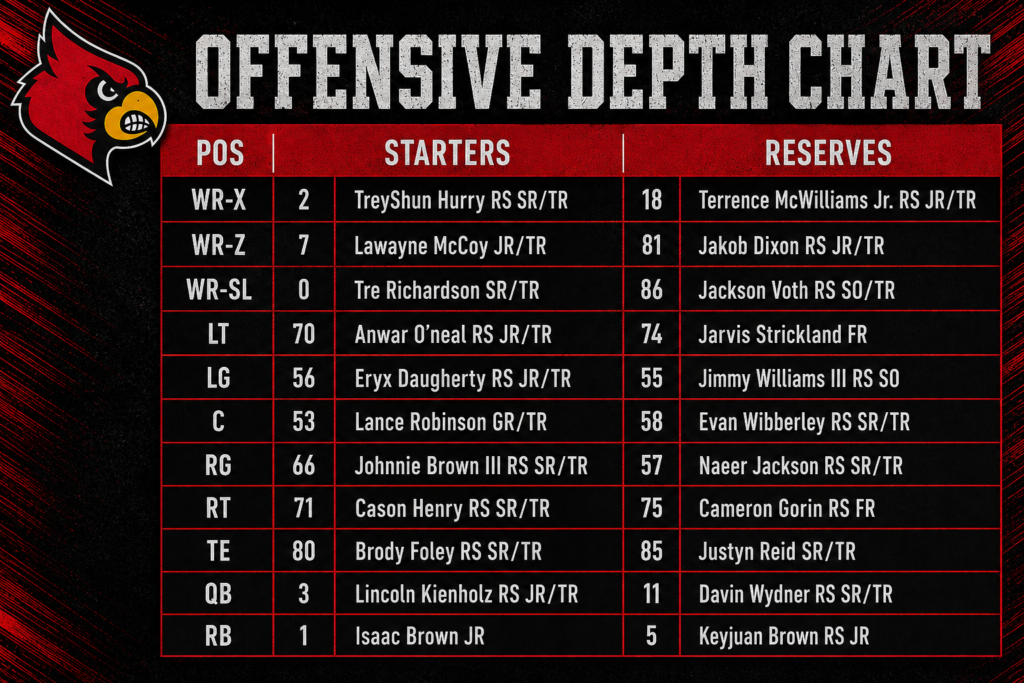
Few coaches in the country have a better track record with quarterbacks than Jeff Brohm, and Louisville’s 2026 season will hinge on his latest project. Lincoln Kienholz takes over after transferring from Ohio State, where he spent three seasons behind a crowded quarterback room. He appeared in seven games last season, completing 11 of 14 passes for 139 yards and a touchdown, so this will be his first real opportunity to run a college offense.
Kienholz won’t have to create everything himself because Isaac Brown gives Louisville an established star in the backfield. Brown and Keyjuan Brown form a talented one-two punch, and the receiving corps has several intriguing options with Tre Richardson, Lawayne McCoy and tight end Brody Foley. There’s enough speed and versatility here for Brohm to continue producing the explosive offense we’ve come to expect from him.
The biggest concern is the offensive line. Louisville returns only one established starter up front in Lance Robinson, who earned honorable mention All-ACC recognition last season. That’s a lot of turnover for an offense breaking in a new quarterback, and it could become especially important immediately against Ole Miss.
Still, I trust Brohm offensively. Kienholz doesn’t need to become a superstar overnight. If Louisville protects him and allows Brown to establish the running game, Brohm should be able to manufacture favorable situations for a talented but inexperienced quarterback. The ceiling of this offense will ultimately depend on how quickly Kienholz develops.
Defensive Outlook
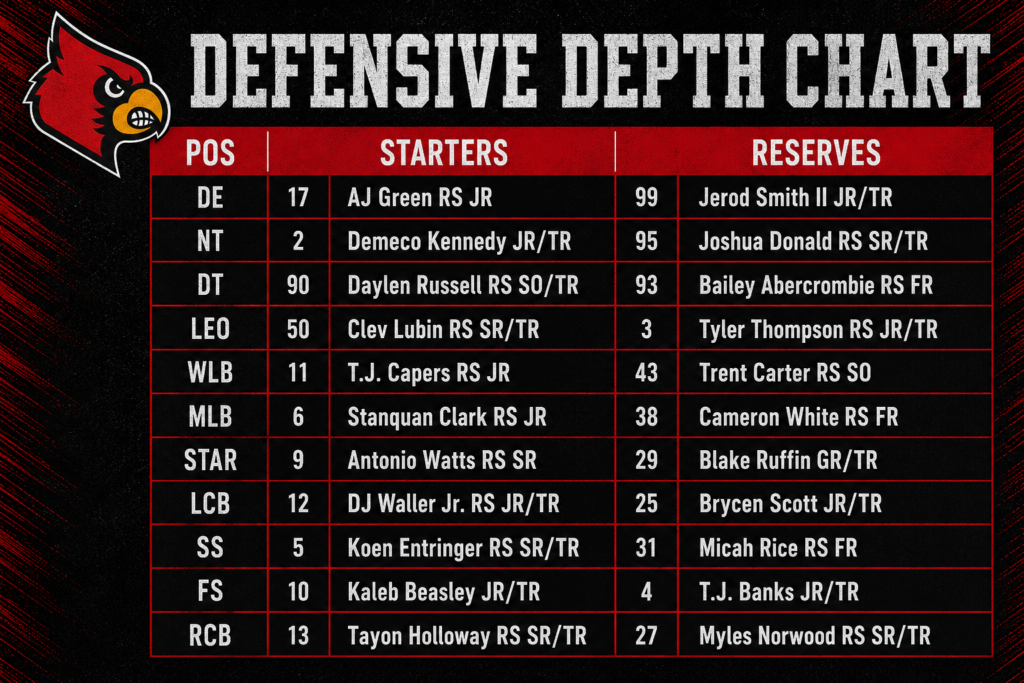
Louisville’s defense has a chance to be one of the better units in the ACC, particularly up front. The Cardinals were 10th nationally against the run in 2025, and they return one of the conference’s most productive pass rushers in Clev Lubin.
Lubin recorded 8.5 sacks and 13.5 tackles for loss last season, ranking fourth in the ACC in sacks and earning third-team All-ACC honors. He’s exactly the type of edge defender Louisville needs while replacing pieces elsewhere. Former five-star linebacker T.J. Capers is another player I’m watching closely and gives the Cardinals considerable athleticism in the middle of the defense.
There are more questions in the secondary after losing multiple starters, although Antonio Watts provides some continuity. Louisville has worked the portal to replenish its depth, and the overall talent level on this side of the ball remains strong.
The other variable is the defensive staff. Mark Ivey and Steve Ellis are now operating as co-defensive coordinators, creating some uncertainty regarding how smoothly the transition will go. But with Lubin and Capers helping anchor the front seven, I think Louisville has enough talent to remain very good defensively. The defensive front may actually be the most dependable part of this team early while the offense finds its footing.
Overview and Projection
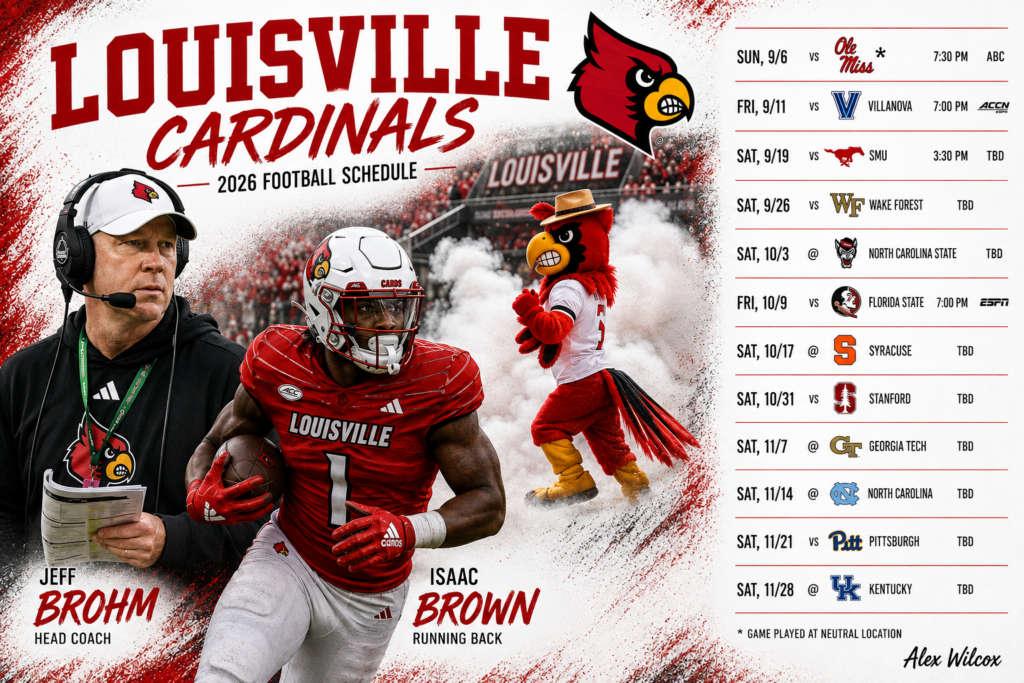
I’m projecting 10–2 overall and 8–1 in the ACC. Louisville isn’t necessarily the second-most talented roster in the conference from top to bottom, but the combination of Brohm, Brown, a potentially excellent defensive front and a favorable conference draw makes the Cardinals one of my favorite teams in the ACC this season.
The ultimate variable is Kienholz. If Brohm can turn him into another productive quarterback, I think Louisville has a legitimate chance to play Miami for the ACC championship. If the offensive line struggles and Kienholz looks like an inexperienced starter, eight or nine wins becomes much more realistic. I’m betting on Brohm getting enough out of him, which is why Louisville lands at 10–2 and firmly in the ACC title race.
Projected Record: 10-2 (8-1)
SMU Mustangs
Offensive Outlook
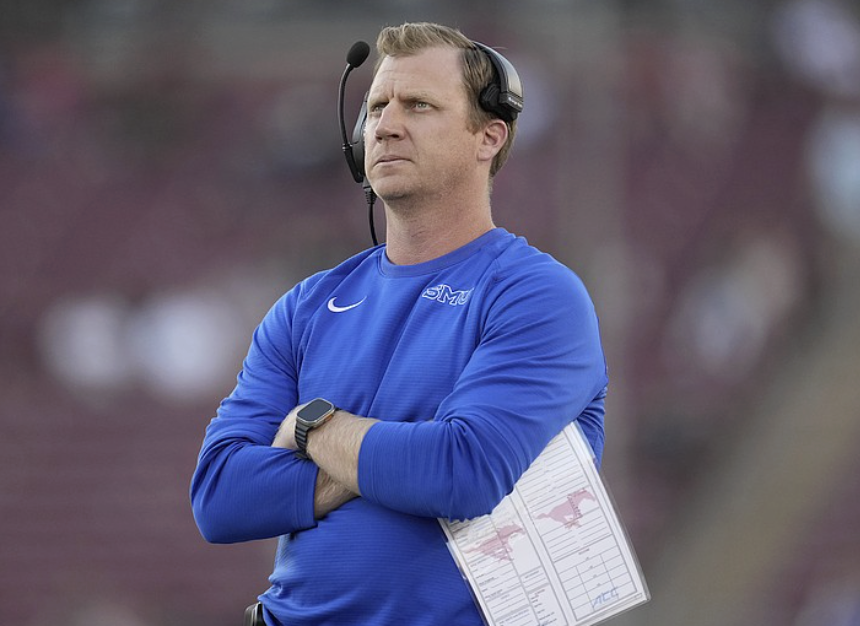
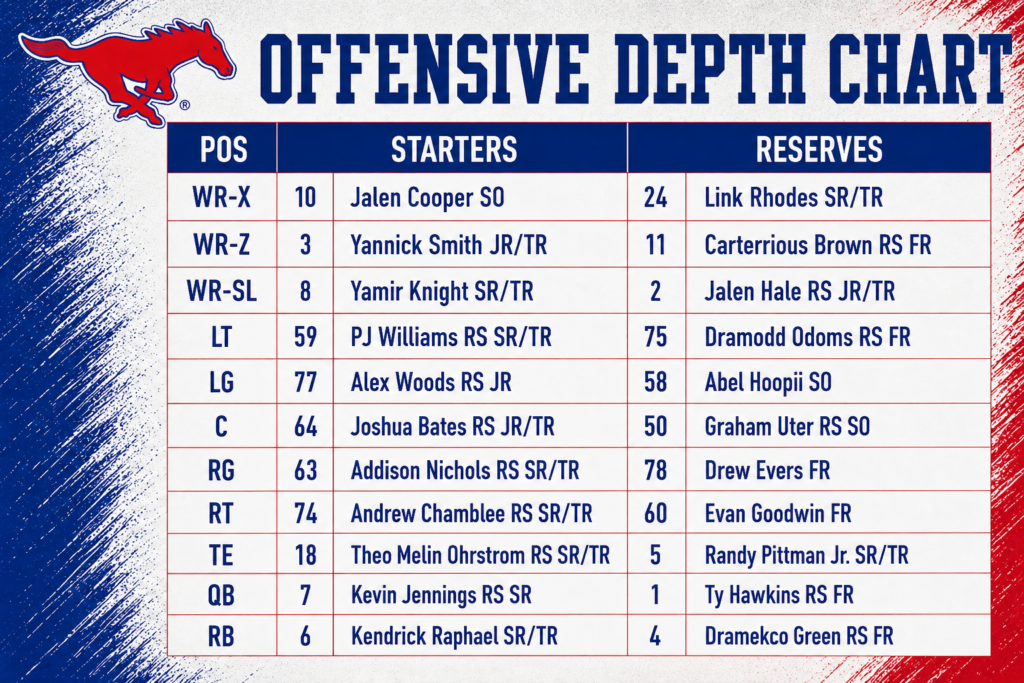
Continuity at quarterback gives SMU something very few ACC contenders can match in 2026. Kevin Jennings is back for his third season as the Mustangs’ starter after helping transform Rhett Lashlee’s program into an immediate ACC contender. He enters the season with 19 career wins as a starter, tied for third among returning Power Four quarterbacks, and SMU has launched a Heisman campaign around him. I’m not buying into it, but he is a well above average ACC QB.
Jennings is particularly dangerous because of what he can create when the original play breaks down. His mobility forces defenses to account for him in the running game, while Lashlee’s tempo creates opportunities for explosive plays downfield. SMU threw for 3,680 yards and 26 touchdowns as a team last season, and Jennings returns behind what could be one of the ACC’s best offensive lines.
The supporting cast has changed, but there is plenty to like. Alabama transfer Jalen Hale joins the receiving corps, while East Carolina transfer Yannick Smith provides another experienced target. Kendrick Raphael adds experience to the backfield after stops at Cal and NC State, and Florida State/UCF transfer Randy Pittman Jr. gives Jennings a versatile option at tight end.
That’s ultimately why I’m confident in this offense despite some turnover. Jennings and Lashlee have been together long enough that SMU isn’t installing an identity—it already has one. With an experienced quarterback, a strong offensive line and enough portal talent around him, I expect the Mustangs to remain one of the ACC’s most difficult offenses to defend.
Defensive Outlook
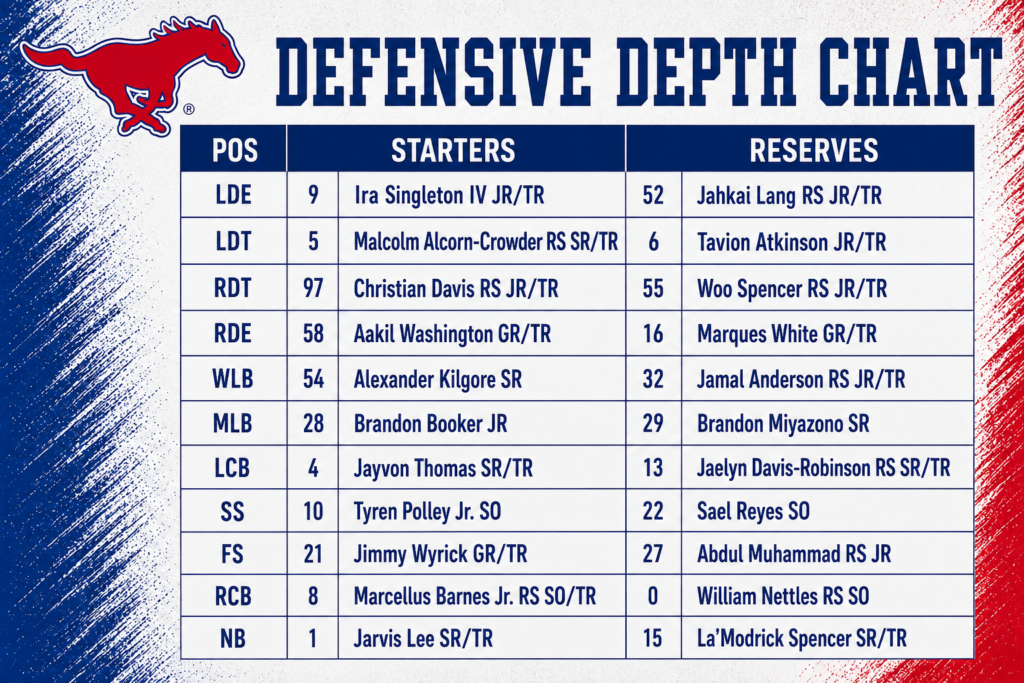
The defense may actually be what separates this SMU team from some of Lashlee’s earlier groups. The Mustangs enter the season with a unit ranked inside the preseason SP+ top 30, giving SMU legitimate balance rather than forcing Jennings and the offense to win shootouts every week.
One particularly important development is the return of safety Ahmaad Moses. A 2025 first-team All-ACC selection, Moses was granted another year of eligibility just before the season and rejoined the program following offseason spinal fusion surgery. His experience is especially valuable for a secondary incorporating several new pieces.
SMU also attacked the portal for defensive help. Former Texas A&M corner Jayvon Thomas, Syracuse transfer Marcellus Barnes Jr., Kansas State defensive lineman Malcolm Alcorn-Crowder and USF edge Ira Singleton IV are among the additions. There’s some uncertainty because of the turnover, but the Mustangs have accumulated enough Power Four experience that I don’t expect a major rebuilding period.
That’s important because my projection requires SMU to win several close conference games. The Mustangs don’t need an elite defense, but if this unit remains disruptive and the secondary settles in around Moses, SMU should be balanced enough to compete with anyone in the ACC (besides Miami).
Overview and Projection
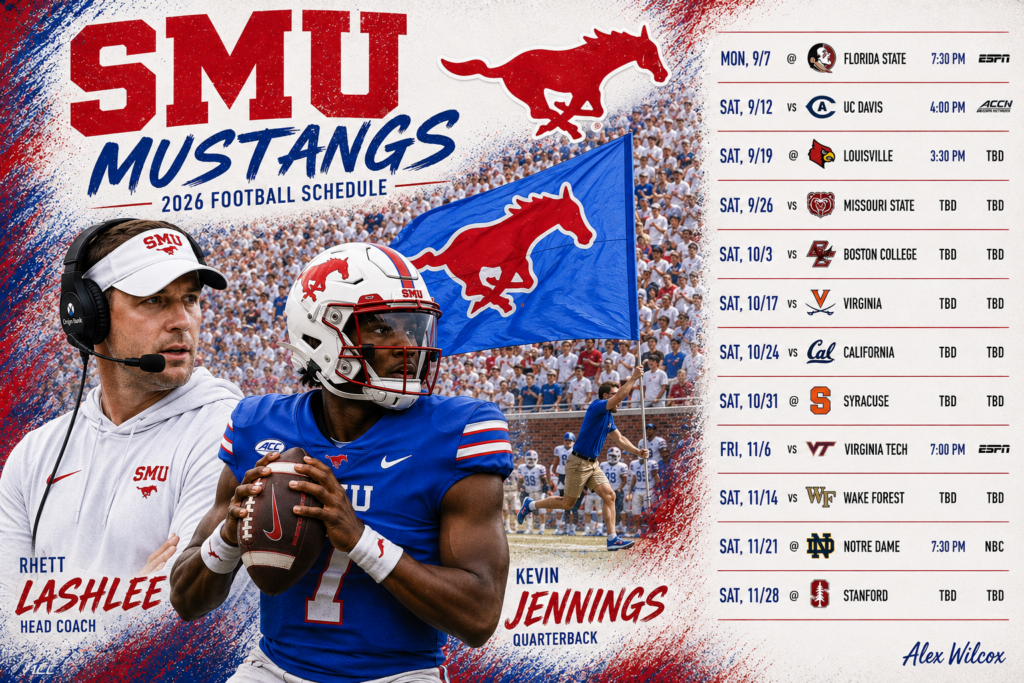
I’m projecting 9–3 overall and 7–2 in the ACC. Jennings is experienced enough to win a huge game or two on the road, and Lashlee has already demonstrated that SMU belongs at this level.
SMU feels like one of the safest teams near the top of the ACC. The Mustangs have an established quarterback, an offensive system that consistently produces and a defense capable of complementing it. SMU should be firmly in the ACC championship race deep into November.
Projected Record: 9-3 (7-2)
Clemson Tigers
Offensive Outlook
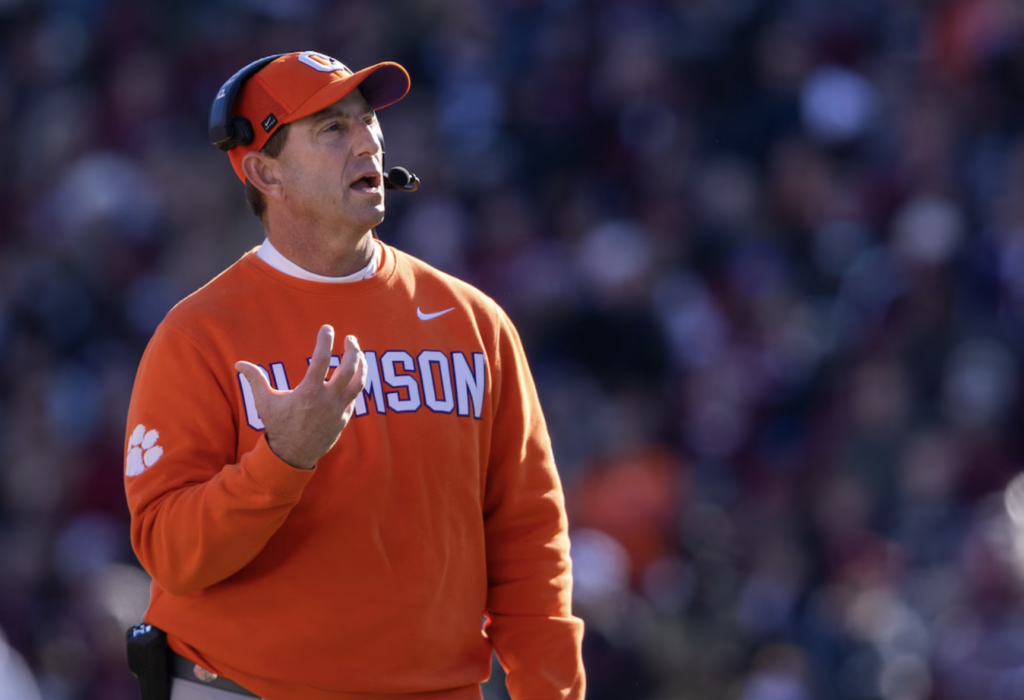
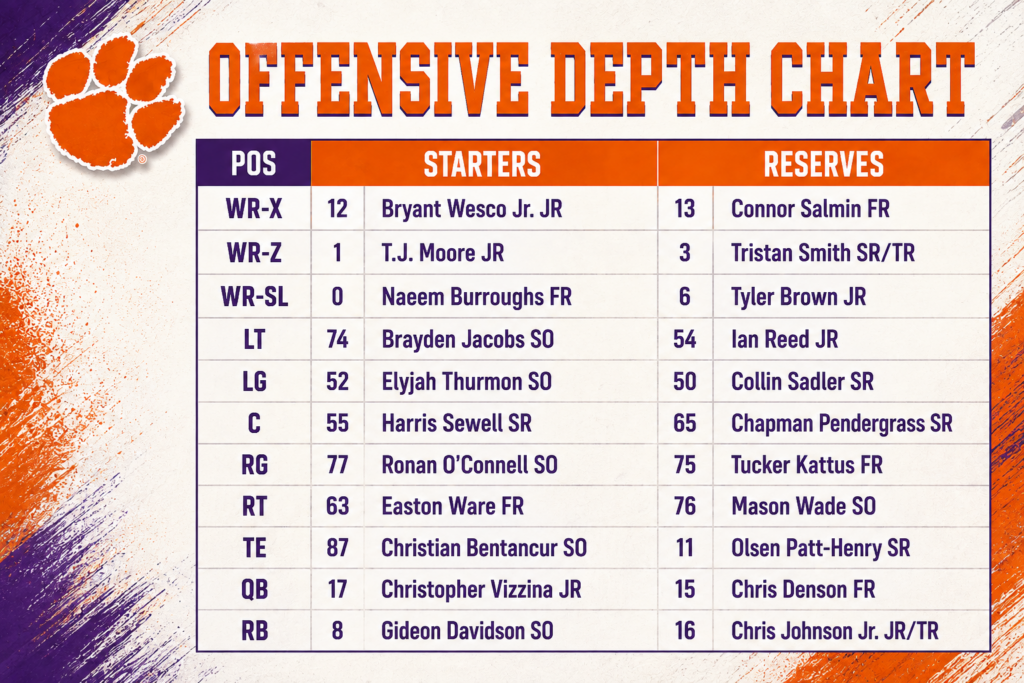
After a disappointing 7–6 season, Clemson is trying to prove that 2025 was a temporary stumble rather than evidence that the program has permanently slipped from the ACC’s elite. The biggest change comes at quarterback, where Christopher Vizzina has officially won the starting job following Cade Klubnik’s departure for the NFL. Vizzina has waited three years for this opportunity, appearing in 14 games but making only one career start.
There is reason for optimism despite the lack of experience. That lone start came against SMU last season, and Vizzina responded by completing 29 of 42 passes for 317 yards and three touchdowns. He finished 2025 with 406 passing yards, four touchdowns and one interception. True freshman Tait Reynolds pushed him throughout camp and is expected to play as well, so this may not be a completely settled quarterback situation if Vizzina struggles early.
Clemson still has legitimate weapons. Bryant Wesco Jr. and T.J. Moore give Vizzina two talented receivers capable of stretching defenses vertically, while sophomore Gideon Davidson has an opportunity to become the featured player in the backfield following Adam Randall’s departure. The more interesting change is on the sideline: Chad Morris is back as offensive coordinator, returning to Clemson more than a decade after helping build the explosive offenses that initially elevated Swinney’s program.
My biggest concern is the offensive line. Clemson lost several experienced starters, including NFL first-round pick Blake Miller and longtime left tackle Tristan Leigh, leaving highly regarded sophomore Brayden Jacobs as one of the key building blocks. Clemson also ranked just 111th nationally in rushing offense last season, so this isn’t simply about replacing personnel—the Tigers need to become substantially better at creating movement up front. Vizzina has enough weapons to succeed, but the offensive line and running game will determine whether Clemson’s offense actually returns to a high caliber unit.
Defensive Outlook
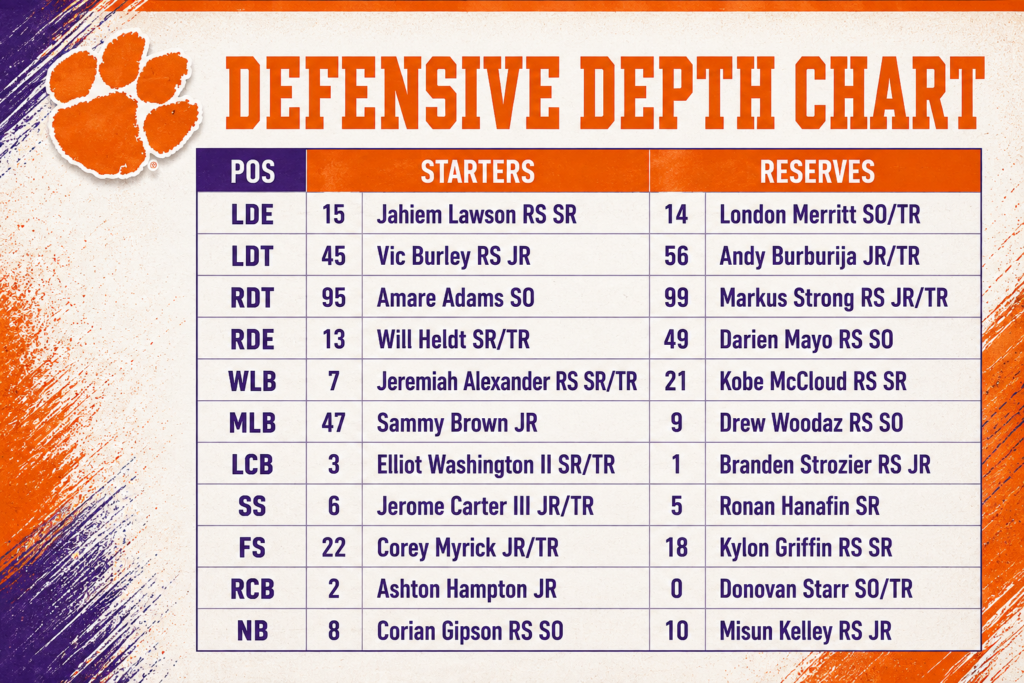
Clemson’s defense is also undergoing considerable transition after losing an extraordinary collection of NFL talent. Peter Woods, T.J. Parker, Avieon Terrell, Wade Woodaz and DeMonte Capehart were all selected in the 2026 NFL Draft. That’s an enormous amount of proven production to replace, particularly along the defensive front.
The good news is that Tom Allen remains defensive coordinator, and Clemson still recruits well enough that the cupboard isn’t empty. Amare Adams is one of the young defensive linemen I’m most interested in watching, while Clemson added reinforcements such as Markus Strong as it attempts to rebuild the interior. The talent is there, but expecting the new front to immediately reproduce what Woods and Parker provided would be unrealistic.
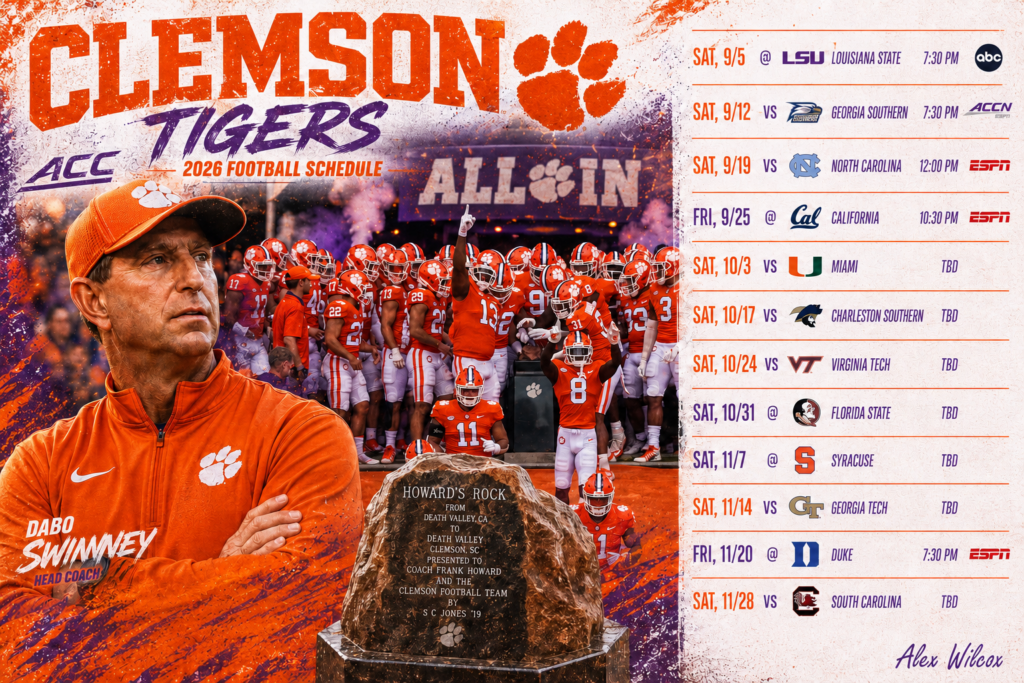
The secondary has also been reworked after losing Terrell and other experienced contributors. Clemson has emphasized adding more speed on the back end, which will be tested immediately against LSU’s rebuilt offense and quarterback Sam Leavitt.
I still trust Clemson defensively because of the program’s recruiting and Allen’s track record, but this isn’t the veteran-loaded group we saw entering last season. There is considerably more projection involved at every level. The ceiling remains high; the question is whether the young talent becomes dependable quickly enough to compensate for an offense that may have its own early growing pains.
Overview and Projection
I have the Tigers finishing 8–4 overall and 6–2 in the ACC. That’s a modest improvement from last year’s 7–6 disappointment, but still below the standard Clemson established during its championship years. The receiving corps is talented, Morris should help offensively, and Allen gives the defense excellent coaching. There are simply too many important replacements—particularly at quarterback, offensive line and across the defense—for me to assume any sort of return to dominance.
Clemson is also one of the teams with the widest range of outcomes in the conference. If Vizzina builds on what he showed against SMU and the young defensive talent emerges quickly, 10 wins and an ACC Championship appearance are absolutely possible. But until Clemson proves the offensive line is fixed and its new defensive stars can replace an NFL-heavy departing class, I’m staying somewhat cautious. At 8–4, I expect Clemson to improve without reclaiming its old position atop the ACC.
Projected Record: 8-4 (6-2)
Virginia Cavaliers
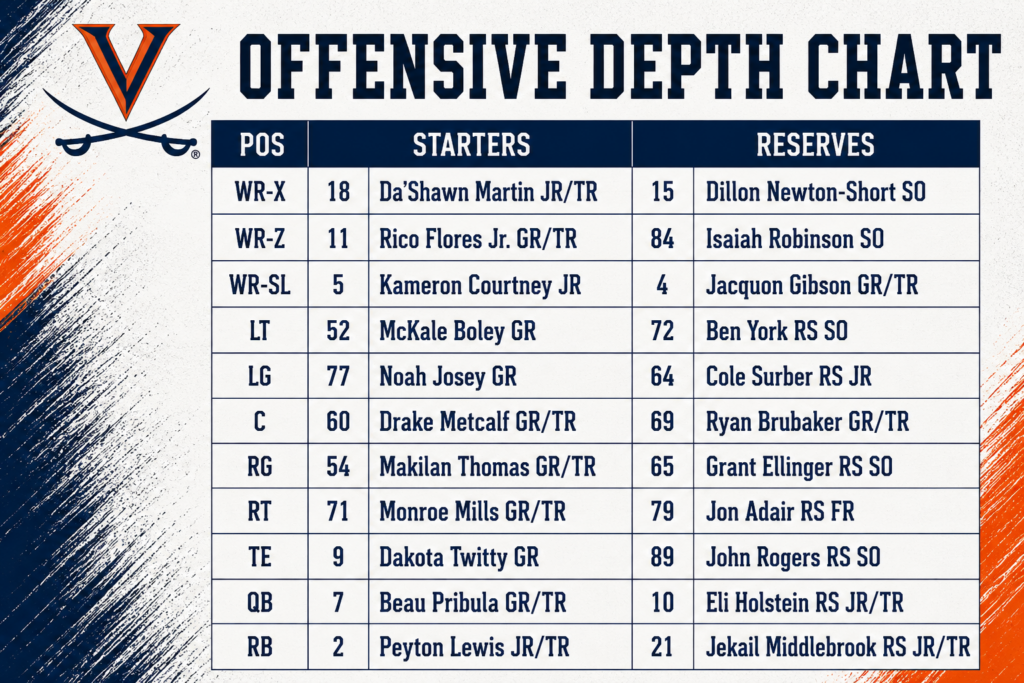
Offensive Outlook
Following the best season in school history, Virginia now has to prove 2025 wasn’t a one-year peak. The Cavaliers went 11–3, 7–1 in the ACC, reached the ACC Championship Game and beat Missouri in the Gator Bowl. Tony Elliott has openly emphasized starting over rather than assuming last year’s success will carry forward, which makes sense considering how heavily Virginia has had to reload through the portal.
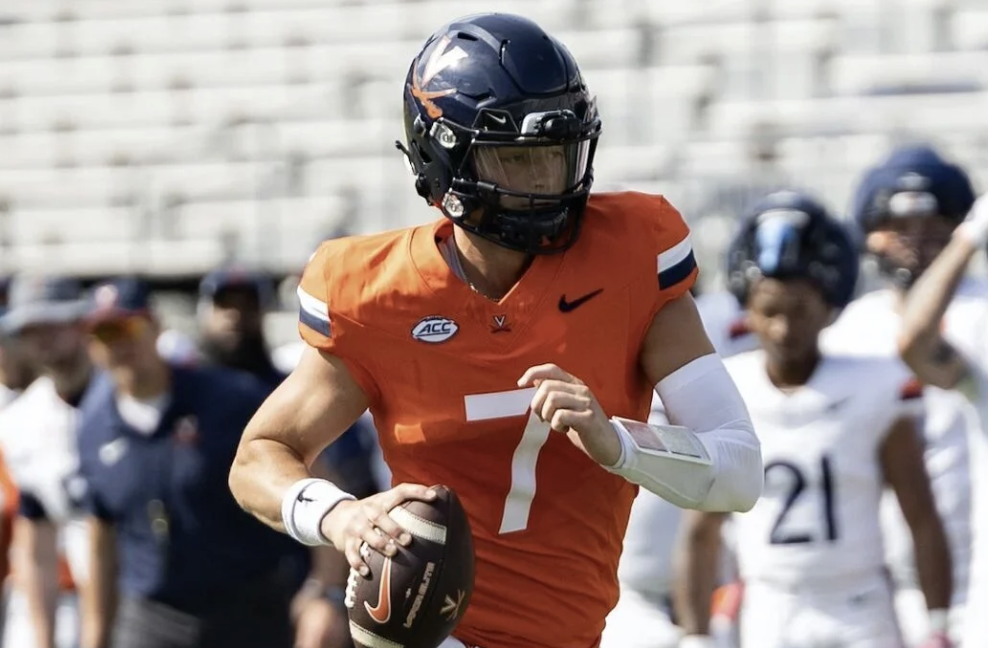
The biggest change is quarterback, where Missouri transfer Beau Pribula replaces Chandler Morris. Pribula started 10 games for Missouri last season and completed 67.4% of his passes for 1,941 yards, 11 touchdowns and nine interceptions, while adding 297 rushing yards and six touchdowns. He’s not the pure passer Morris was, but his toughness and running ability fit an offense that wants to be physical.
We’ve already gotten our first look at that formula. Virginia opened the season by crushing NC State 34–8, with Pribula completing 9 of 11 passes for 155 yards and two touchdowns while rushing for 110 yards. The Cavaliers piled up 258 rushing yards and controlled the game with their offensive line. That’s exactly how I envisioned this offense succeeding.
Virginia also has plenty of options around him. Xavier Brown, Peyton Lewis and Noah Vaughn give the Cavaliers a deep backfield, while Notre Dame/UCLA transfer Rico Flores Jr. adds experience at receiver. This offense probably won’t be built around Pribula throwing 40 times per game. If Virginia continues controlling the line of scrimmage and uses Pribula as a legitimate part of the rushing attack, the Cavaliers can remain very effective despite losing Morris.
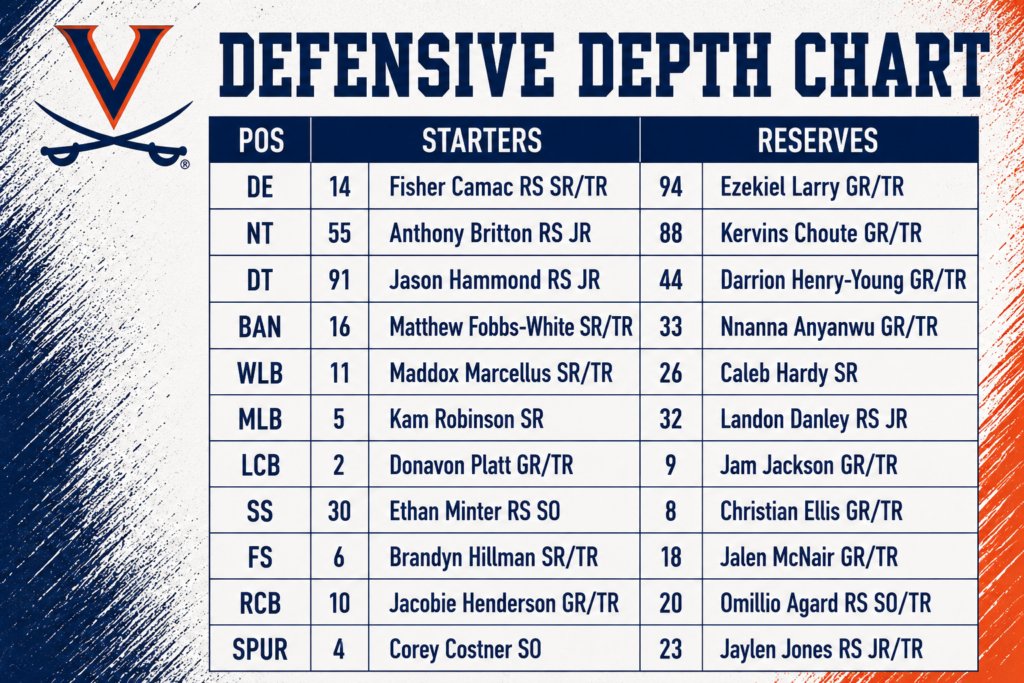
Defensive Outlook
Virginia’s defensive performance in the opener was arguably even more encouraging. NC State managed only 168 total yards and eight points, while the Cavaliers forced two turnovers and completely neutralized an offense led by established quarterback CJ Bailey. For a defense replacing important pieces from an 11-win team, that was about as convincing a start as Tony Elliott could have wanted.
Like the offense, this is another portal-heavy unit. Virginia added 29 transfers during the offseason, continuing an approach that worked extremely well during last year’s breakthrough. One newcomer who made an immediate impact was safety Brandyn Hillman, who was involved in both turnovers against NC State.
The biggest thing I like about Virginia defensively is the identity Elliott has established. This isn’t a roster that needs to overwhelm opponents with five-star talent. The Cavaliers need to be disciplined, tackle well, prevent explosive plays and create enough negative plays to complement an offense designed to control possession.
That formula worked extremely well in 2025, when Virginia held opponents to just 28% on third down. There will be much tougher offensive tests than NC State, but holding a conference opponent to 168 yards in Week 0 makes me considerably more confident that the defensive rebuild has come together quickly.
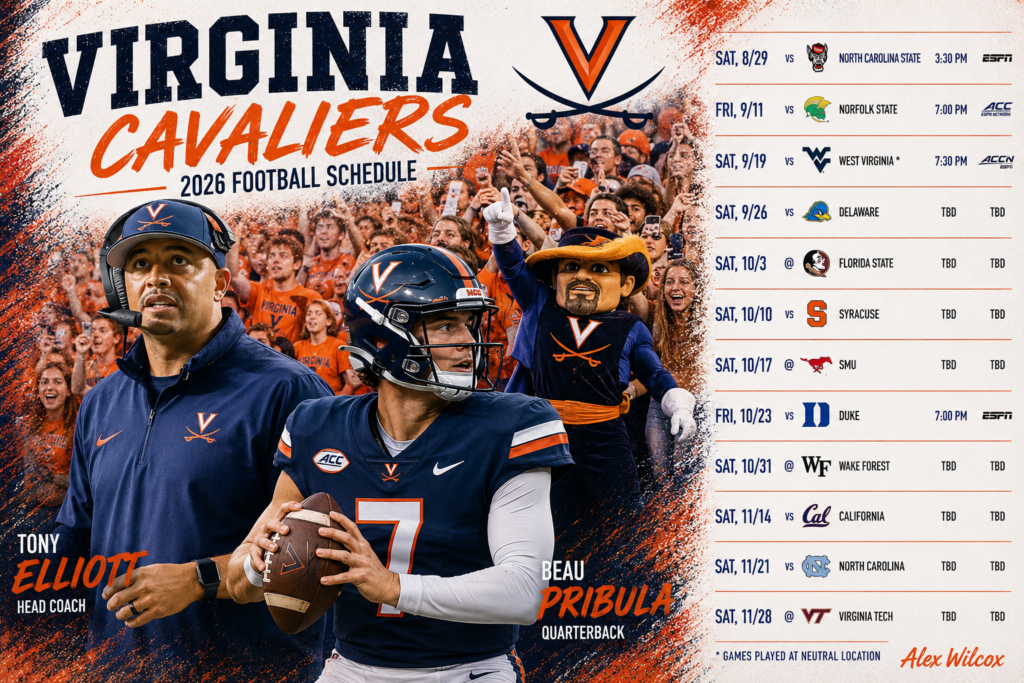
Overview and Projection
I’m sticking with 9–3 overall and 6–3 in the ACC, and the dominant opening win only makes me more comfortable with that projection. Pribula doesn’t need to duplicate Morris statistically if Virginia can run the football the way it did against NC State, and the defense already looks further along than I expected.
Virginia’s challenge in 2026 isn’t proving that last season happened—it’s proving the program has actually changed. I expect some regression from the historic 11-win campaign, but not a return to the bottom half of the ACC. Nine wins would reinforce that Elliott’s breakthrough was the beginning of something sustainable in Charlottesville rather than a one-season anomaly.
Projected Record: 9-3 (6-3)
California Golden Bears
Offensive Outlook
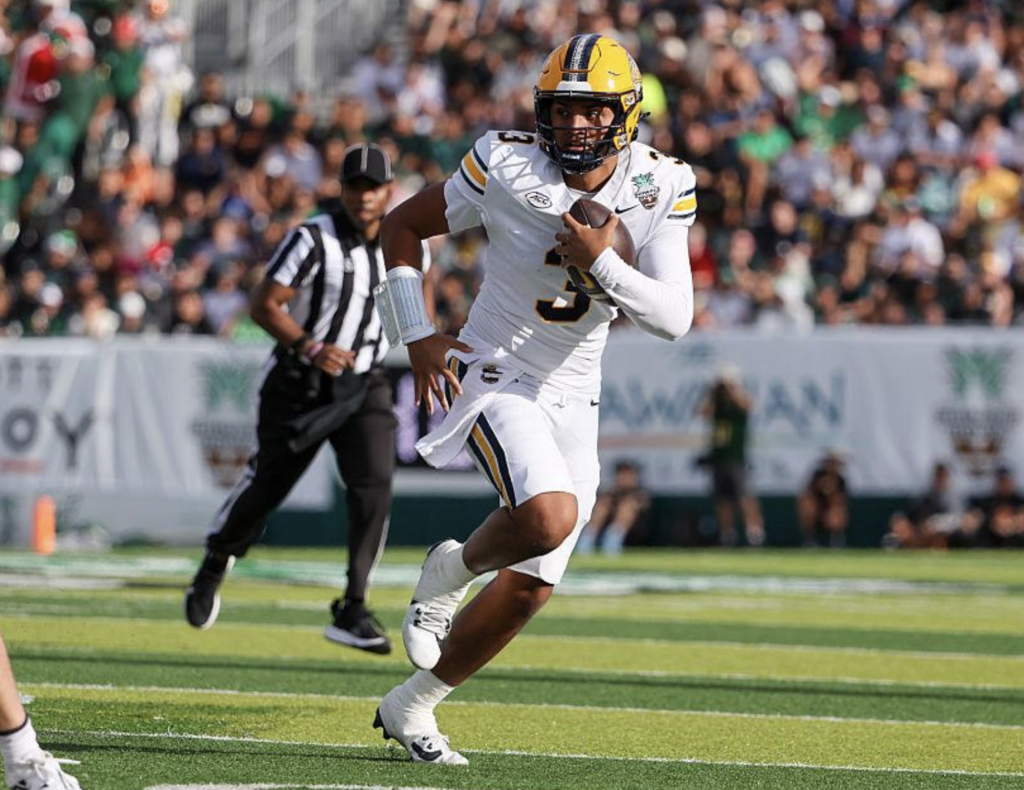
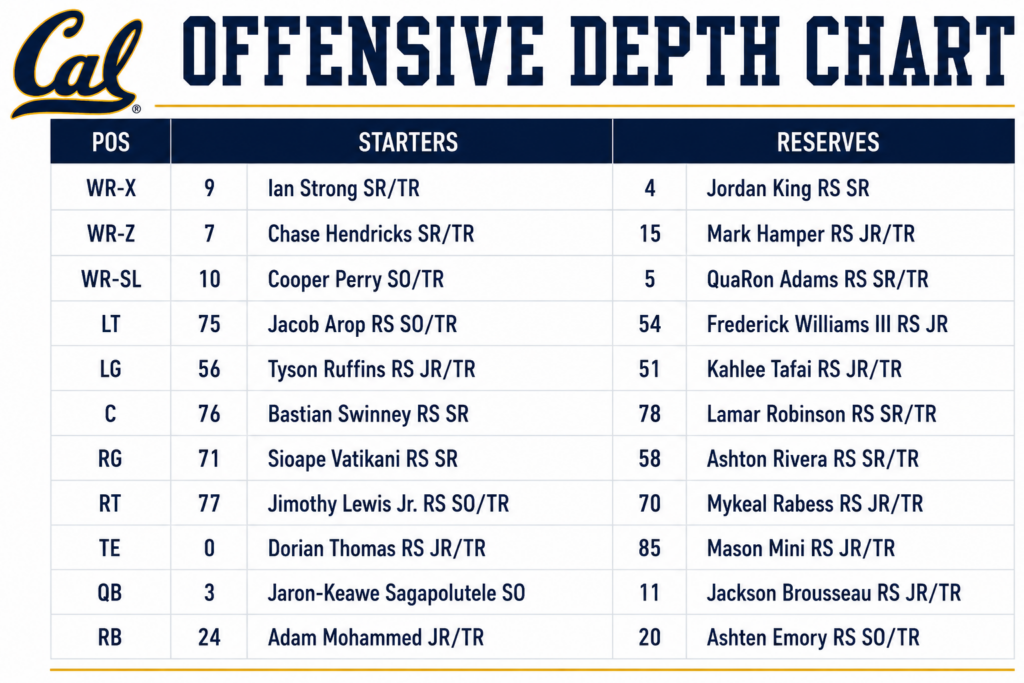
A new era begins in Berkeley with Tosh Lupoi taking over a Cal program that suddenly feels capable of making real noise in the ACC. The biggest reason for that optimism is sophomore quarterback Jaron-Keawe Sagapolutele, better known as JKS, who stayed at Cal despite the coaching change. As a true freshman, JKS completed 316 of 492 passes for 3,454 yards and 18 touchdowns, throwing for at least 200 yards in all 13 games.
Lupoi has aggressively upgraded the roster around him. Cal brought in 32 transfers as part of a 34-player February addition class, a group that ranked second in the ACC and 14th nationally according to the 247Sports ranking cited by Cal. Washington transfer Adam Mohammed should play a major role in the backfield after rushing for 523 yards and five touchdowns last season while adding 138 receiving yards.
The offensive line and receiving corps have also been reconstructed around JKS, with six transfer linemen among that February group alone. That amount of turnover creates some uncertainty, but it also gives Cal a substantially higher talent ceiling. New offensive coordinator Jordan Somerville arrives from the Tampa Bay Buccaneers, where he worked with Baker Mayfield as assistant quarterbacks coach.
Everything ultimately revolves around JKS. He was already productive as an 18-year-old freshman, and now he gets an offseason of development plus a roster specifically constructed to maximize him. If he makes the sophomore leap I expect, Cal could have one of the better offenses in the ACC.
Defensive Outlook
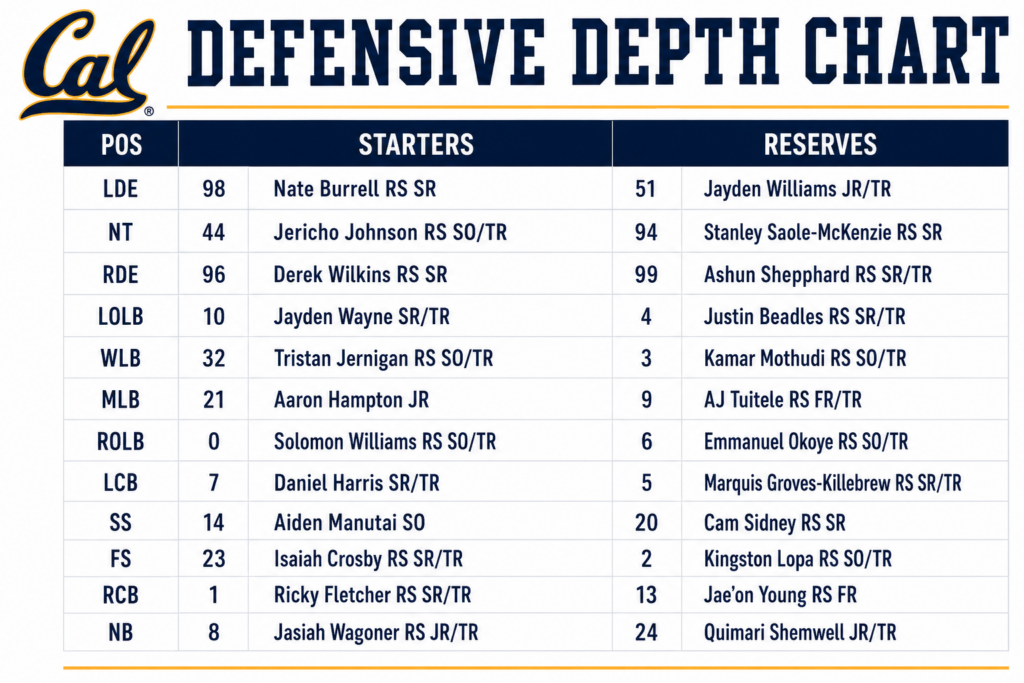
Lupoi’s fingerprints should be most obvious on defense. A former Cal defensive lineman himself, he has built his career around recruiting and developing defensive talent at places such as Alabama, Oregon and in the NFL. His first Cal roster reflects that philosophy, with 16 defensive transfers included in the February additions.
The list includes players from some of the country’s deepest programs. Defensive lineman Jericho Johnson, linebacker Kamar Mothudi and defensive back Kingston Lopa arrive from Oregon; Solomon Williams comes from Texas A&M; and Emmanuel Okoye joins from Tennessee. Cal also added linebacker Tristan Jernigan from Texas A&M and North Texas edge Joshua Pierce. This is essentially a defensive reconstruction built around athleticism and upside.
The secondary received experienced help from former Ole Miss corner Ricky Fletcher, who appeared in 14 games for a Rebels team that reached the College Football Playoff semifinals. New defensive coordinator Michael Hutchings also brings NFL experience after spending three seasons with Minnesota, including two as the Vikings’ safeties coach.
The obvious concern is cohesion. With this many newcomers and an entirely new coaching staff, Cal could look inconsistent early. But I like the direction. Lupoi has immediately raised the athletic profile of this defense, and I expect the unit to become increasingly difficult to play against as the season progresses.
Overview and Projection
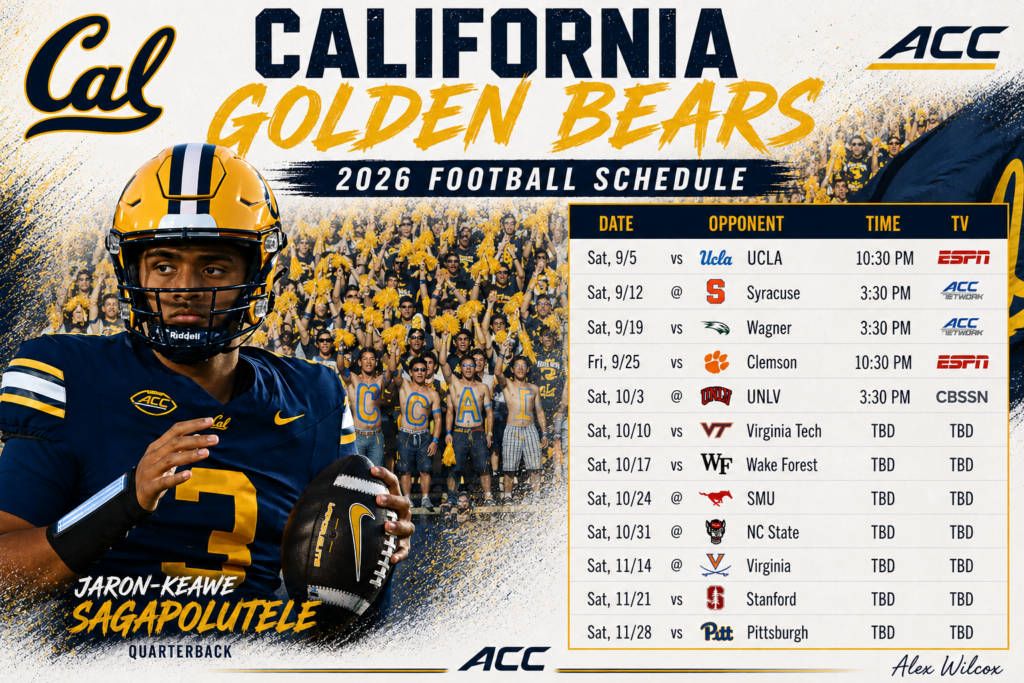
I’m projecting 8–4 overall and 6–3 in the ACC. The road games against SMU and Virginia are major tests, and Clemson is obviously dangerous even at home. The nonconference trip to UNLV is another game Cal can’t overlook. But this schedule doesn’t include Miami or Louisville, which gives the Bears a realistic opportunity to stay near the top of the conference standings.
This projection is ultimately a bet on JKS becoming one of college football’s breakout stars. Cal has a first-year head coach, dozens of transfers and plenty of uncertainty, but it also has something many rebuilding programs don’t: an established young quarterback with elite upside. If Lupoi’s portal overhaul works and JKS develops the way I expect, 8–4 may not be Cal’s ceiling—it may only be the beginning of a very different era of football in Berkeley.
Projected Record: 8-4 (6-3)
Georgia Tech Yellow Jackets
Offensive Outlook
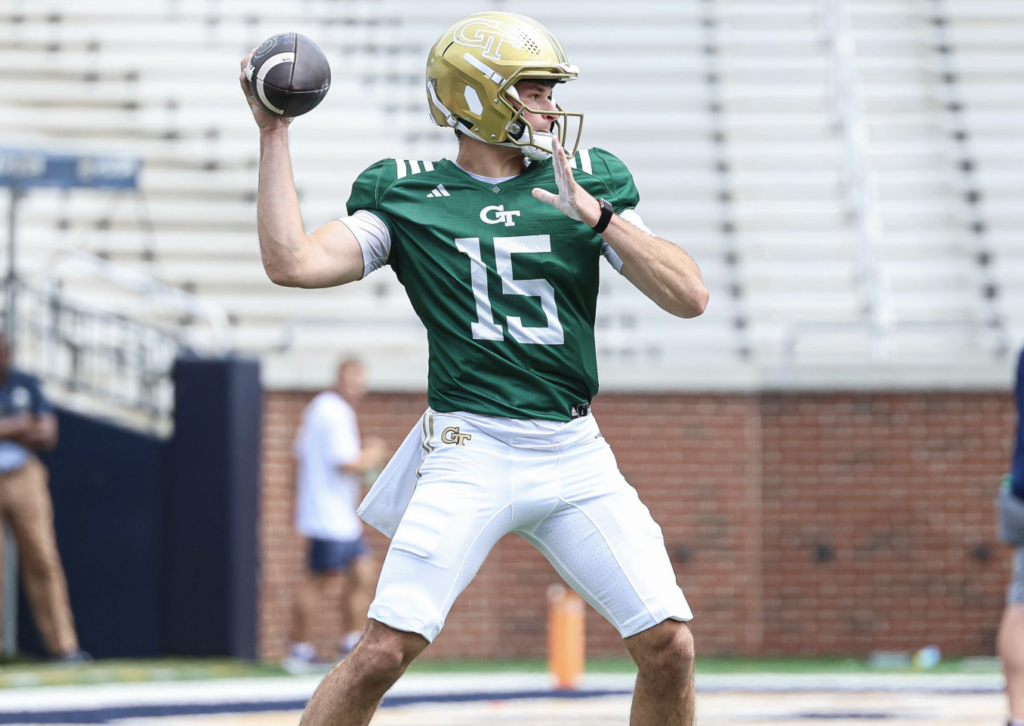
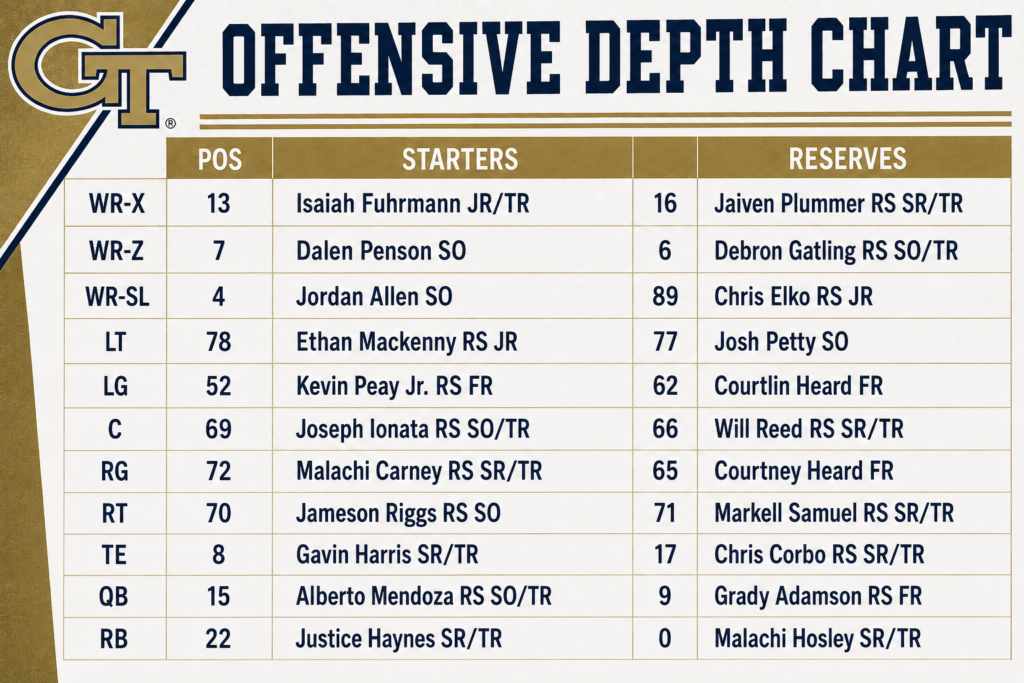
Life after Haynes King was always going to require an adjustment for Georgia Tech, and Thursday night’s opener gave us an immediate look at both the promise and the concerns surrounding the new offense. Indiana transfer Alberto Mendoza won the quarterback job and looked composed in his Yellow Jacket debut, completing 17 of 24 passes for 237 yards in the 14–13 loss to Colorado. For a player replacing the defining quarterback of the Brent Key era, Mendoza’s performance was encouraging.
The bigger concern was a rushing attack that managed only 51 yards on 30 attempts. That’s particularly surprising because the backfield looked like one of Georgia Tech’s greatest strengths entering the season. Malachi Hosley returns as an All-ACC performer, while Alabama transfer Justice Haynes gives the Jackets another high-upside option; both were named to the Doak Walker Award watch list. New offensive coordinator George Godsey needs to get that tandem going because this offense shouldn’t have to depend on Mendoza throwing its way out of trouble.
Up front, Ethan Mackenny and Malachi Carney give Georgia Tech returning All-ACC pieces, and Key’s background as an offensive-line coach makes me more willing to believe the Week 1 rushing problems can be corrected. The receiving corps is less established, although Dalen Penson flashed against Colorado with the 42-yard reception that put Tech in position for a potential game-winning field goal.
The offensive formula needs to be straightforward: let Mendoza distribute the football efficiently and make Hosley and Haynes the engine of the offense. The opener showed Mendoza may be ready for the job. It also showed Georgia Tech won’t reach its ceiling unless the rushing attack becomes substantially better.
Defensive Outlook
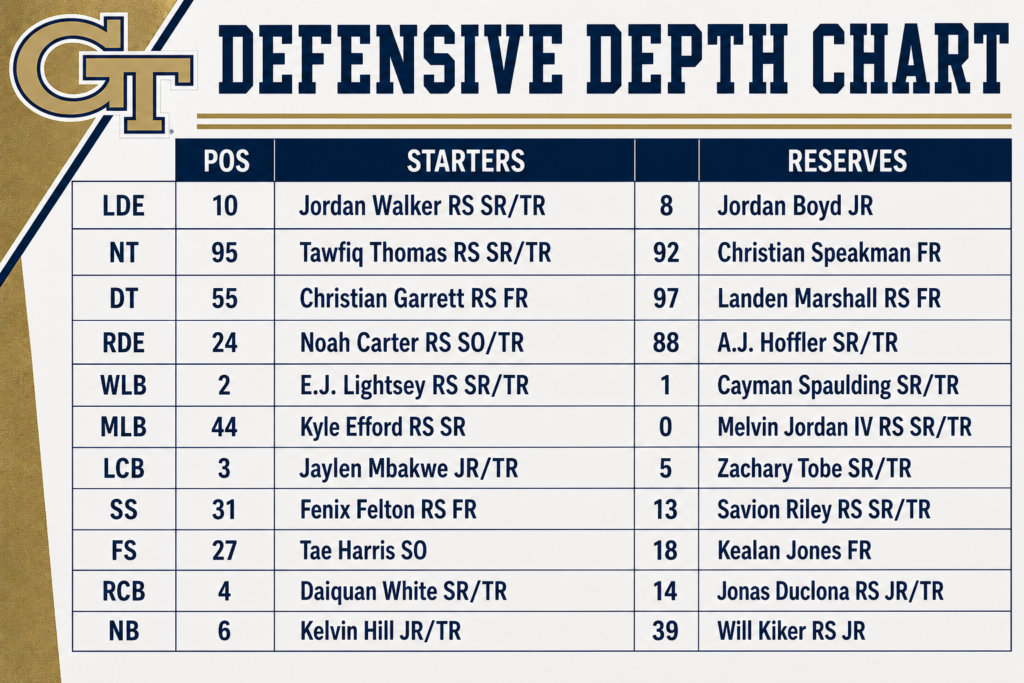
The defense actually gave Georgia Tech plenty of chances to win against Colorado. The Jackets allowed only 307 total yards and 14 points, holding quarterback Julian Lewis to 124 passing yards. Unfortunately, Colorado rushed for 183 yards and produced the decisive 75-yard touchdown drive in the final two minutes.
Kyle Efford remains the leader of the unit after recording a team-high 77 tackles in 2025. He’s exactly the kind of veteran linebacker a team needs while transitioning to new defensive coordinator Jason Semore, who joined the staff alongside Godsey during the offseason. Efford’s experience and physicality should keep the middle of the defense relatively stable.
There is talent elsewhere, including corner Daiquan White, linebacker E.J. Lightsey and several portal additions. The challenge is replacing key production from a 2025 defense while becoming more consistent against the run. Last year’s group had some individual playmakers but wasn’t dominant enough to consistently carry the team.
I came away from the Colorado game reasonably encouraged defensively. Fourteen points should be enough to win at home. If Semore can tighten the run defense while maintaining the solid coverage we saw in the opener, Georgia Tech should have a respectable ACC unit.
Overview and Projection
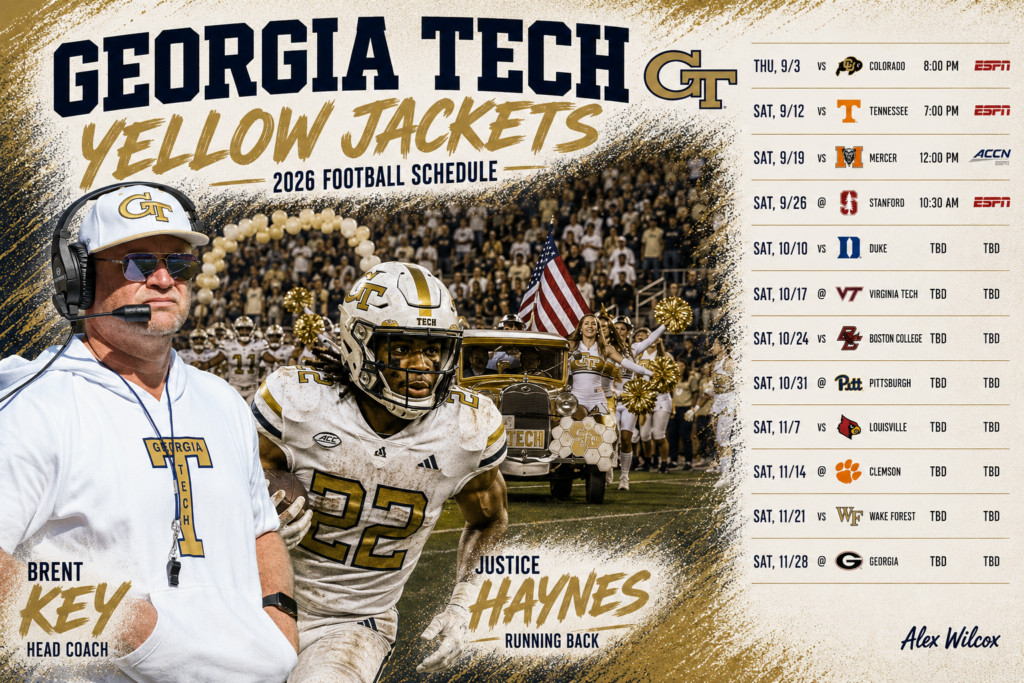
I’m sticking with 7–5 overall and 5–3 in the ACC, although the path is narrower after the 14–13 loss to Colorado. Mendoza’s debut gives me confidence that quarterback won’t be as significant a weakness as I initially feared, but the running game has to rebound immediately—especially with Tennessee coming to Atlanta next.
Georgia Tech has finished in the ACC’s top four in each of Brent Key’s three full seasons, an impressive measure of how far the program has come. I expect the Jackets to remain competitive in 2026, but replacing King, breaking in two new coordinators and navigating a difficult nonconference schedule should produce some regression. Seven wins feels optimistic, but I’ll give Key the benefit of the doubt here.
Projected Record: 7-5 (5-3)
Virginia Tech Hokies
Offensive Outlook
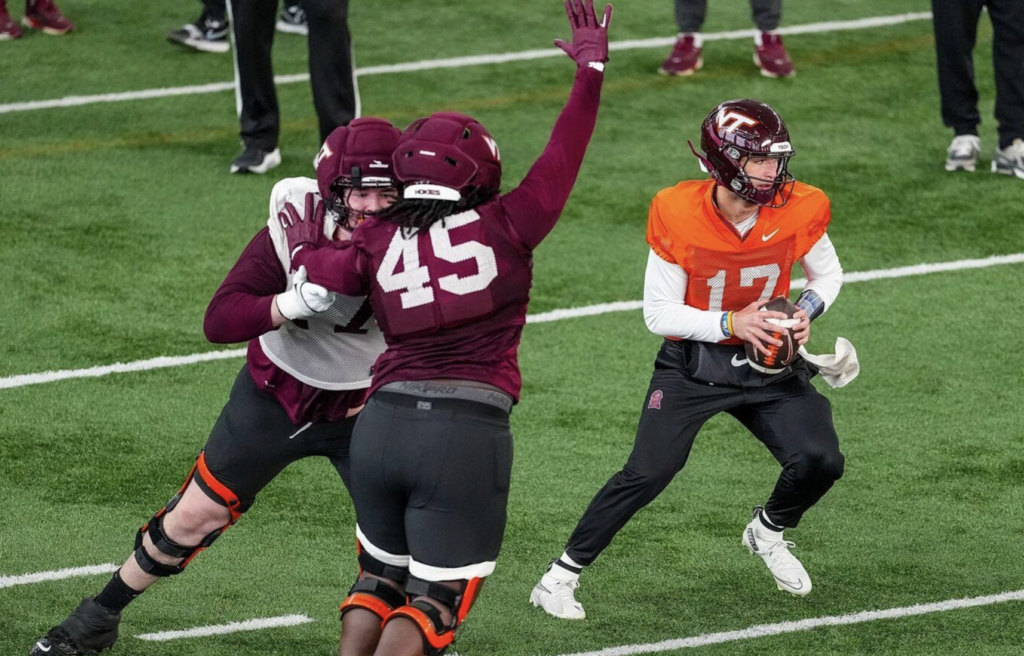
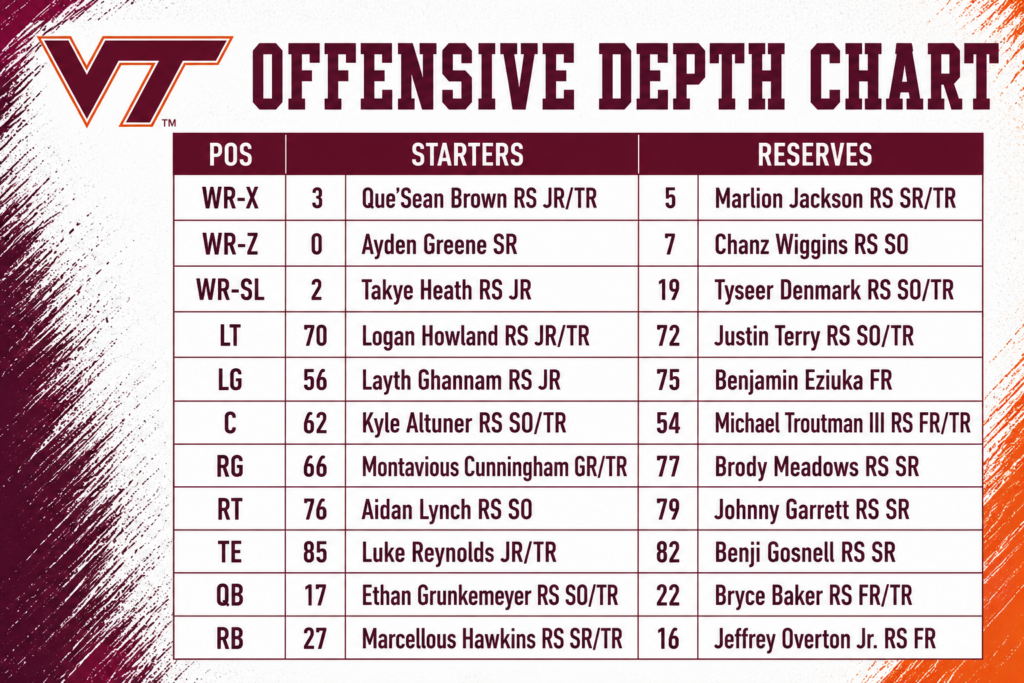
A complete reset in Blacksburg has given Virginia Tech considerably more optimism than you’d normally associate with a team coming off 3–9 (2–6 ACC). The obvious reason is James Franklin, who takes over after his long run at Penn State and has already reshaped the roster. His first major decision came at quarterback, where Penn State transfer Ethan Grunkemeyer officially beat out North Carolina transfer Bryce Baker for the starting job.
Grunkemeyer is one of the more intriguing quarterbacks in the conference. After Drew Allar went down last season, he was thrown into a difficult situation at Penn State but improved dramatically with experience. He finished 2025 completing 69.1% of his passes for 1,339 yards, eight touchdowns and four interceptions, ultimately helping Penn State win four consecutive games to finish the season. I think his familiarity with Franklin gives Virginia Tech a much more stable quarterback situation than it had entering last season.
The supporting cast has been heavily reconstructed. Former Penn State receiver Tyseer Denmark, Duke transfer Que’Sean Brown and Louisiana Tech transfer Marlion Jackson join returners such as Ayden Greene in the receiving corps. There isn’t an obvious superstar among them, but there is significantly more depth. The same applies up front, where Franklin made adding size a priority—Virginia Tech entered camp with 30 players weighing at least 300 pounds, compared with only 13 a year ago.
I’m not expecting this to immediately become one of the ACC’s most explosive offenses. But I do expect it to be more physical, more organized and considerably more consistent. Grunkemeyer doesn’t need to carry the Hokies; he needs to distribute the football, avoid negative plays and let Franklin’s rebuilt roster do the rest. If he continues the development he showed late at Penn State, Virginia Tech’s offense could become one of the better offenses in the conference.
Defensive Outlook
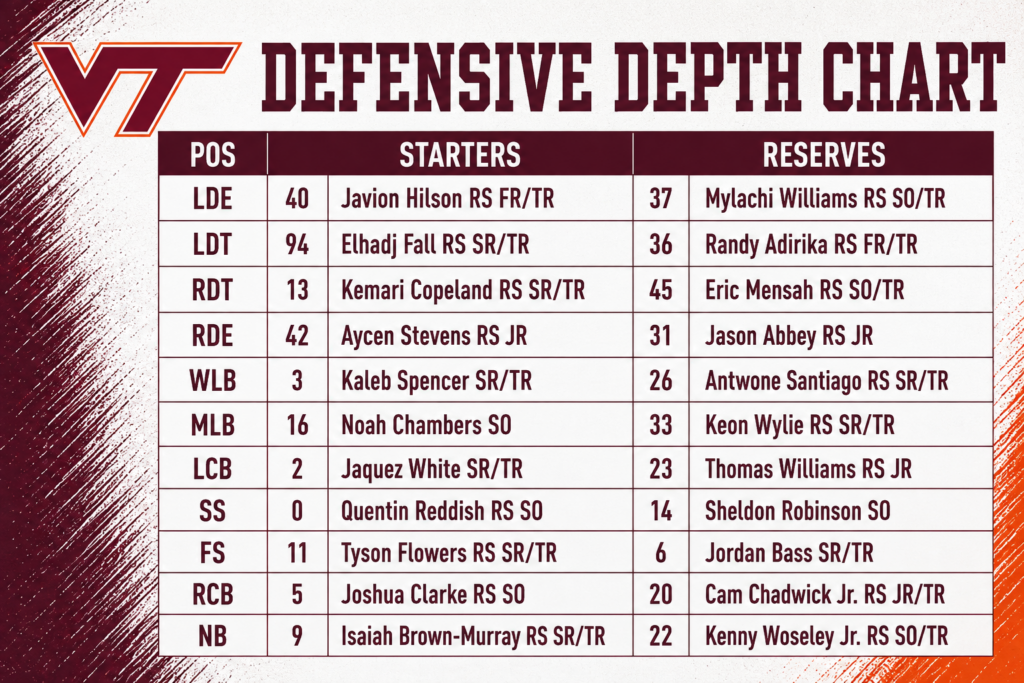
The fascinating twist to Franklin’s arrival is that former head coach Brent Pry remains in Blacksburg as defensive coordinator. Pry’s tenure as head coach obviously didn’t work, but his reputation was originally built as a defensive coordinator under Franklin at Penn State. Putting him back into the role where he enjoyed his greatest success could prove extremely valuable.
The secondary is the group I like most. Jaquez White arrives from Troy with legitimate All-ACC potential at corner, while Quentin Reddish, Tyson Flowers, Joshua Clarke and Sherrod Covil Jr. give the Hokies considerable experience and versatility on the back end. This should be a deeper defensive-back room than Virginia Tech has had recently.
Franklin has also placed a major emphasis on rebuilding the defensive front. Former Penn State defensive line coach Sean Spencer followed him to Blacksburg, and the overall increase in size throughout the roster should help a defense that too often got pushed around during last year’s three-win season.
I actually think the defense could improve faster than the offense. Pry no longer has to manage the entire program, Franklin has upgraded the roster around him, and the secondary has enough talent to hold up if the front generates pressure. Virginia Tech isn’t going to suddenly recreate the great Bud Foster defenses, but this unit should look much more like what Hokie fans expect defensively.
Overview and Projection
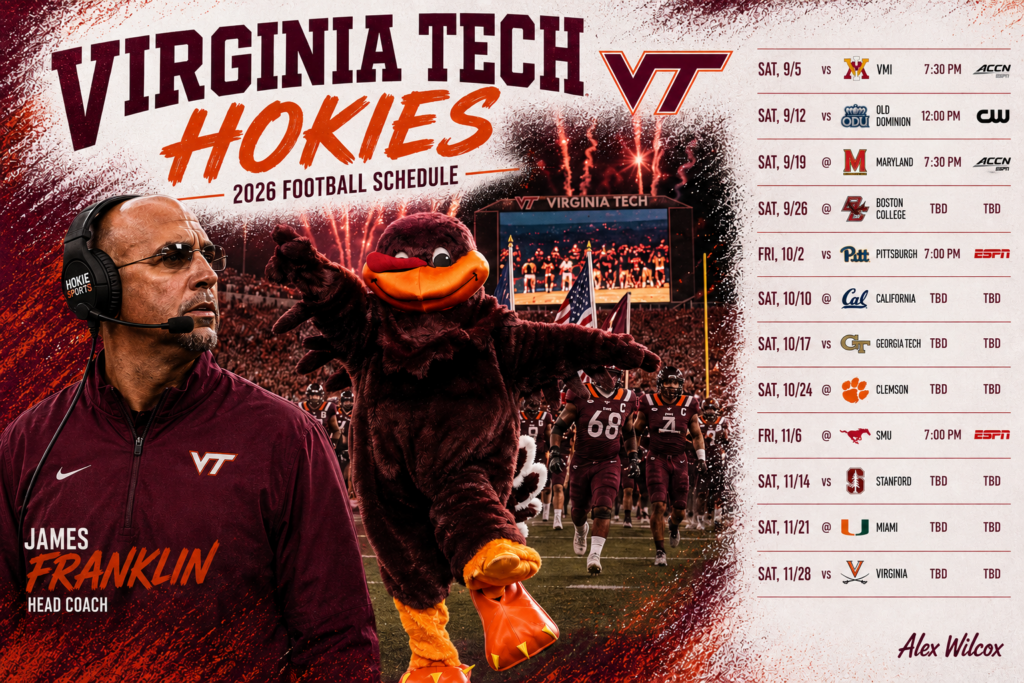
I’m projecting 8–4 overall and 5–4 in the ACC. There will be growing pains because Franklin has changed so much so quickly, and the schedule probably prevents Virginia Tech from immediately challenging Miami or Louisville. But I don’t view this as a traditional multi-year rebuild. Franklin brought Power Four experience, upgraded the roster and already has a quarterback who understands what he wants.
Virginia Tech feels like one of the ACC’s biggest turnaround candidates. Grunkemeyer gives the Hokies stability at the most important position, Pry can focus exclusively on rebuilding the defense, and Franklin has the résumé to change expectations quickly. Eight wins would be a massive jump from 3–9, but I think 2026 is the season Virginia Tech starts looking like a program capable of eventually returning to the top tier of the ACC.
Projected Record: 8-4 (5-4)
North Carolina State Wolfpack
Offensive Outlook
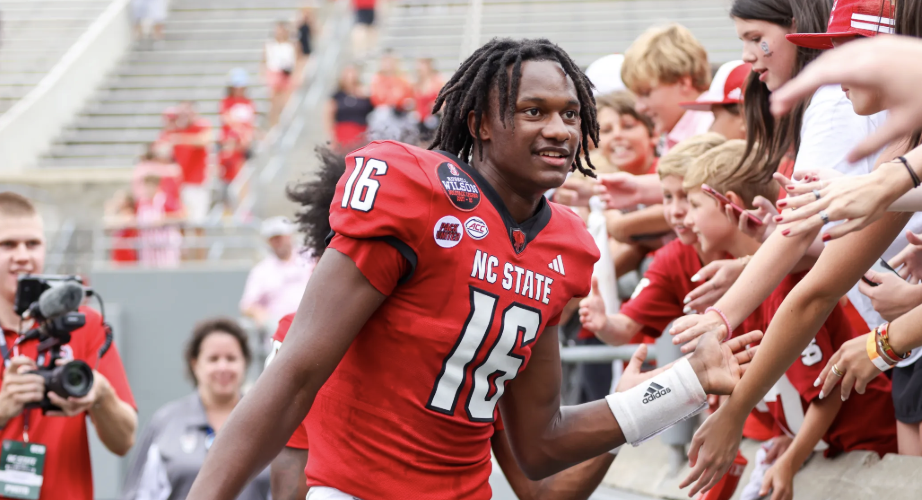
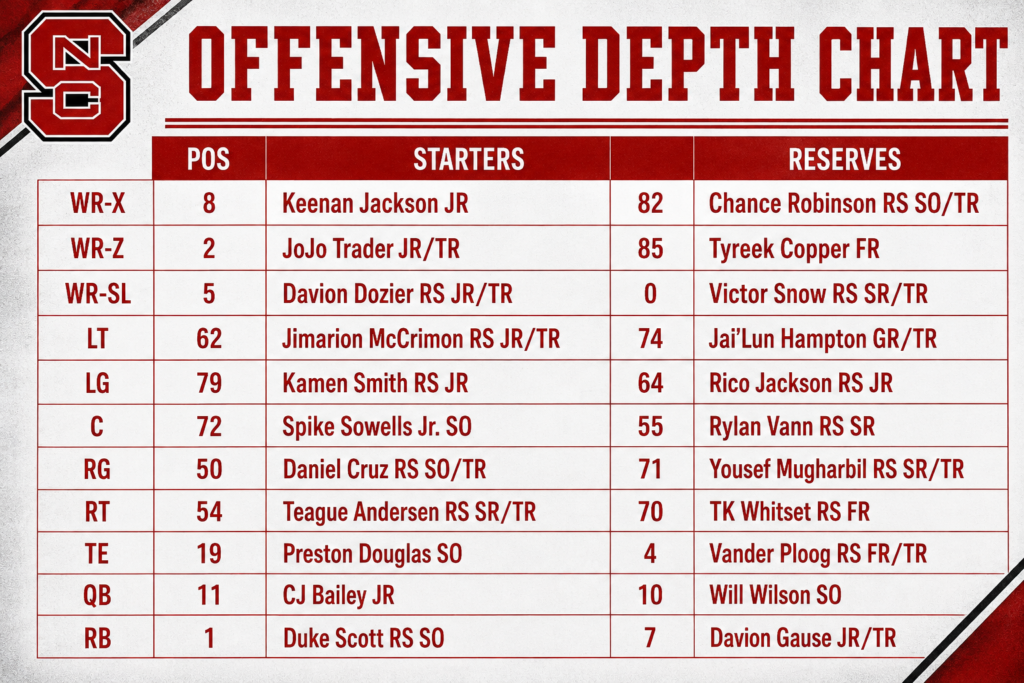
For NC State, 2026 is ultimately about finding out how far CJ Bailey can carry an offense that lost a surprising amount around him. Bailey took another step forward last season, completing 68.8% of his passes for 3,105 yards, 25 touchdowns and nine interceptions while starting all 13 games.
The issue is the supporting cast. NC State lost leading rusher Hollywood Smothers, its starting left tackle and essentially its entire top group of pass catchers. Smothers rushed for 939 yards at 5.9 yards per carry last season, while the Wolfpack’s top five pass catchers by receptions or yards are all unavailable after graduation, transfers or suspension. That’s a significant amount of production to replace around a quarterback being asked to take another developmental step.
Duke Scott moves into the featured role at running back after rushing for 581 yards at 5.5 yards per carry as a freshman. The receiving corps is much more uncertain. Transfers Davion Dozier, Chance Robinson, Victor Snow and JoJo Trader are among the players being asked to emerge, while Keenan Jackson provides some returning experience. Up front, East Carolina transfer Jimarion McCrimon takes over at left tackle alongside center Spike Sowells and right tackle Teague Andersen.
Unfortunately, the 34–8 loss at Virginia in the opener immediately exposed some of those concerns. The Wolfpack were held to four yards per play or fewer, continuing a troubling offensive pattern that has appeared repeatedly over the past several seasons. I’m not going to overreact to one game, especially with Bailey’s track record, but it reinforces my biggest concern: Bailey may be good enough to elevate NC State, but I’m not convinced the offense surrounding him is good enough to consistently elevate Bailey.
Defensive Outlook
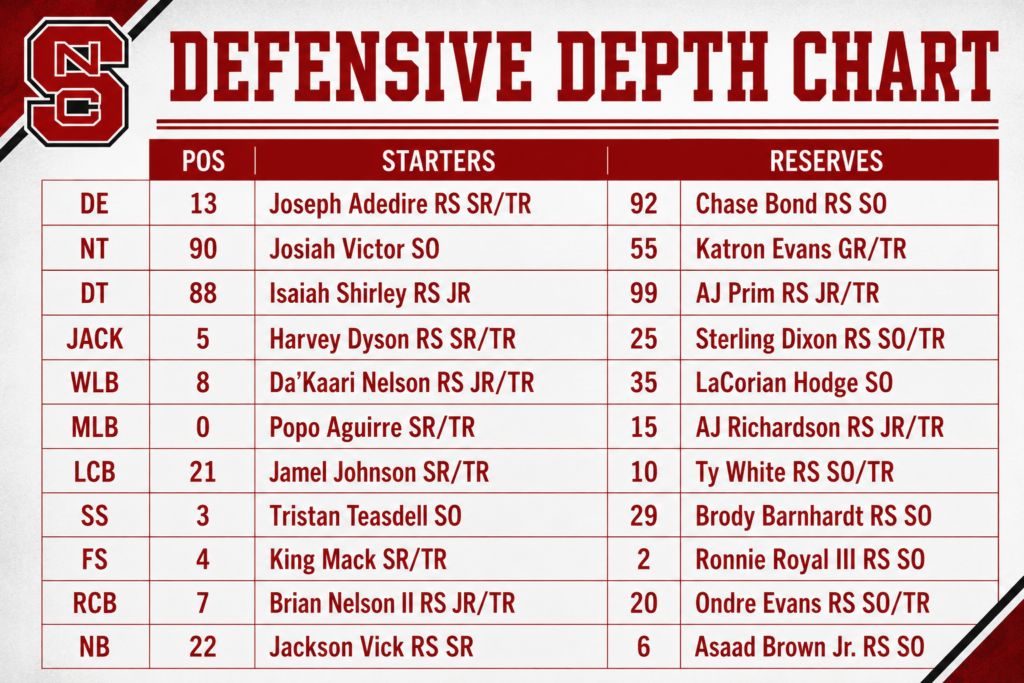
Defense is where I have considerably more concern. NC State allowed 27.2 points and 411.9 yards per game last season, including 273.2 passing yards per game. For a Dave Doeren program traditionally built around physical defense, those numbers simply weren’t good enough.
The Wolfpack particularly struggled to create disruption on passing downs, and that was one of the major priorities throughout the offseason. Harvey Dyson is an important piece on the defensive front, while Popo Aguirre is being counted on to provide playmaking ability at linebacker. There is talent here, but the margin for error is thin and NC State needs several relatively unproven players to emerge.
The Virginia opener wasn’t encouraging. The Cavaliers rushed for 258 yards in the 34–8 win, with quarterback Beau Pribula alone reaching 110. That’s particularly concerning because stopping the run has historically been one of the defining characteristics of Doeren’s better NC State defenses.
I still expect some improvement as the season progresses. Doeren has a long history of developing defensive players, and one ugly performance doesn’t mean the unit is destined to struggle all year. But NC State isn’t talented enough offensively to consistently overcome a defense that gives up long drives and struggles to get off the field. The Wolfpack need this side of the ball to improve quickly if they’re going to reach the six wins I projected.
Overview and Projection
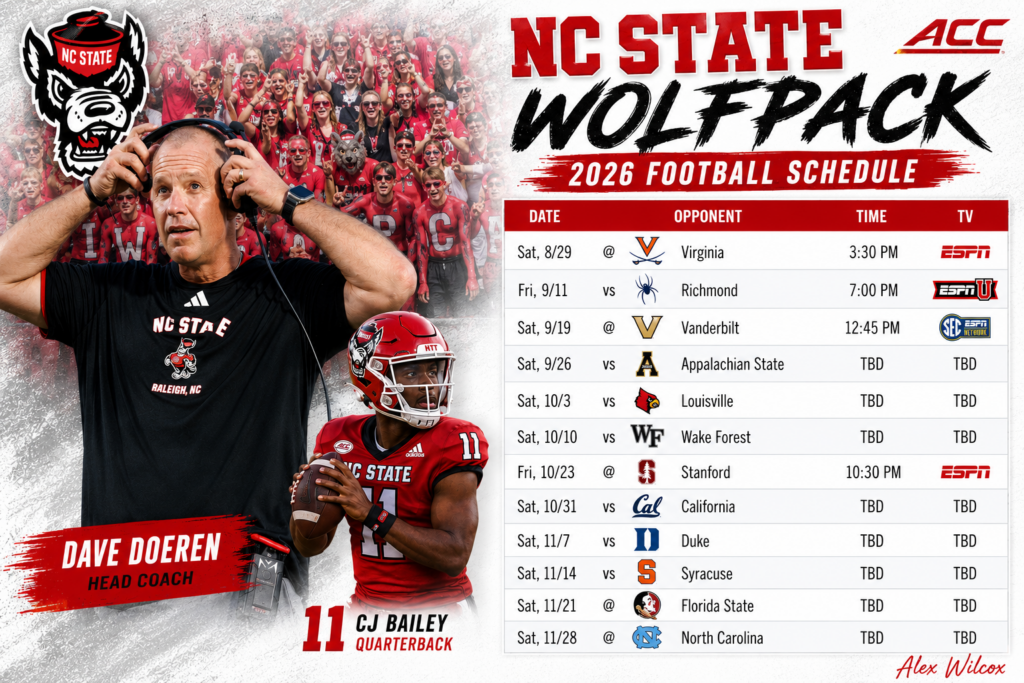
I still have NC State finishing 6–6 overall and 4–5 in the ACC. Bailey is the primary reason. He’s experienced, talented and capable of winning games that the rest of the roster might not. But losing Smothers and so much receiving production puts an enormous amount of responsibility on his shoulders, while the defense looks like a legitimate concern.
NC State feels like the definition of a middle-of-the-pack ACC team this season. Bailey gives the Wolfpack enough quarterback talent to beat teams above them, but the roster around him has enough holes to lose to teams below them as well. The ceiling could reach seven or eight wins if Bailey becomes a true star and the defense improves dramatically. After what we saw against Virginia, however, 6–6 feels like an appropriate projection for a team whose quarterback is considerably more proven than almost everything surrounding him.
Projected Record: 6-6 (4-5)
Duke Blue Devils
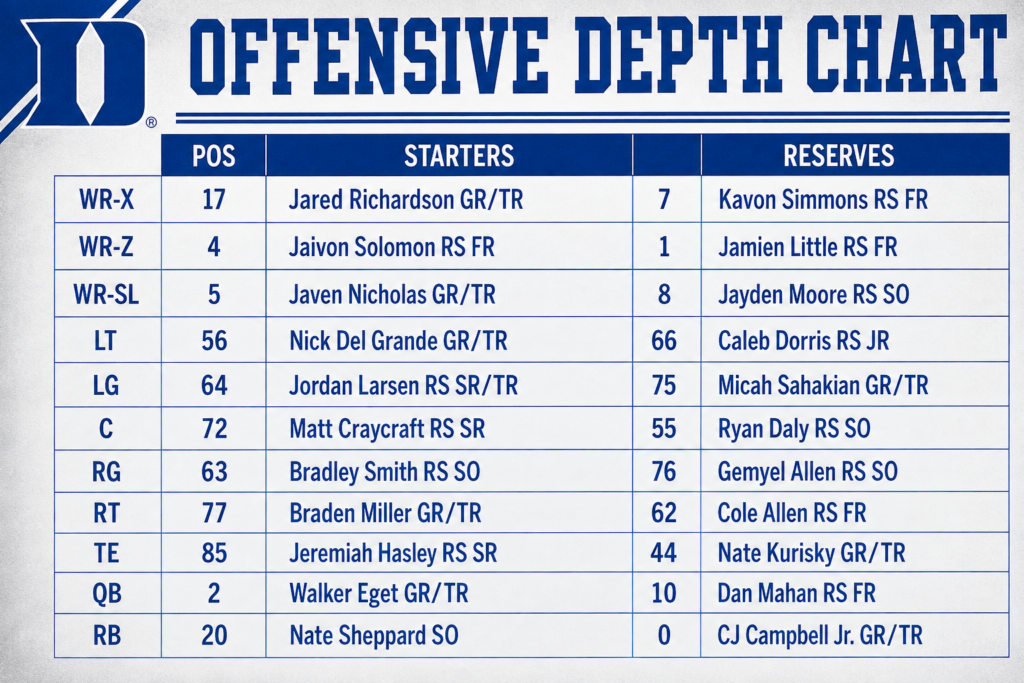
Offensive Outlook
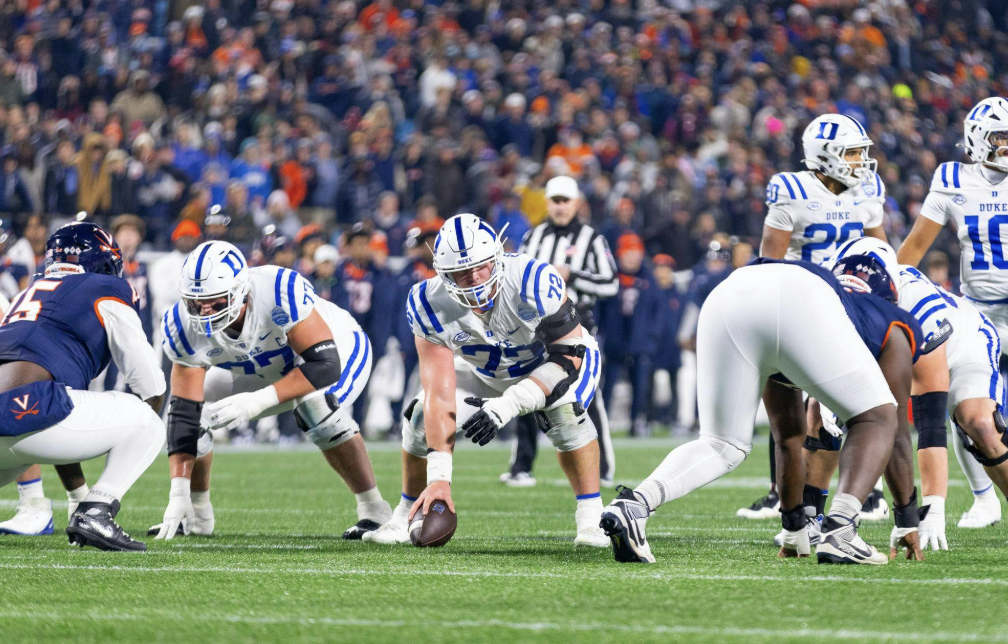
Defending an ACC championship would already be difficult enough, but Duke has to do it after losing the quarterback who powered last year’s title run to a conference rival. Darian Mensah transferred to Miami along with leading receiver Cooper Barkate, leaving Manny Diaz and offensive coordinator Jonathan Brewer with major production to replace. Duke went 9–5 in 2025, beat Virginia in overtime for the ACC Championship and then defeated Arizona State in the Sun Bowl.
The new quarterback is Walker Eget, a San Jose State transfer who officially won the job in August. Unlike some of the first-year starters we’ve covered, Eget brings substantial experience: 27 career appearances, 18 starts, 5,563 passing yards and 30 touchdowns. He earned honorable mention All-Mountain West recognition last season.
Fortunately, Nate Sheppard gives Duke an established centerpiece in the running game after surpassing 1,000 yards last season. That’s particularly important because I expect Duke to lean more heavily on the ground game while Eget becomes comfortable in Brewer’s offense. The receiving corps is much less proven without Barkate, meaning several newcomers and younger players will need to emerge.
There’s also a significant concern up front. Duke is already without offensive lineman Roman Fina for the season because of a lower-body injury, another blow for an offense replacing important pieces. I don’t expect Duke’s offense to resemble the Mensah-led version statistically. The formula has to change: establish Sheppard, protect Eget, avoid turnovers and allow the defense to keep games manageable.
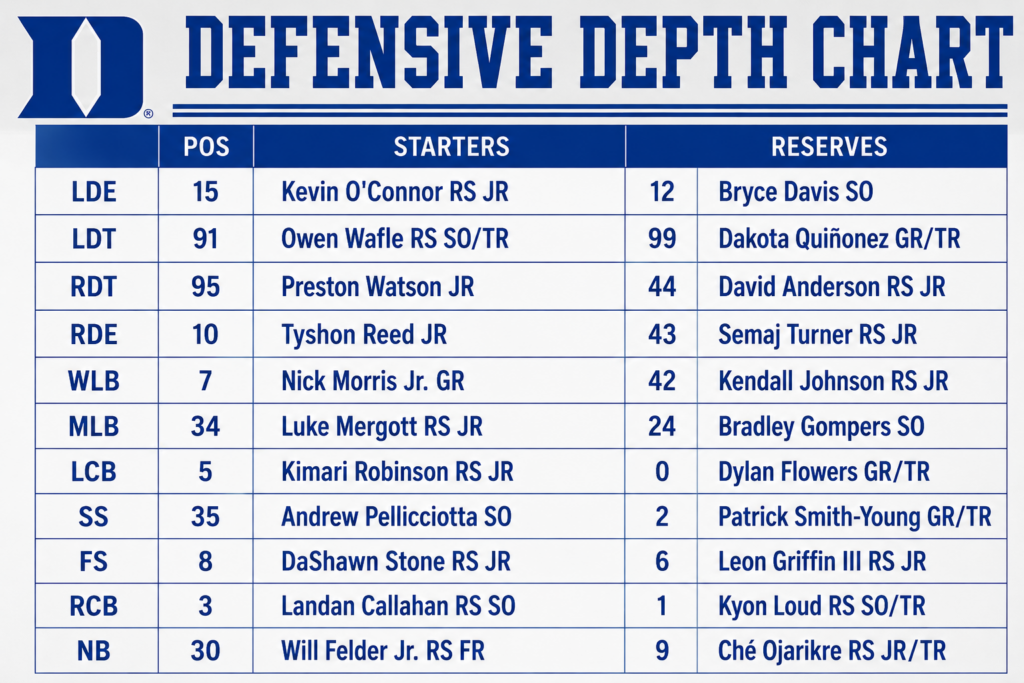
Defensive Outlook
Defense is where I have more confidence in Duke. Jonathan Patke returns as defensive coordinator, giving the Blue Devils continuity on both sides of the ball despite considerable roster turnover. Duke is one of only five ACC programs returning both coordinators this season.
Veteran linebacker Luke Mergott is one of the most important returning pieces and should become an even bigger leader on a unit replacing several starters. The defensive line is undergoing more substantial reconstruction, with four new starters expected up front, which could create some early inconsistency.
The reason I’m relatively comfortable with that turnover is Diaz. Whatever criticisms followed him from his head-coaching tenure at Miami, his ability to build aggressive defenses has never really been in question. Duke’s identity under Diaz is based on creating pressure, generating negative plays and forcing quarterbacks into mistakes rather than simply sitting back and preventing yardage.
This unit may need to carry more weight than it did during last year’s championship season. If the rebuilt defensive front develops quickly, I think Duke can remain difficult to play against even with the offensive regression I’m expecting. But with fewer proven difference-makers than the ACC’s top teams, there will be games where the defense simply can’t compensate for the talent gap.
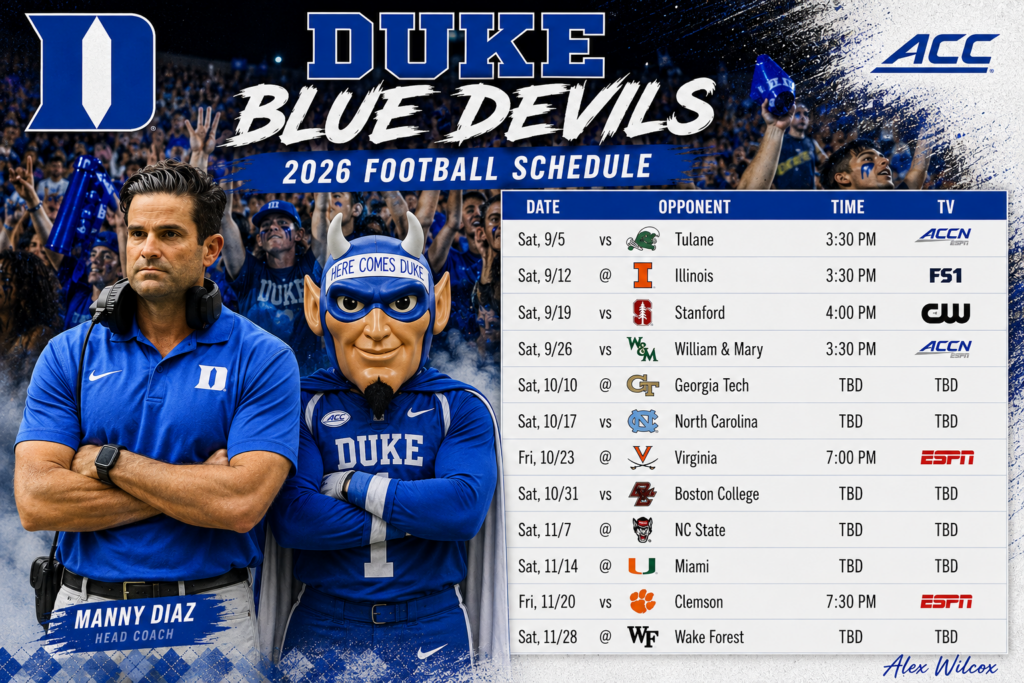
Overview and Projection
I’m projecting 6–6 overall and 4–5 in the ACC. I trust Diaz enough to believe Duke will remain organized and competitive, and Eget’s experience gives the offense a reasonable floor. But replacing Mensah with Eget is one of the largest quarterback downgrades among ACC teams, particularly when Mensah didn’t merely leave—he transferred directly to Miami, the team I have winning the conference.
That creates one of the more unusual stories in college football this season: the defending ACC champion could finish in the bottom half of the league without necessarily becoming a bad football team. Duke’s program is in a much healthier place than it was several years ago, but 2026 feels like a recalibration after an extraordinary championship season. At 6–6 (4–5), I still expect the Blue Devils to reach a bowl—I just don’t see enough returning firepower for another run at Charlotte.
Projected Record: 6-6 (4-5)
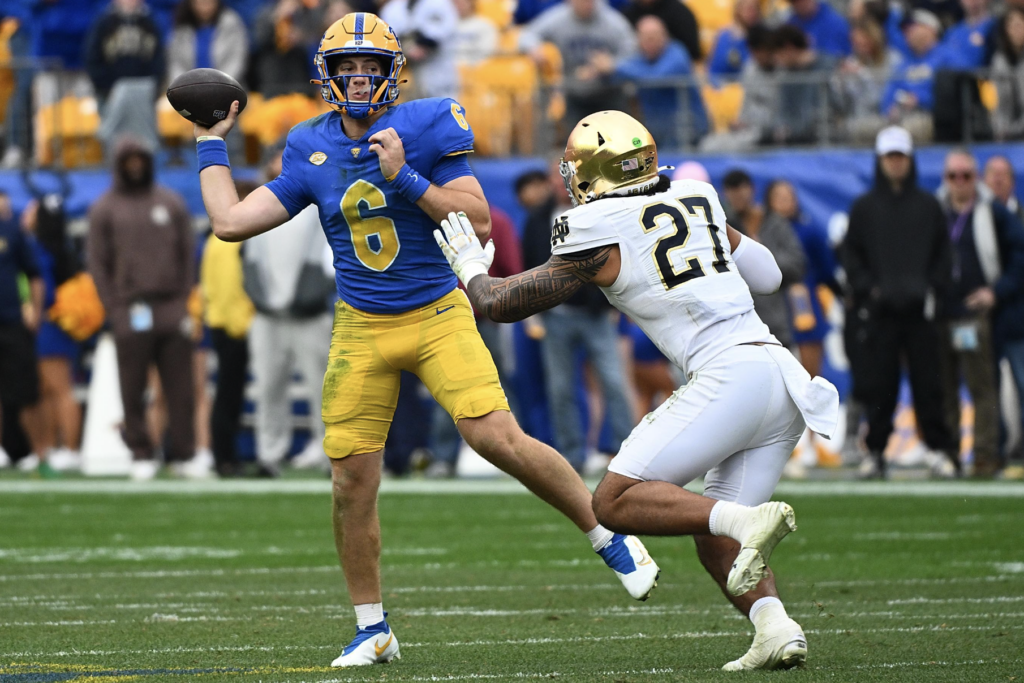
Pittsburgh Panthers
Offensive Outlook
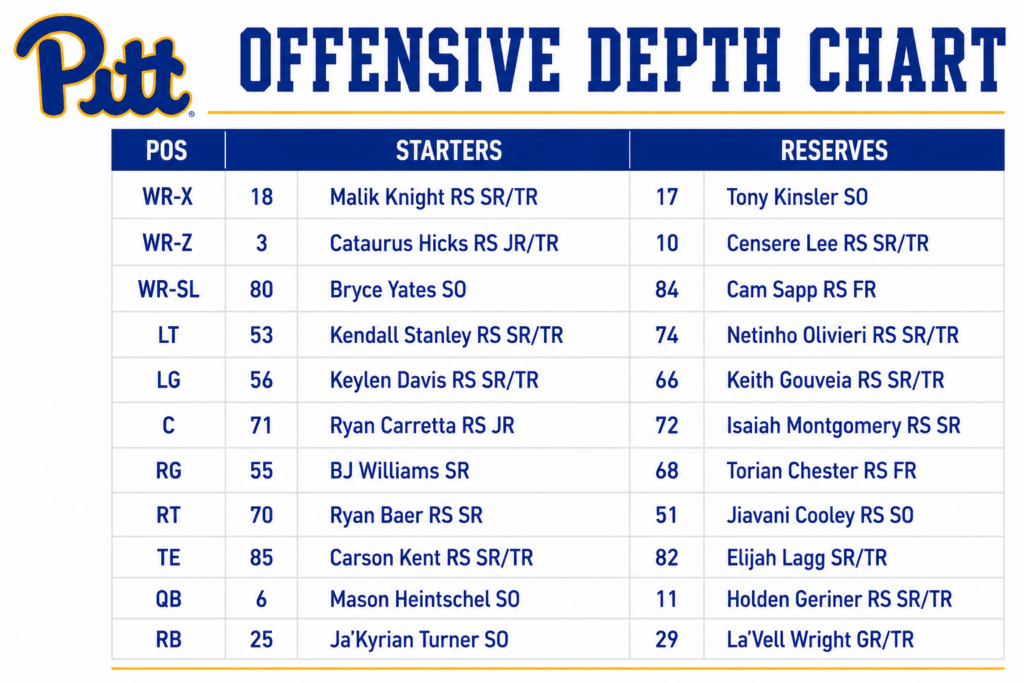
Pitt may be sitting 11th in my ACC projections, but this is one of the teams in the middle of the conference that I think has a legitimate chance to outperform its placement. A big reason is sophomore quarterback Mason Heintschel, who went from an unexpected freshman contributor to the unquestioned face of the offense. After taking over as the starter five games into 2025, Heintschel completed 201 of 316 passes for 2,354 yards, 16 touchdowns and eight interceptions.
Unlike last offseason, Pat Narduzzi and offensive coordinator Kade Bell have had an entire year to build the offense around Heintschel’s strengths. That’s important because we saw stretches last season where he looked like one of the ACC’s most promising young quarterbacks. He still needs to become more consistent and cut down on mistakes, but the experience he gained as a true freshman should be invaluable.
There are questions around him. Ja’Kyrian Turner opens the season as the starting running back, with Western Kentucky transfer La’Vell Wright behind him, while the receiving corps will feature Censere Lee, Cataurus Hicks and Western Carolina transfer Malik Knight. Lee is particularly interesting after catching 19 passes for 254 yards and three touchdowns before injury interrupted his 2025 season. Pitt also added Oklahoma transfer Carson Kent at tight end and multiple offensive linemen through the portal.
I like the quarterback more than I like the proven supporting cast. If Heintschel makes the sophomore jump I’m expecting, Pitt can have a good offense. But with several skill players needing to establish larger roles, there may be weeks when too much falls on his shoulders.
Defensive Outlook
Defense has always been the foundation of Pat Narduzzi’s program, and I don’t expect that philosophy to change in Year 12. Pitt will continue to play aggressively, create pressure and challenge receivers rather than allowing opposing quarterbacks to comfortably work underneath. The Panthers’ ability to generate a pass rush has been one of the most consistent characteristics of Narduzzi’s tenure.
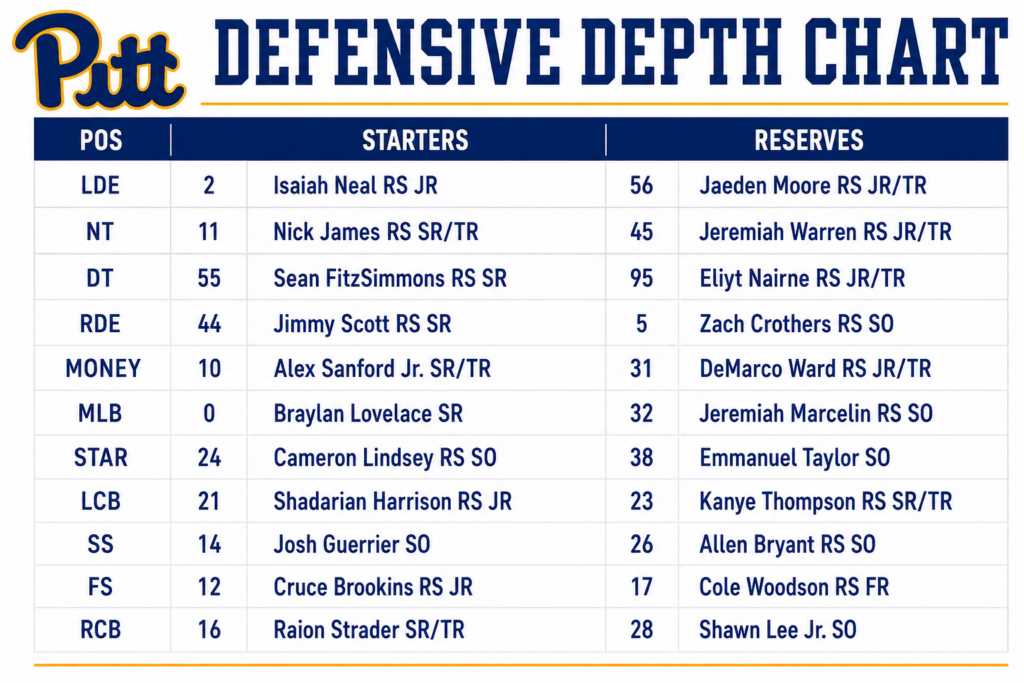
There has been turnover, though, and the secondary is one of the areas I’ll be watching early. Pitt brought in Auburn transfer Raion Strader and Division II transfer Kanye Thompson at defensive back, while Illinois defensive tackle Jeremiah Warren, Tulane defensive tackle Eliyt Nairne, Memphis linebacker DeMarco Ward and Purdue linebacker Alex Sanford Jr. were among the defensive portal additions.
That’s a lot of new personnel to integrate, but Pitt’s defensive system tends to create opportunities for front-seven players to be disruptive. The concern is what happens when the pressure doesn’t get home. Narduzzi’s aggressive coverage philosophy can leave the secondary vulnerable to explosive plays, particularly against the better quarterbacks on this year’s schedule.
I expect Pitt to remain aggressive and disruptive rather than statistically dominant. There will probably be games where the Panthers give up some big plays, but they’ll also create sacks, tackles for loss and turnovers. If the reconstructed secondary holds up, the defense should be good enough to complement what could become a very productive offense.
Overview and Projection
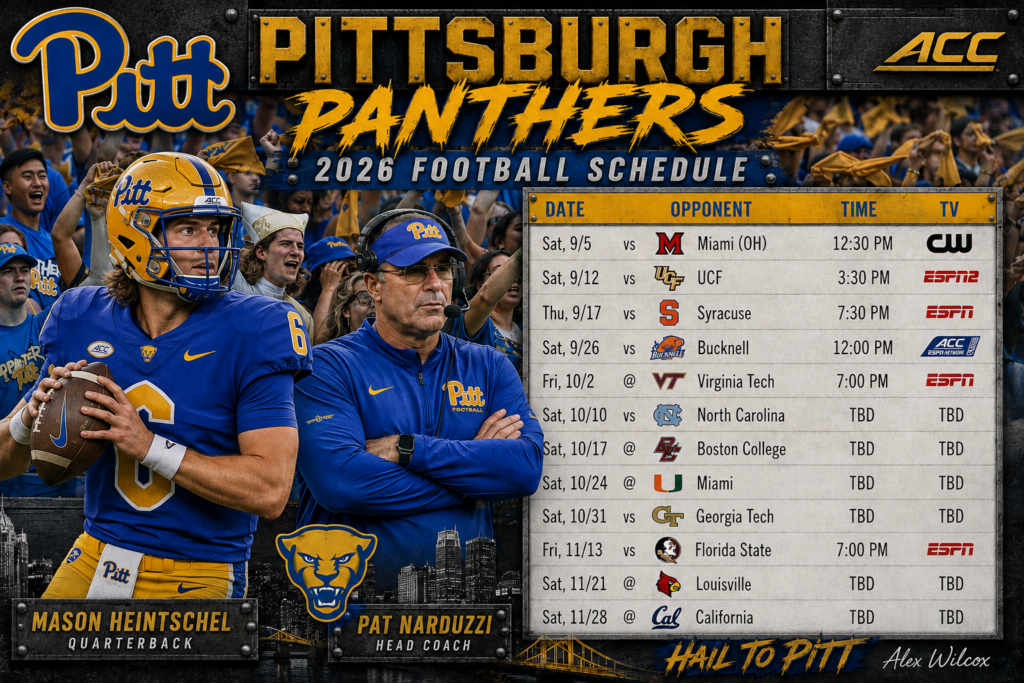
I’m projecting 7–5 overall and 4–5 in the ACC. The Panthers should take advantage of the early home schedule, and I think Heintschel gives them enough quarterback upside to beat somebody I have ranked above them. But consistently navigating the second half of this schedule is a different challenge.
Pitt is the type of team I wouldn’t want to play despite having them 11th in the conference. Heintschel could emerge as one of the ACC’s breakout quarterbacks, Narduzzi’s defense will create problems, and this program has a history of knocking off more talented opponents. The difference between my 7–5 projection and a nine-win season may only be two close games. For now, though, 7–5 (4–5) feels right for a dangerous but somewhat inconsistent Pitt team sitting in the ACC’s crowded middle tier.
Projected Record: 7-5 (4-5)
Florida State Seminoles
Offensive Outlook
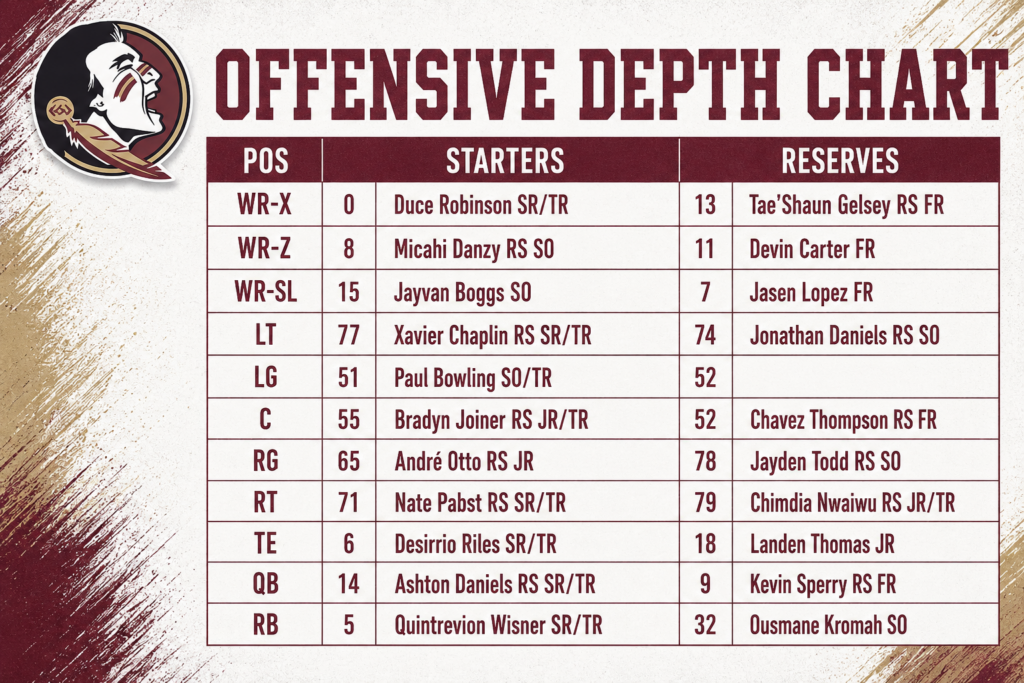
Few programs enter this season under more pressure than Florida State, and the offense has to become the stabilizing force if Mike Norvell is going to get things turned around. The Seminoles improved from 2–10 in 2024 to 5–7 last season, averaging a respectable 33.0 points per game, but inconsistency remained a major problem. With Tommy Castellanos gone after throwing for 2,760 yards and 15 touchdowns, FSU once again has a new quarterback running the offense.
That quarterback is Ashton Daniels, the former Stanford and Auburn quarterback who gives Norvell another experienced dual-threat option. He’s experienced and athletic enough to make plays outside structure, but consistency issues as a passer has followed him throughout his career. Florida State needs him to become more efficient rather than simply relying on his athletic ability.
His supporting cast gives him a chance. Duce Robinson is back after establishing himself as FSU’s premier receiving weapon, and at 6-foot-6 he gives Daniels an enormous target on the outside. The backfield also has talent, with Ousmane Kromah returning after averaging 5.7 yards per carry as a freshman and Samuel Singleton Jr. coming off a season in which he averaged 7.1 yards per attempt.
The major concern is the offensive line, where five new starters have to come together. That’s especially concerning because Florida State’s early schedule doesn’t provide much time for experimentation. New offensive coordinator Tim Harris Jr. has weapons to work with, but this offense will only be as good as its protection. Daniels doesn’t need to be an elite quarterback for Florida State to score points, but the rebuilt line has to give him an opportunity to play efficiently.
Defensive Outlook
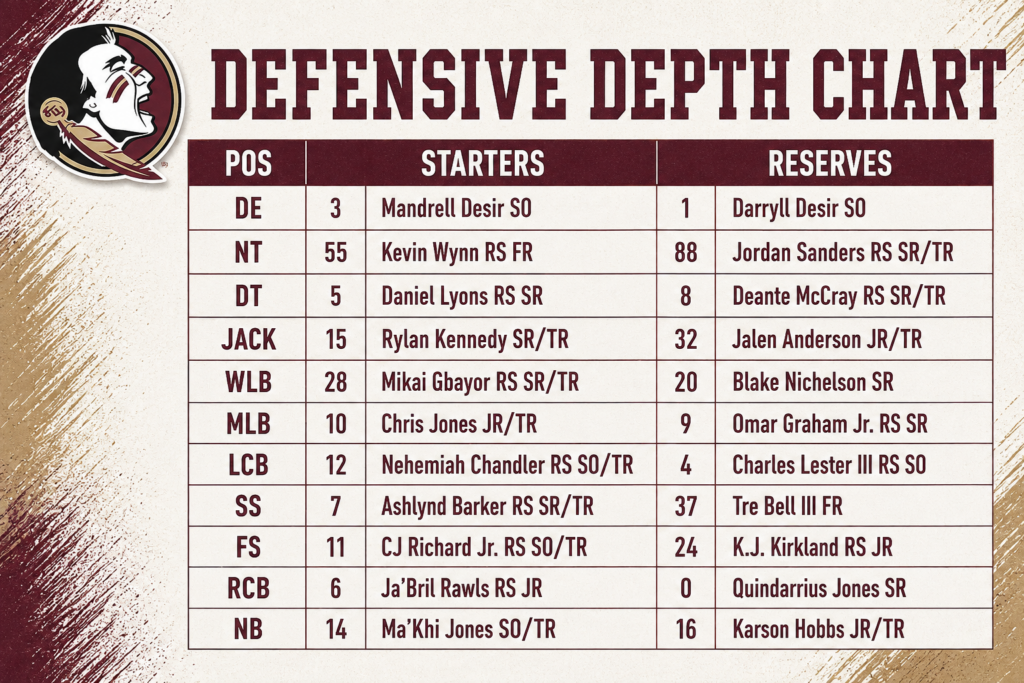
Florida State was quietly much better defensively than its 5–7 record suggested. The Seminoles allowed 22.0 points per game last season and held opponents to just 190.8 passing yards per game, while intercepting 12 passes. That side of the ball gives Norvell a much better foundation than he had during the disastrous 2024 season.
Tony White returns as defensive coordinator, and I still like the long-term fit of his aggressive, multiple scheme. The Seminoles are relying heavily on younger players making a Year 2 jump, particularly along a defensive front that has been rebuilt around players such as Darryll Desir and veteran defensive tackle Daniel Lyons.
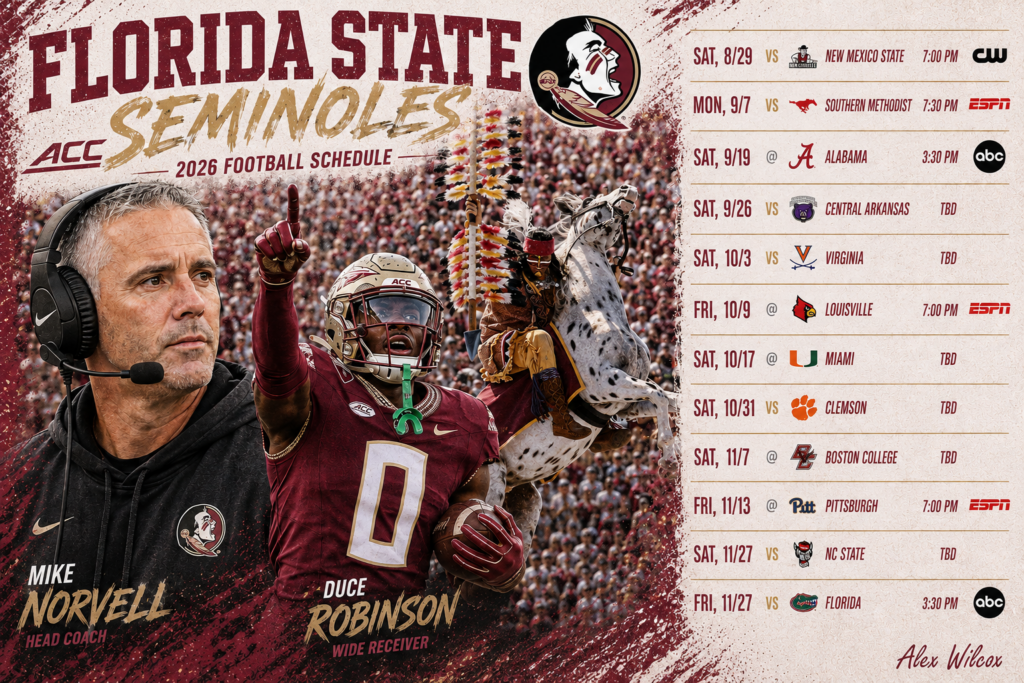
There are still questions in the secondary and with overall depth, but the defense has enough athleticism to be competitive. The issue is that Florida State’s schedule contains several quarterbacks capable of punishing communication mistakes. That becomes particularly important against SMU’s Kevin Jennings and Miami’s Darian Mensah.
We’ve already seen some of that inconsistency in the season-opening win over New Mexico State. Florida State won 34–17, but Norvell came away frustrated with defensive communication and third-down execution. Those problems are correctable, but they’ll have to be corrected quickly. I expect the defense to be the more dependable side of this team, but it isn’t dominant enough to carry FSU through the schedule by itself.
Overview and Projection
I’m sticking with 5–7 overall and 3–5 in the ACC. Daniels should keep the offense functional, Robinson gives him an excellent target and I think the defense will be respectable. But the rebuilt offensive line, another quarterback transition and one of the conference’s most difficult schedules leave too little margin for error.
Florida State is probably more talented than the 12th-best team in the ACC, but I’m not convinced that translates into a better record. This program has now spent two years trying to recover from the collapse that followed 2023, and 2026 feels like the point where progress has to become visible in the win column. My projection says it doesn’t happen quickly enough. At 5–7, Florida State misses a bowl for a third consecutive season—and if that happens, the conversation surrounding the future of the program will become impossible to ignore.
Projected Record: 5-7 (3-5)
Wake Forest Demon Deacons
Offensive Outlook
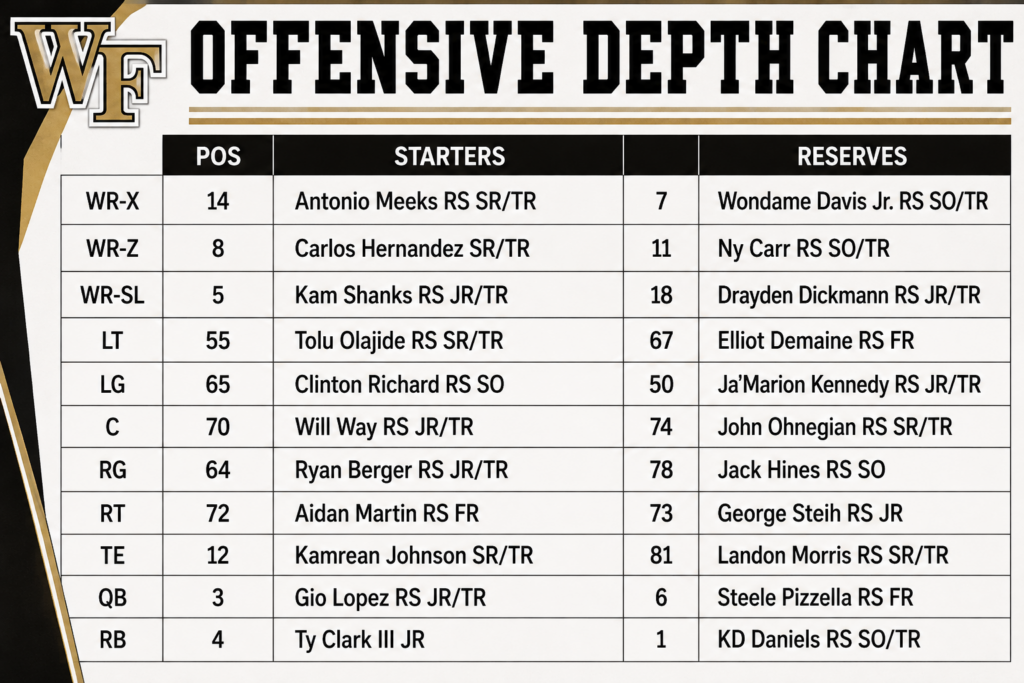
After dramatically exceeding expectations in Jake Dickert’s first season, Wake Forest now has to replace several of the offensive pieces that helped produce its nine-win breakthrough. The Demon Deacons averaged 28.1 points and 393.8 yards per game in 2025, including a respectable 237.7 passing yards per game. The biggest change comes at quarterback, where Gio Lopez takes over after transferring from North Carolina.
Lopez is an interesting reclamation project because we’ve already seen him play excellent football. He reunites with offensive coordinator Rob Ezell, who coached him at South Alabama when Lopez threw for more than 2,500 yards and 18 touchdowns. His 2025 season at North Carolina was more disappointing—he completed roughly 65% of his passes but managed only 10 touchdowns against five interceptions.
There is significant turnover around him. Leading rusher Demond Claiborne is gone after being selected by Minnesota in the NFL Draft, leaving Ty Clark III and Florida transfer KD Daniels to handle much of the backfield workload. Wake also lost five of its top six receivers behind returning leader Carlos Hernandez. Dickert responded by adding Ny Carr from Miami, Kam Shanks from Arkansas, Chase Tyler from Duke and Drayden Dickmann from Rice through the portal.
Hernandez is the player I trust most in the skill group, but there are a lot of new relationships that need to develop around Lopez. I don’t expect Wake’s offense to collapse, but I’m also not convinced Lopez will provide enough consistency at quarterback to compensate for losing Claiborne and so much receiving production. This unit should be functional; whether it becomes genuinely good will depend heavily on Lopez recapturing the form he showed earlier in his career.
Defensive Outlook
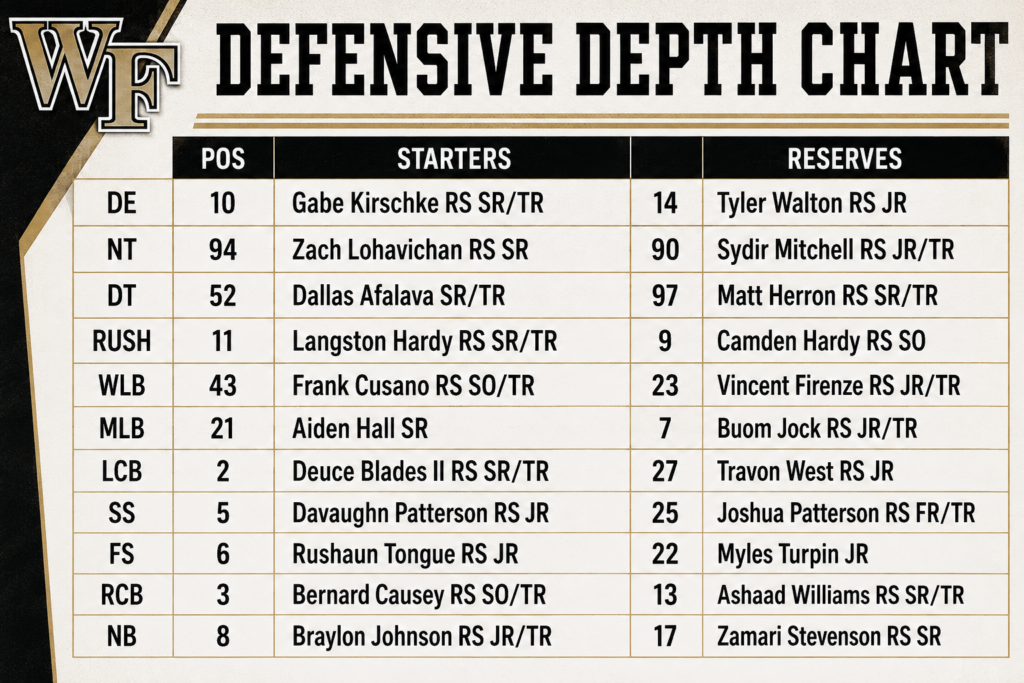
Defense was probably the biggest reason Wake Forest shocked the ACC last season. The Demon Deacons allowed only 22.1 points and 328.5 yards per game, a massive improvement from the final years of the Dave Clawson era. They also held opponents to just 3.4 yards per rushing attempt and a 35.6% third-down conversion rate.
The best news is that the defensive line returns almost intact. Langston Hardy is the centerpiece after recording 67 tackles, 17 tackles for loss and seven sacks last season. Fellow edge defender Gabe Kirschke added five sacks, while defensive tackles Dallas Afalava and Zach Lohavichan also return. That’s an experienced front that should give defensive coordinator Scottie Hazelton something dependable to build around.
There are useful pieces behind them as well. Davaughn Patterson returns after finishing second on the team in tackles, while Aiden Hall was third. FIU transfer Deuce Blades II adds extensive starting experience at corner, an important addition for a secondary replacing multiple contributors.
I actually trust this side of the ball more than the offense. Wake isn’t loaded with blue-chip talent, but Dickert established a much more physical defensive identity almost immediately. With Hardy leading an experienced defensive line, I think the Demon Deacons can remain difficult to run against and keep themselves in games even when the offense struggles.
Overview and Projection
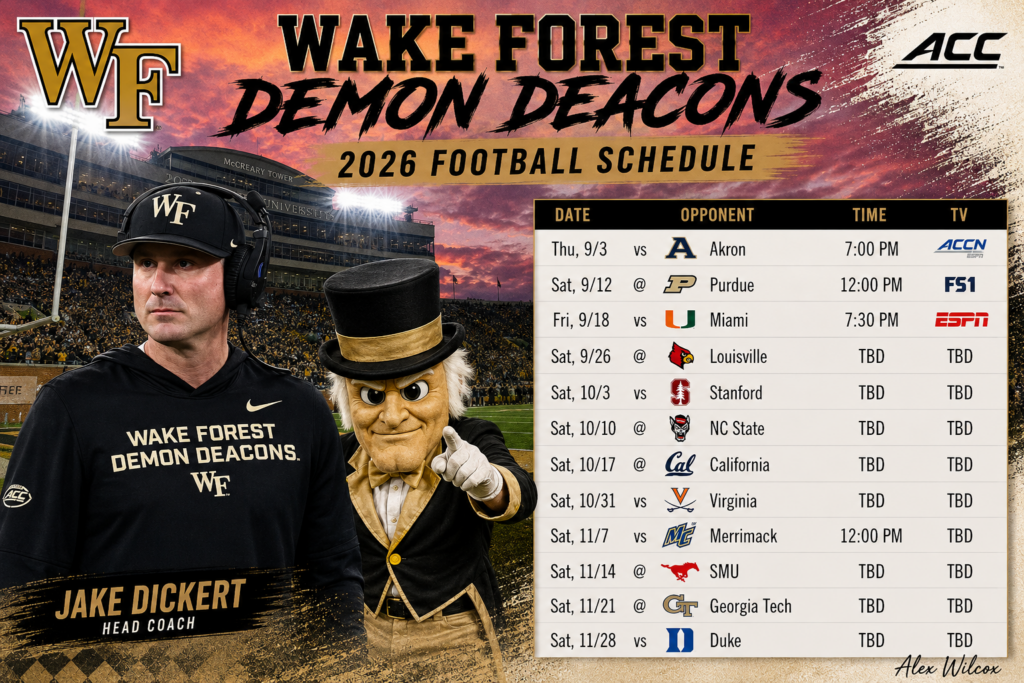
I’m projecting 5–7 overall and 3–6 in the ACC. Akron, Stanford and Merrimack are games Wake should expect to win, while Purdue, NC State, Virginia and Duke represent the group that will ultimately decide whether the Demon Deacons reach another bowl. Miami, Louisville and SMU are substantial underdog situations in my projections, and the trips to Cal and Georgia Tech won’t be easy either.
Wake Forest may be better than its 5–7 record suggests. I like the defensive front, I trust Dickert after what he accomplished last season, and Lopez has enough talent to outperform my quarterback grade if reuniting with Ezell unlocks him. But after everything broke right during the nine-win breakthrough, I expect some correction in the opposite direction. Five wins feels like the most realistic outcome, with Lopez’s performance determining whether Wake can turn one or two of those close losses into another bowl season.
Projected Record: 5-7 (3-6)
North Carolina Tarheels
Offensive Outlook
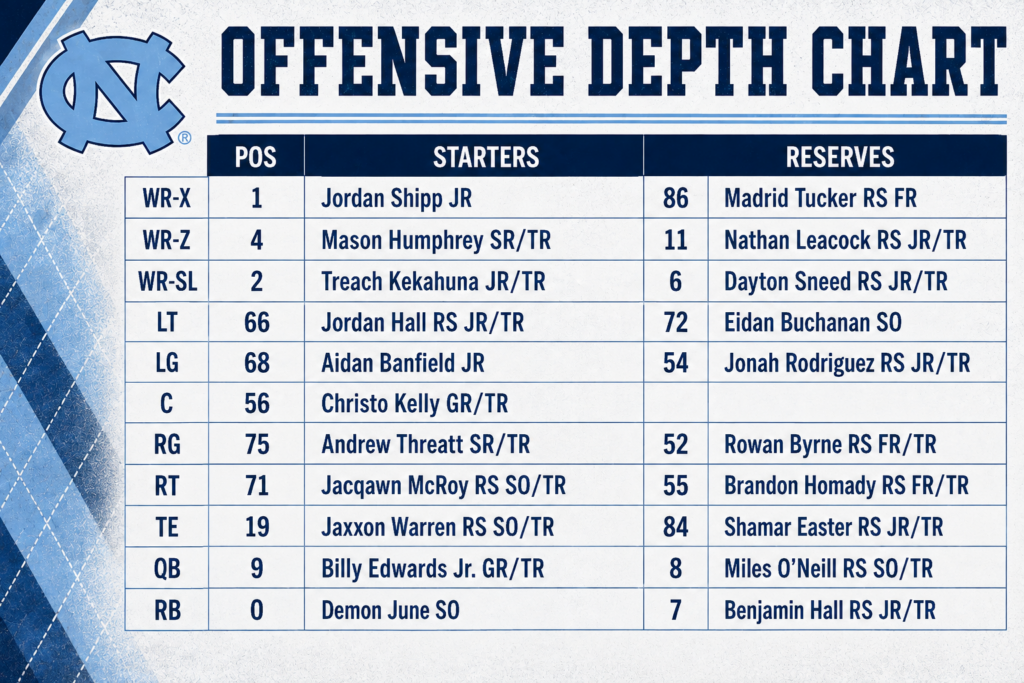
After one of the most disappointing debut seasons imaginable for Bill Belichick, North Carolina has essentially started over offensively. The Tar Heels went 4–8 (2–6 ACC) in 2025 while averaging only 19.2 points and 288.8 yards per game, including just 105.3 rushing yards per contest. Gio Lopez is now at Wake Forest, and Belichick responded by bringing in veteran offensive coordinator Bobby Petrino and rebuilding the quarterback room through the portal.
The new starter is Maryland transfer Billy Edwards Jr., who won the competition over Miles O’Neill and Taron Dickens. He’s experienced and has enough mobility to extend plays, but UNC needs much more consistency from its passing game than it received last season. Petrino’s arrival is important here. Whatever else has followed him throughout his career, his ability to construct productive college offenses is well established.
The best returning offensive player is receiver Jordan Shipp, who caught 60 passes for 671 yards and six touchdowns last season despite UNC’s passing struggles. He gives Edwards an established No. 1 target, while Wisconsin transfer Trech Kekahuna adds another option in the slot. The Tar Heels also added tight ends Jelani Thurman and Shamar Easter, giving Petrino considerably more size to work with in the middle of the field.
The running game has to improve substantially. Demon June led last year’s team with only 464 rushing yards, although he averaged a respectable 5.5 yards per carry, and Benjamin Hall is also back. UNC has again reconstructed much of its offensive line through the portal, with players such as Jordan Hall, Andrew Threatt, Christo Kelly and JacQawn McRoy currently occupying starting roles. Petrino should make this offense better schematically, but I’m not convinced UNC has enough established high-end talent for the improvement to be dramatic.
Defensive Outlook
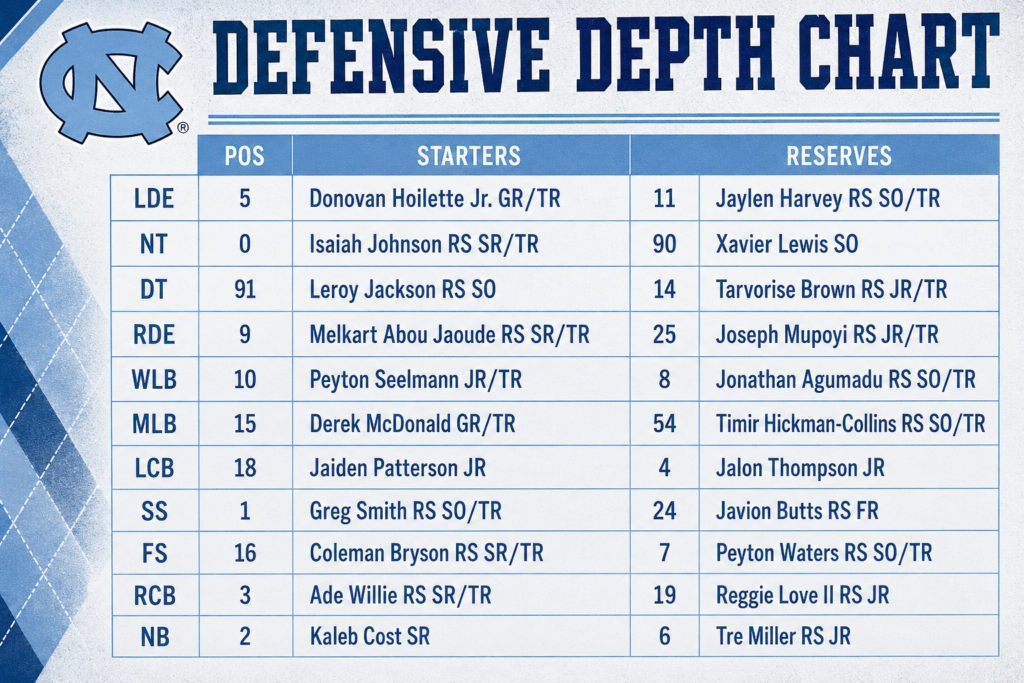
Interestingly, defense wasn’t really the primary reason North Carolina went 4–8. The Tar Heels allowed 24.5 points per game last season, a respectable figure considering how frequently an ineffective offense put the defense in difficult situations. That gives Belichick something more substantial to build around entering Year 2.
The roster has once again undergone enormous turnover, though. UNC brought in another massive group of newcomers after already completely reconstructing the team before Belichick’s first season. The current depth chart features transfers throughout the front seven and secondary, making continuity one of the biggest questions surrounding the unit.
That makes UNC difficult to evaluate. There is more size and athleticism than the 4–8 record might suggest, and Belichick’s defensive background gives the Tar Heels a clear schematic identity. But constantly turning over the roster also makes it difficult to establish the communication and chemistry required to become an elite defense.
We did see something encouraging immediately. North Carolina opened 2026 by upsetting TCU 15–10 in Ireland, a major contrast from the disastrous start to Belichick’s first season. Holding TCU to ten points reinforces my belief that the defense is capable of keeping UNC competitive; the question is whether the offense can score enough to take advantage of it.
Overview and Projection
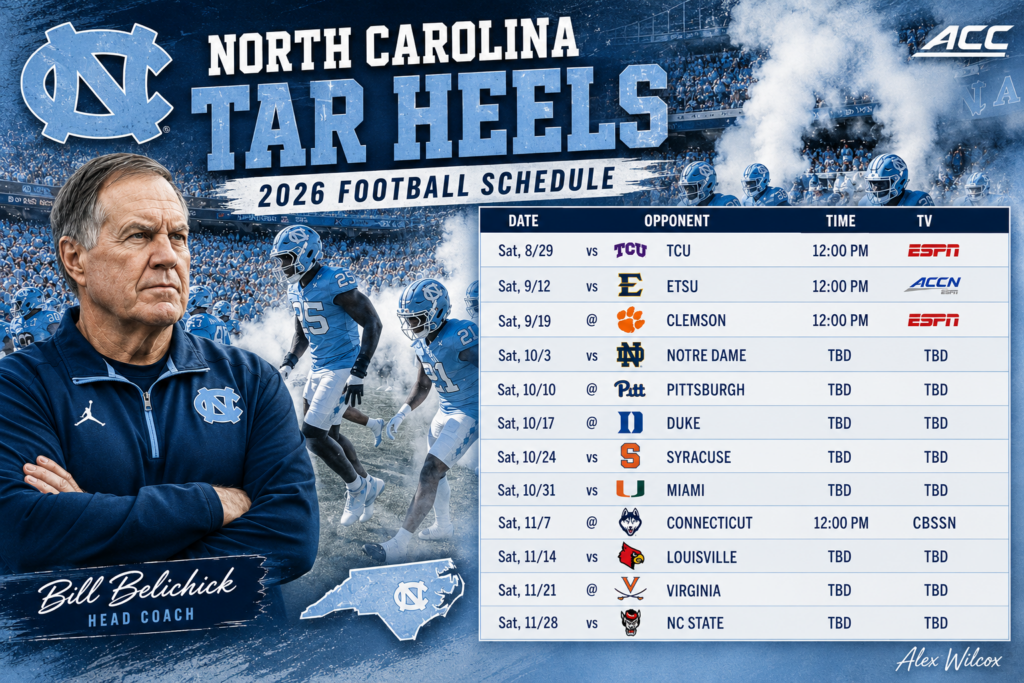
A 5–7 (2–6 ACC) projection is where I’m staying with the Tarheels. The TCU upset raises the ceiling and gives Belichick some desperately needed momentum, but one result doesn’t erase the concerns created by last season or another offseason of enormous roster turnover.
North Carolina should be better in Year 2, but I’m not ready to call the Belichick experiment a success yet. Petrino should improve the offense, the defense looks capable of winning games and the opening upset was genuinely encouraging. But until UNC proves it can consistently move the football against ACC defenses, I see improvement rather than a breakthrough—five wins, another missed bowl and continued pressure on Belichick heading into Year 3.
Projected Record: 5-7 (2-6)
Syracuse Orange
Offensive Outlook
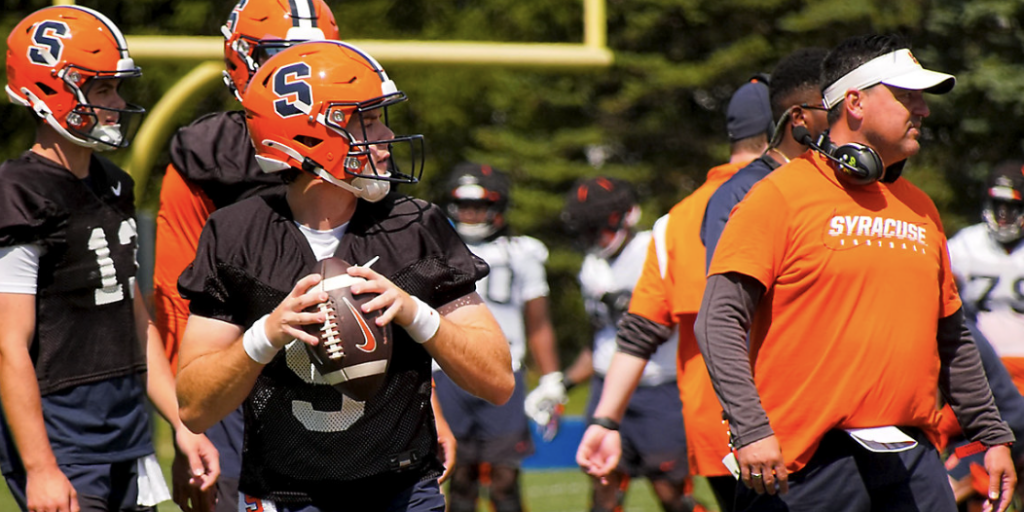
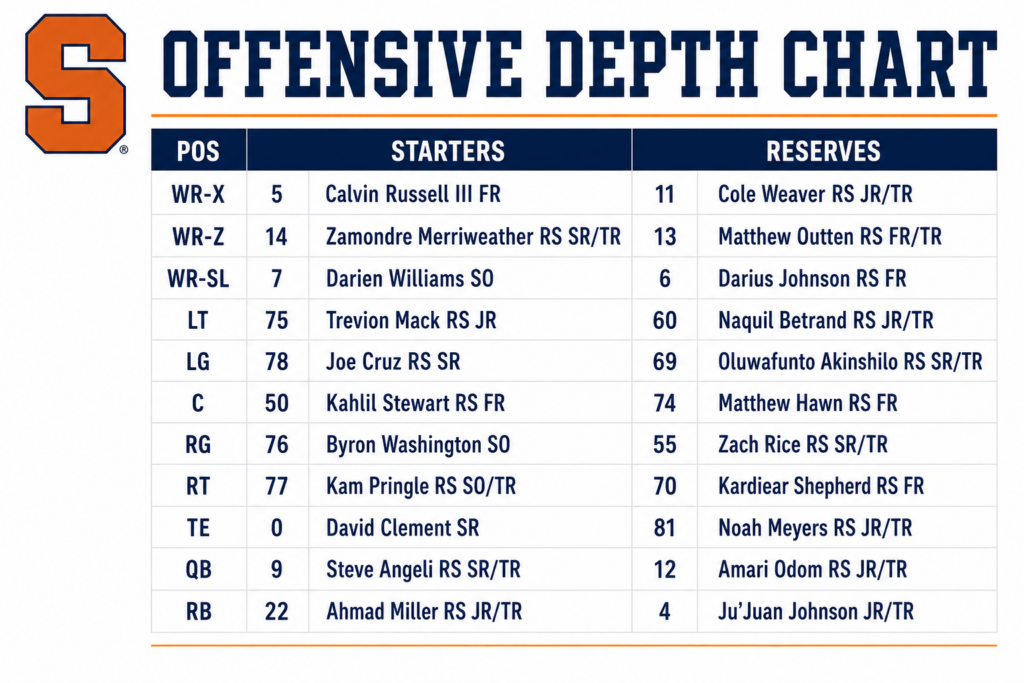
Syracuse’s 2025 season can almost be divided into two completely different teams: the Orange with Steve Angeli and the Orange without him. Angeli suffered a season-ending Achilles injury after four games, and Syracuse proceeded to lose each of its final eight contests while failing to score more than 20 points in any of them. Now healthy again, Angeli has reclaimed the starting job and gives Fran Brown a chance to find out what last season might have looked like without the injury.
Before going down, Angeli had shown enough to make the quarterback situation genuinely encouraging, including an impressive performance against Clemson. He returns bigger, healthy and much more experienced, while Syracuse completely rebuilt the depth behind him with transfers Amari Odom, Malachi Nelson and Danny Lauter.
The skill-position picture is less settled. Tylik Hill surprisingly emerged from camp as the starting running back, ahead of Penn State transfer Matthew Outten, while Jackson State transfer Ahmed Miller should also factor into the rotation. LSU transfer Ju’Juan Johnson has been dealing with availability issues entering the opener. At receiver, Justus Ross-Simmons provides size and experience after catching 20 passes for 312 yards and five touchdowns last season, while Tyshawn Russell and Umari Hatcher return from injuries.
The offensive line remains the area I’m most concerned about. Syracuse needs to protect Angeli after seeing how completely the offense unraveled without him, and the running game needs to provide much more consistency. A healthy Angeli makes Syracuse considerably better than the team we watched during the final two months of 2025.
Defensive Outlook
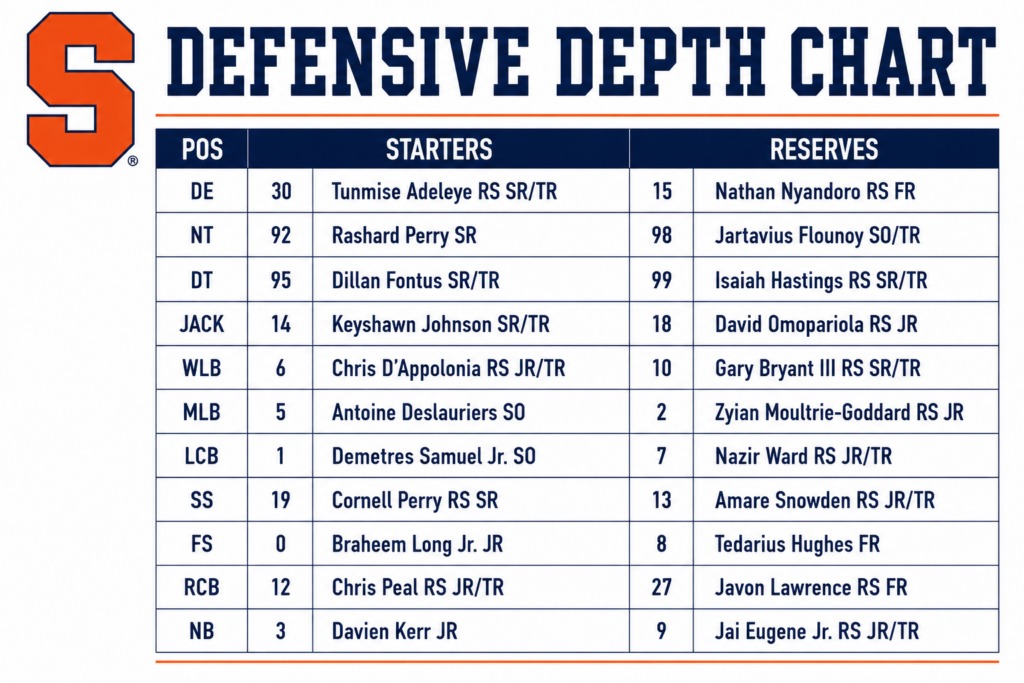
Syracuse has also made changes defensively, with Vince Kehres taking over as coordinator. The early emphasis has been straightforward: become more physical against the run, create pressure up front and simplify responsibilities enough for the defense to play faster.
The defensive line may be the most encouraging position group. Tunmise Adeleye, the former Texas A&M/Michigan State/UNLV edge defender, has been one of the standouts of fall camp and gives Syracuse some much-needed disruption up front. Reports throughout August consistently identified the defensive line as one of the deepest and most impressive groups on the roster.
There are useful pieces in the secondary as well, including Chris Peal and Demetres Samuel Jr., and I expect Brown’s recruiting background to continue raising the overall athletic profile of the defense. Samuel in particular is one of the young players with the physical upside to become a major piece of the program. The issue is whether Syracuse has enough proven difference-makers right now to consistently hold up against the better offenses on its schedule.
I expect improvement from this unit, but I’m not projecting a dramatic transformation. Syracuse needs its defensive front to become a legitimate strength, because the schedule includes several experienced quarterbacks who will punish the Orange if they can’t generate pressure without constantly committing extra defenders.
Overview and Projection
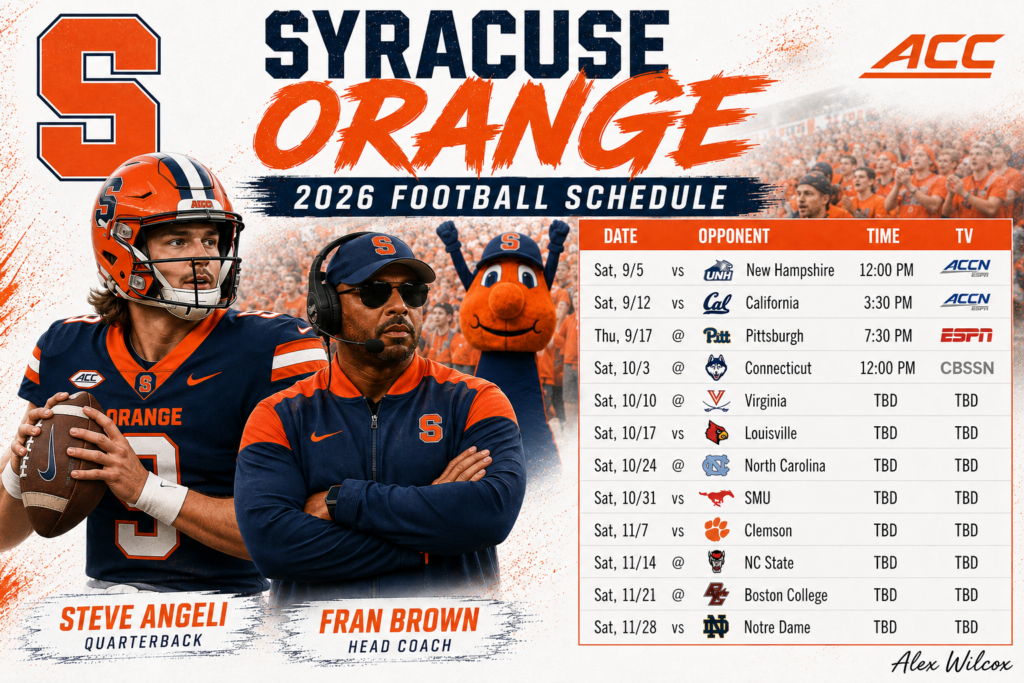
I’m sticking with a projection of 4–8 overall and 2–7 in the ACC. I actually think Syracuse could be noticeably better than last season without improving much in the win column. Angeli’s return alone should prevent the offense from becoming as ineffective as it was during the eight-game losing streak, and I like some of the defensive additions.
The entire season hinges on keeping Angeli healthy and giving him enough support. If he plays all 12 games and the offensive line exceeds expectations, Syracuse has a realistic path to six wins and a bowl. But the combination of questions in the trenches and a difficult conference draw keeps me cautious. I expect a more competitive Syracuse team in 2026, but at 4–8 (2–7), I still think the Orange finish near the bottom of a deeper ACC.
Projected Record: 4-8 (2-7)
Boston College Eagles
Offensive Outlook
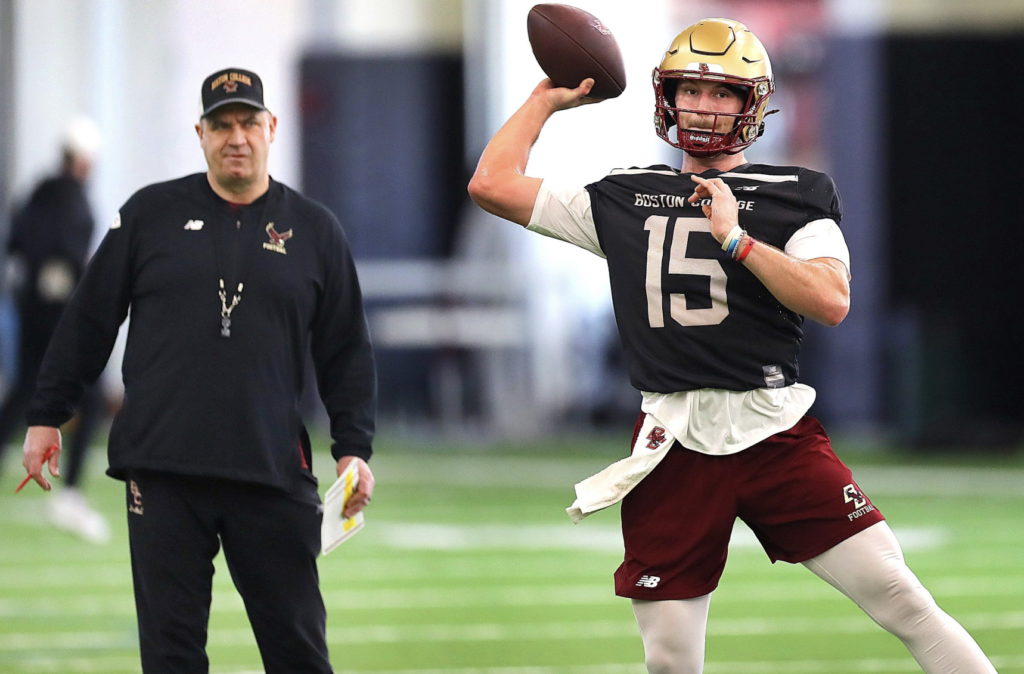
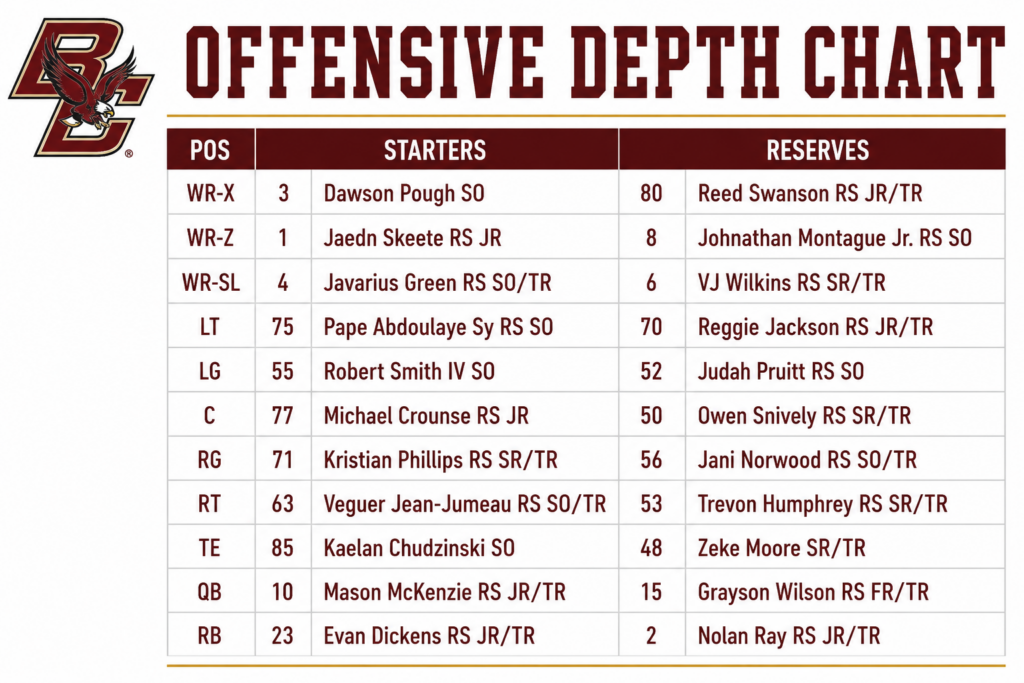
There may not be a more difficult rebuilding job in the ACC this season than the one facing Bill O’Brien at Boston College. After going 7–6 in his debut season, the Eagles collapsed to 2–10 in 2025, prompting another substantial roster overhaul. Quarterback Dylan Lonergan departed for Rutgers after throwing for 2,025 yards, 12 touchdowns and five interceptions in 10 appearances, leaving O’Brien searching for another answer at the most important position.
The answer is Mason McKenzie, a fascinating transfer from Division II Saginaw Valley State. McKenzie was the 2025 GLIAC Player of the Year after producing 2,086 passing yards and 17 touchdowns while adding 942 rushing yards and 10 scores. He officially sits atop BC’s Week 1 depth chart ahead of Grayson Wilson and freshman Femi Babalola. That isn’t because I dislike his skill set—the jump from Division II football directly into the ACC is simply enormous.
The backfield has also been rebuilt. Evan Dickens transferred from Liberty and opens the year as the starter, with Bo MacCormack and Nolan Ray giving BC additional options. At receiver, Reed Swanson, Jaedn Skeete and Javarius Green are among the players McKenzie will be relying upon. There’s no established star here, so O’Brien will need to manufacture production rather than simply feeding an elite playmaker.
The offensive line concerns me just as much. Boston College enters the season with an almost entirely reconstructed group up front, which is a difficult situation for a quarterback making such a dramatic jump in competition. McKenzie’s mobility should help when protection breaks down, and I actually think he’s one of the more interesting players on this roster. But asking a Division II transfer to elevate an inexperienced supporting cast against an ACC schedule is a massive assignment.
Defensive Outlook
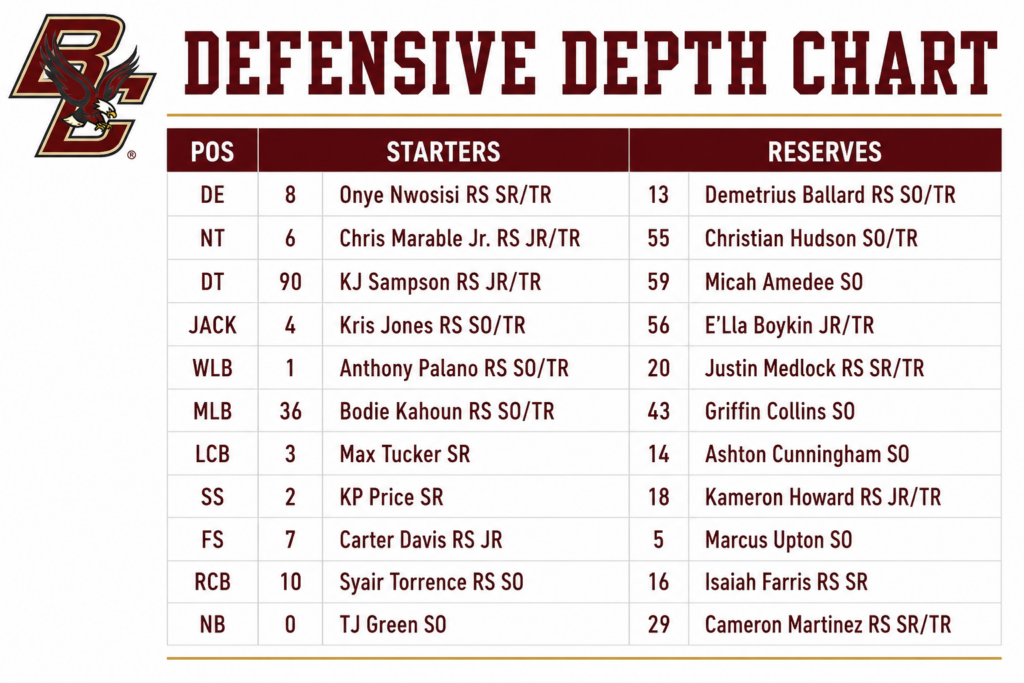
Boston College also made a major change defensively, with veteran coach Ted Roof taking over as defensive coordinator. The Eagles leaned heavily on the portal to replenish the front seven after last year’s two-win season, but there are at least a few established pieces around which Roof can build.
Defensive tackle Chris Marable Jr. provides experience inside, while KJ Sampson is listed alongside him on the opening depth chart. On the edge, Kris Jones and Onye Nwosisi are expected to handle significant roles. The linebacker group is led by Anthony Palano, who has emerged as one of the defense’s leaders entering the season.
I may actually be more intrigued by the secondary. KP Price and Carter Davis provide veteran stability, while younger defensive backs such as TJ Green, Ashton Cunningham and Syair Torrence give the Eagles some developmental upside. If Roof can generate enough pressure up front, I think the back end has a chance to be respectable.
The problem is depth. BC simply doesn’t have the margin for injuries or poor performances that the better teams in this conference possess. The Eagles need their defense to become substantially more physical because I’m not expecting the offense to consistently win shootouts. If this team is going to upset somebody, it will probably happen because the defense keeps the game ugly and McKenzie creates a few plays with his legs.
Overview and Projection
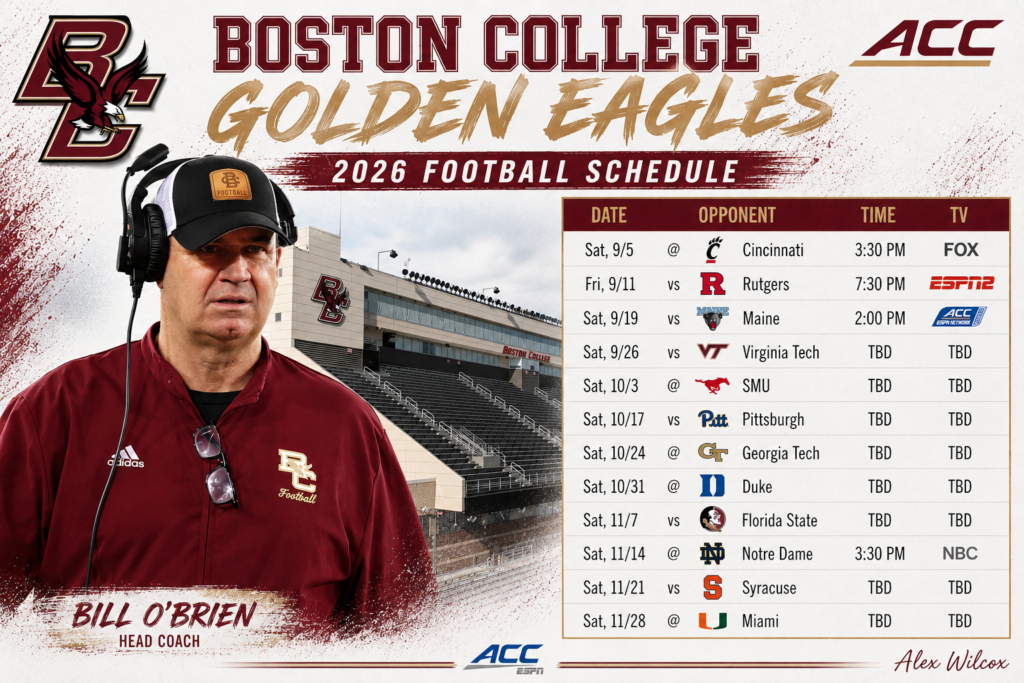
Maine is the one victory I have circled, leaving Boston College at 1–11 overall and 0–8 in the ACC. Cincinnati and Rutgers give the Eagles opportunities early to prove me wrong, while Syracuse and Florida State are the conference games where I think an upset is most realistic. But the back half is brutal: from October 24 onward, BC plays at Georgia Tech, at Duke, Florida State, at Notre Dame, Syracuse and at Miami.
Boston College’s season may ultimately be less about its record than what the record means for O’Brien. If McKenzie proves he belongs at this level and the Eagles are competitive despite losing games, there could at least be evidence of a foundation. But if my 1–11 (0–8 ACC) projection is accurate, it would leave BC with three wins over two seasons and raise very serious questions about the direction of the program.
Projected Record: 1-11 (0-8)
Stanford Cardinal
Offensive Outlook
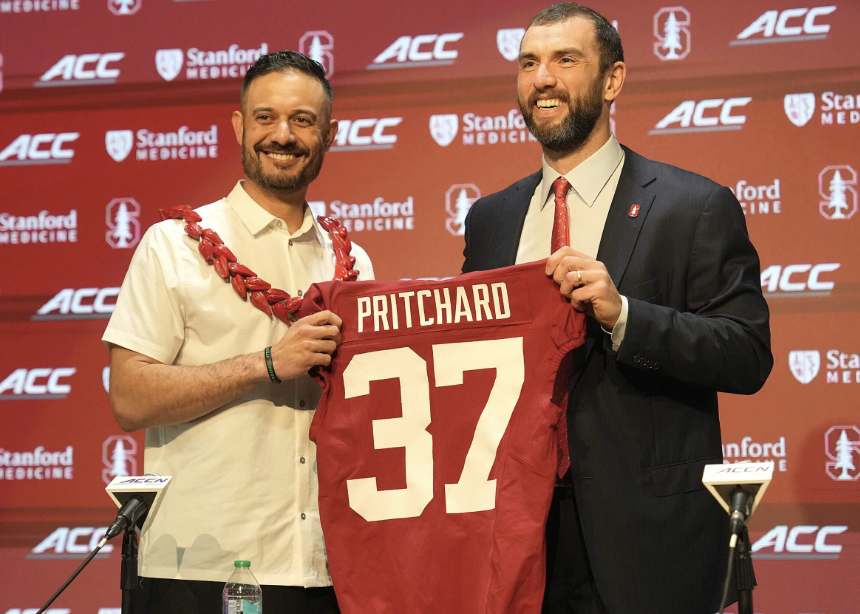
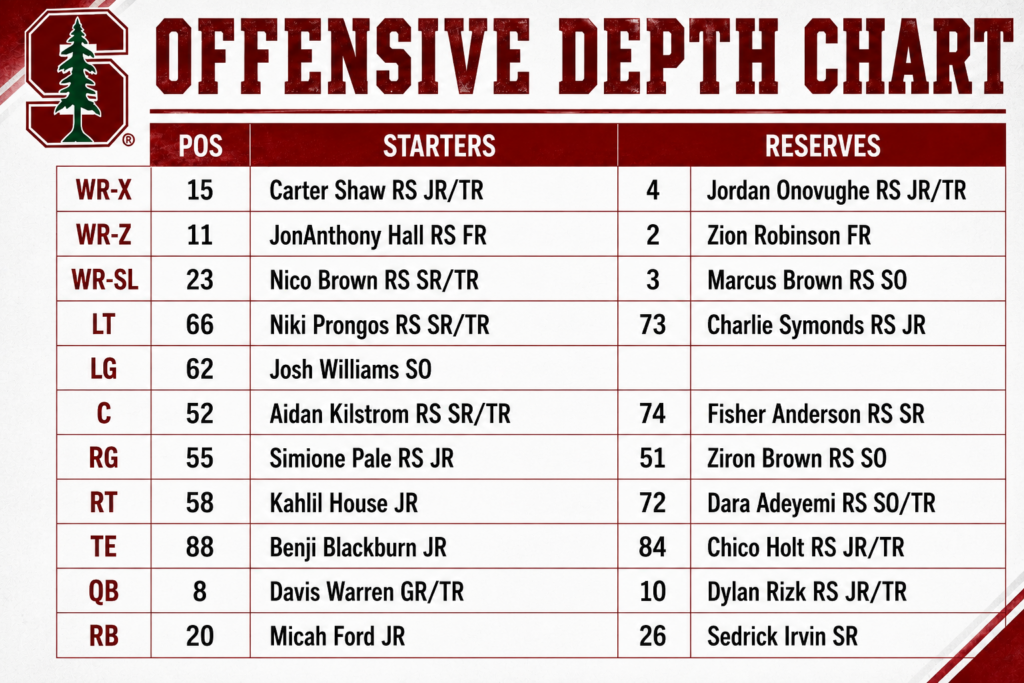
Stanford’s rebuild finally has a permanent direction. After the unusual circumstances surrounding the program in 2025, former Cardinal quarterback Tavita Pritchard is back on The Farm as head coach, tasked with rebuilding a program that has endured five consecutive losing seasons. His first major offensive decision was turning the team over to Michigan transfer Davis Warren, who gives Stanford an experienced Power Four quarterback and was one of the three players Pritchard brought with him to ACC Kickoff.
He’s a tough, experienced player, but Stanford needs efficiency more than hero-ball from him. The encouraging development is that we’ve already seen the offense produce: Stanford opened the season with a 37–27 victory over Hawai’i, giving Pritchard a win in his head-coaching debut.
Running back Micah Ford is particularly important. He entered the year as Stanford’s leading returning rusher and should be one of the focal points of an offense that needs to take pressure off Warren. Stanford simply hasn’t possessed enough consistent explosive playmaking in recent seasons, so establishing a physical rushing attack is critical.
That’s really my concern with this entire offense. There are competent pieces, but I don’t see enough high-end skill talent or proven line play to consistently win against the better defenses on Stanford’s schedule. Pritchard should improve the culture and organization of the program, but this remains a roster reconstruction rather than a finished product.
Defensive Outlook
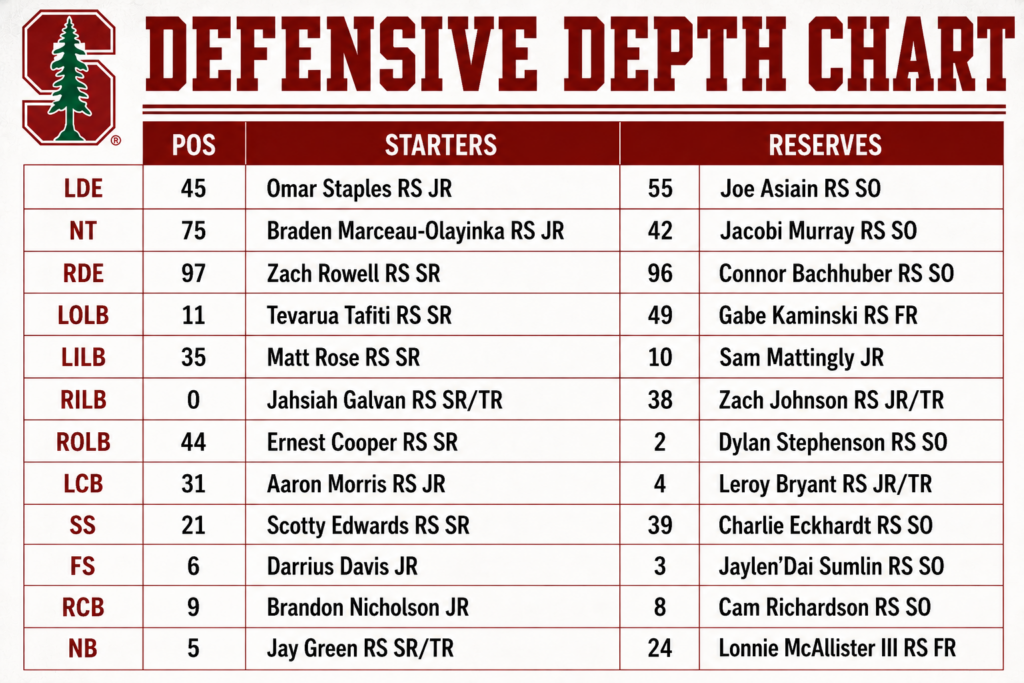
Defensively, Stanford has some pieces I find more interesting. Jay Green returns at safety after leading the Cardinal in both forced fumbles and pass breakups in 2025, making him one of the few established playmakers on a roster undergoing substantial change.
Pritchard’s challenge is building considerably more depth around players like Green. Stanford’s best teams under Jim Harbaugh and David Shaw were defined by physicality in the trenches, and the program has moved a long way from that identity. Reestablishing it isn’t something I expect to happen in one offseason.
The 37–27 win over Hawai’i was encouraging because Stanford immediately demonstrated enough offense to win a game even while surrendering 27 points. Against ACC competition, however, the defense is going to face much greater athleticism. Miami tonight represents the extreme version of that problem.
I expect Stanford to play hard and become more disciplined under Pritchard, but this defense still looks like one of the least talented units in the conference from top to bottom. There are individual players I like, but not enough proven depth for me to expect consistency over a nine-game ACC schedule.
Overview and Projection
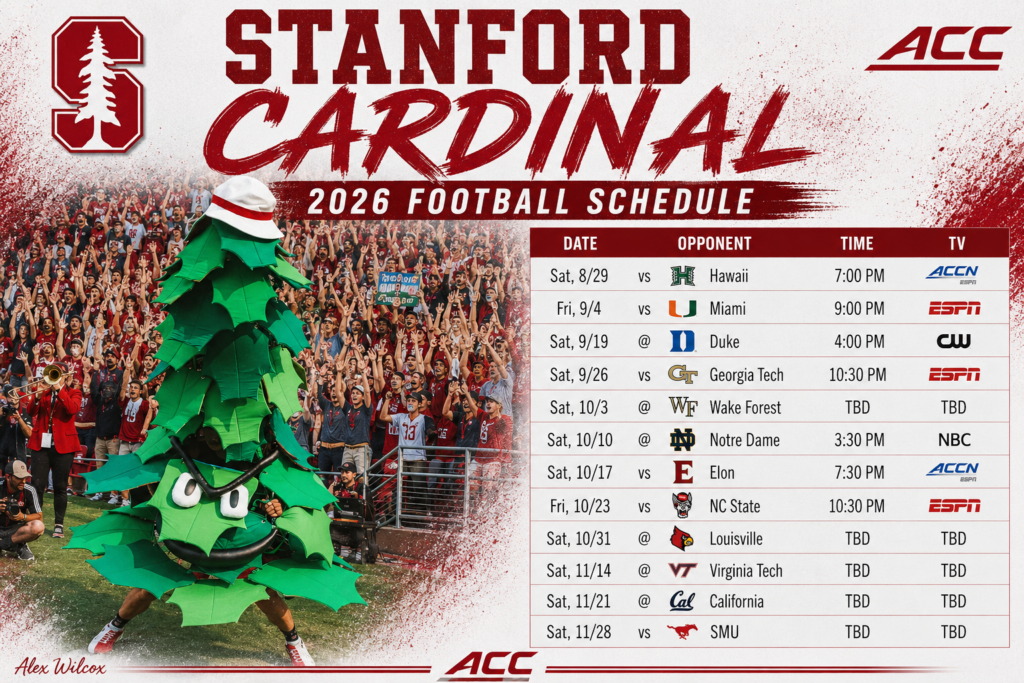
I’m sticking with our locked 2–10 overall and 0–9 ACC projection. The Hawai’i victory already accounts for one of those wins, and Elon is the other game I expect Stanford to win. There are potential upset opportunities against Wake Forest, Duke or NC State, but Stanford will be an underdog in the overwhelming majority of its conference schedule.
Stanford is one of those teams where the final record won’t necessarily tell us whether Year 1 was successful. Pritchard needs to establish an identity, improve recruiting and roster retention, and make the Cardinal competitive enough that tangible progress becomes visible. I don’t expect that to translate into many victories immediately. At 2–10 (0–9 ACC), Stanford finishes at the bottom of my ACC standings, but the more important question is whether Pritchard can finally give the program a foundation for climbing out of it.
Projected Record: 2-10 (0-9)
ACC Championship Game Projection: Miami 34, Louisville 17
Independents
Notre Dame Fighting Irish
Offensive Outlook
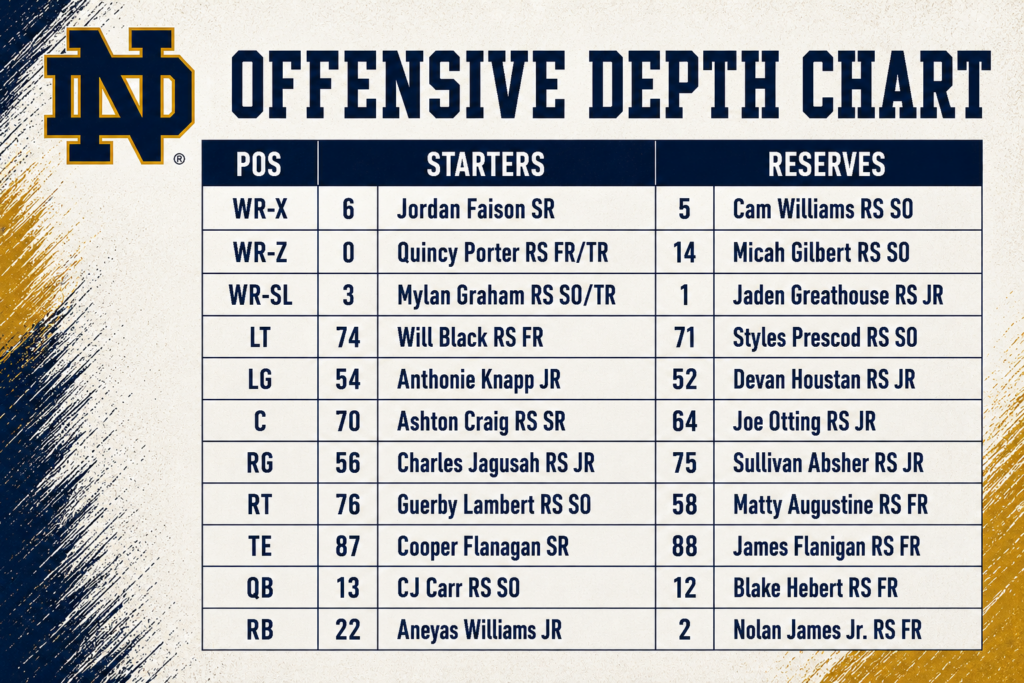
There might not be a more complete national-title contender in college football than Notre Dame, and the biggest reason I’m willing to go all the way to 12–0 is the return of CJ Carr. After winning the starting job as a freshman, Carr completed 195 of 293 passes for 2,741 yards and 24 touchdowns while leading an offense that averaged an incredible 42.0 points per game, second nationally. He now enters his second year as the starter as a legitimate Heisman candidate and one of the country’s premier quarterbacks.
The major offensive challenge is replacing the phenomenal backfield combination of Jeremiyah Love and Jadarian Price. Love rushed for 1,372 yards at 6.9 yards per carry last season, while Price added 674 yards at 6.0 per attempt. That’s more than 2,000 rushing yards walking out the door, and I don’t expect one player to simply reproduce Love’s impact.
But Notre Dame has recruited well enough to absorb losses like that. Aneyas Williams averaged 9.3 yards on his limited carries last season, while Nolan James Jr., Kedren Young and a talented collection of younger backs give Marcus Freeman options. It will probably be more of a committee than we’ve seen recently, but the offensive line should allow Notre Dame to remain committed to its physical identity.
Carr’s receiving corps gives me even more confidence. Jordan Faison returns as a veteran weapon, and Notre Dame has assembled considerable size and athleticism around him. With Mike Denbrock still coordinating the offense, Carr should be given more responsibility rather than Notre Dame asking its new running backs to immediately replace Love and Price.
That’s why I don’t anticipate a significant offensive regression. The running game may become less explosive, but Carr could be considerably better. If his development continues, Notre Dame can transition from an offense centered around an elite running back to one centered around an elite quarterback—and still remain among the country’s best.
Defensive Outlook
This is the side of the ball that makes my 12–0 projection feel realistic rather than overly ambitious. Notre Dame surrendered just 17.6 points per game in 2025, finishing 11th nationally in scoring defense. The Irish have lost important players, but the secondary has a legitimate argument as the best in college football entering the season.
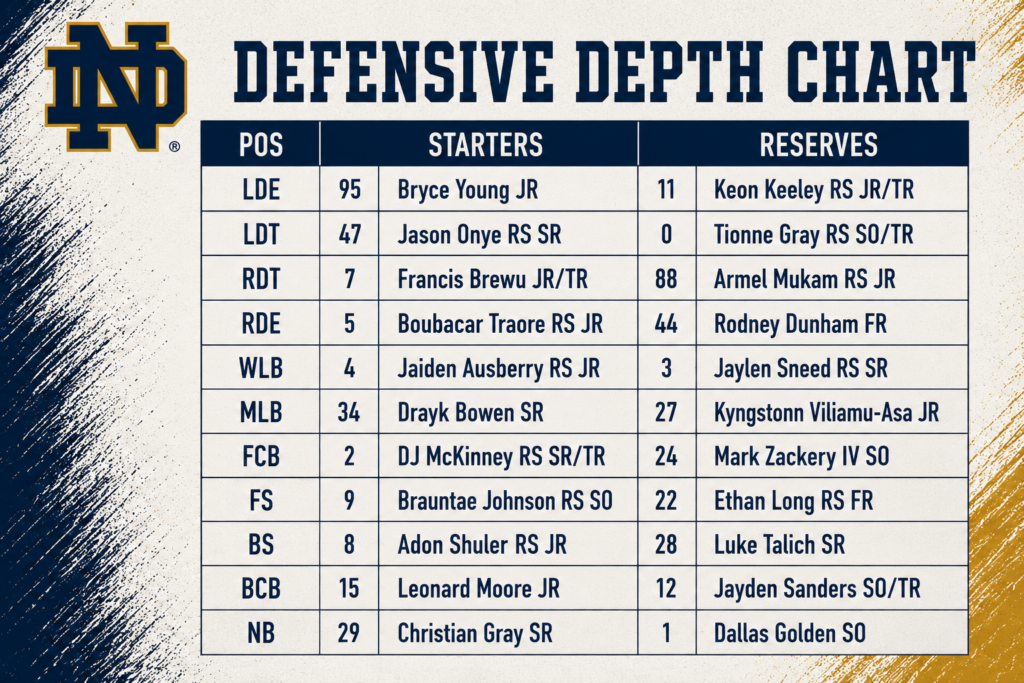
Everything starts with Leonard Moore. He enters 2026 as one of the premier cornerbacks in the country after finishing last season as PFF’s highest-graded player at the position. At a position where one elite player can effectively remove part of the field, Moore gives Notre Dame a massive advantage against the better passing offenses on its schedule.
There’s plenty around him, too. Notre Dame continues to recruit at an elite level defensively, and the roster has enough depth that Freeman can rotate players along the front rather than relying on one or two stars. Jaylen Sneed provides veteran experience at linebacker, while the secondary surrounding Moore gives defensive coordinator Chris Ash considerable flexibility.
Ash is another reason I’m comfortable with the defense. Notre Dame doesn’t need to reinvent itself. The Irish have established a defensive identity under Freeman built around physicality, coverage versatility and preventing explosive plays. Ash inherits a roster talented enough to maintain that standard.
There may be some early adjustment as the front seven settles into its rotation, but I don’t see an obvious weakness on this defense that opponents can consistently attack. With Moore anchoring an elite secondary and blue-chip talent throughout the depth chart, Notre Dame should once again field one of the best defenses in the country.
Overview and Projection
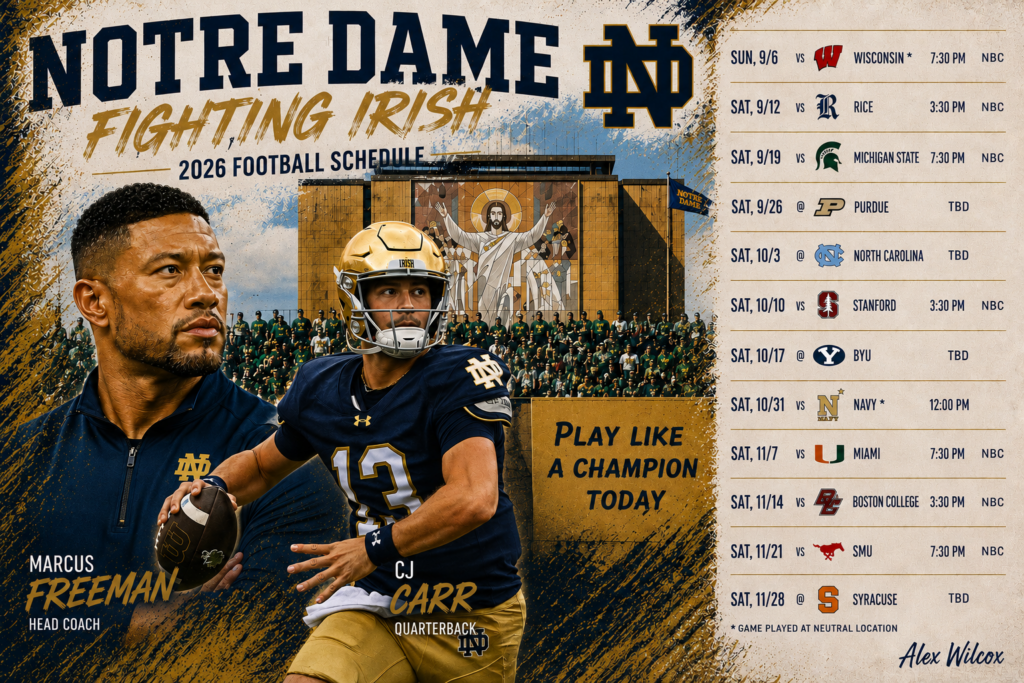
I’m projecting 12–0, making Notre Dame one of my strongest national-title contenders entering 2026. Carr takes another step toward becoming one of college football’s elite quarterbacks, the defense remains among the nation’s best, and the Irish survive the handful of games on the schedule capable of threatening an undefeated season.
Notre Dame has spent the Freeman era getting progressively closer to the summit. In 2026, I think the Irish finally arrive at the postseason without a blemish. A 12–0 regular season wouldn’t finish the job—this program will ultimately be judged by what happens in the College Football Playoff—but I expect Notre Dame to enter that tournament undefeated and with a very real chance to win its first national championship since 1988.