The Tale of the Tape
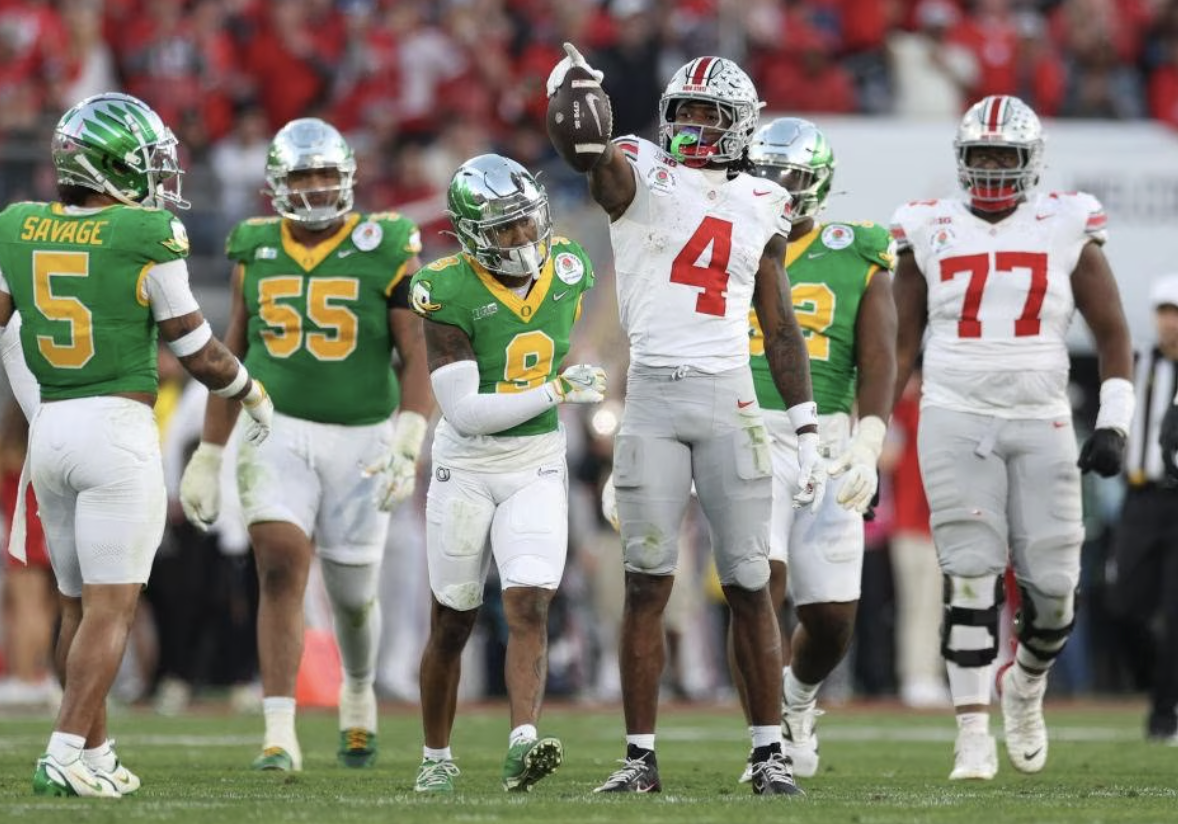
The Big Ten enters this season with a fascinating race at the top, as Ohio State, Oregon and reigning national champion Indiana all have legitimate championship aspirations. Even typing “reigning national champion Indiana” still feels surreal after the Hoosiers completed an unbelievable 16–0 season and captured the first national championship in program history. Curt Cignetti has built something unique to the history of American sports, while Ohio State remains the conference’s standard in terms of sheer talent. But as I look across the league, I keep coming back to Oregon. The Ducks have come agonizingly close since joining the Big Ten, and with Dante Moore returning to lead what may be Dan Lanning’s most complete roster yet, this feels like it could finally be Oregon’s year of destiny—the season when the Ducks break through, capture college football’s ultimate prize and add their name to the Big Ten’s remarkable championship run. We’ll see if they can finally do it, or if they will come up oh so short once again.
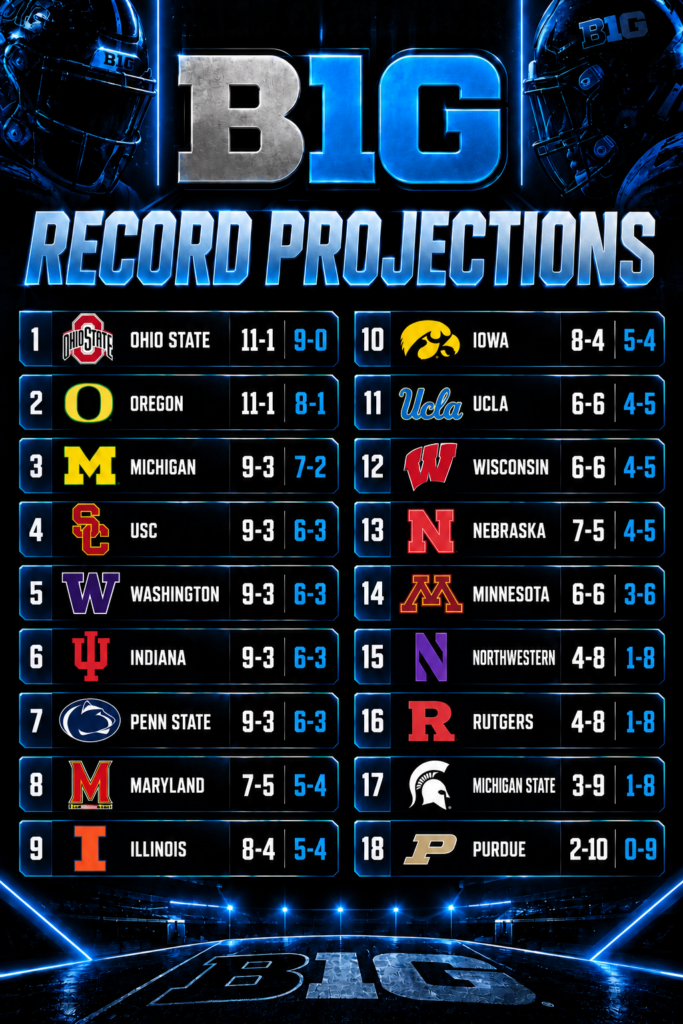
Ohio State and Oregon are the two most talented teams in this league. While it’s hard to project Cignetti and company to lose three times, I see more of a logjam behind the Buckeyes and the Ducks than a clear third best team. Indiana will certainly be a formidable foe that plays disciplined, tough football, but I think that the schedule is tough enough for them to lose three times. USC is a very talented team, but the schedule is a bear. The Wolverines will be rock solid in their first season under long time Utah bench boss Kyle Whittingham, but a loss to their arch rival in the final game of the season will keep them out of the playoff field.
Ohio State Buckeyes
Offensive Outlook
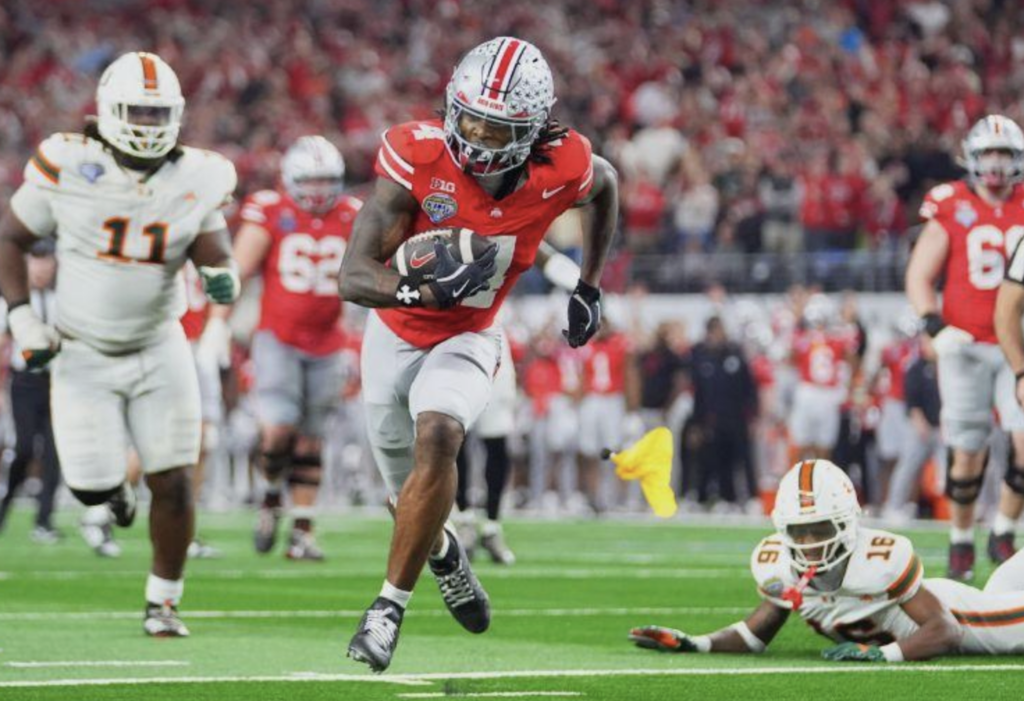
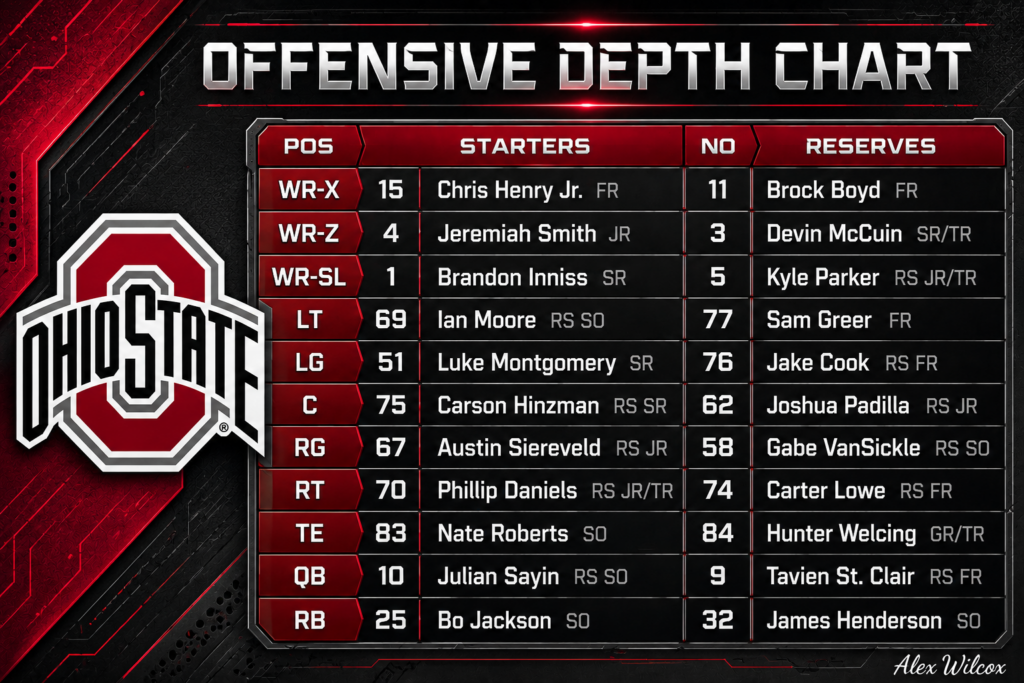
Ohio State enters 2026 with an offense that has a legitimate chance to be the best in college football. It starts with Julian Sayin, who was outstanding in his first season as the starter, completing an FBS-best 77.0% of his passes for 3,610 yards, 32 touchdowns and only eight interceptions while finishing as a Heisman Trophy finalist. Sayin now gets another year of development under Ryan Day and, more importantly, still gets to throw to arguably the best player in the sport in Jeremiah Smith. Through only two collegiate seasons, Smith already has 2,558 receiving yards and 27 touchdowns, both the most by any Big Ten receiver over his first two years. The departure of first-round pick Carnell Tate creates a significant opening opposite Smith, but Ohio State has no shortage of candidates, with veteran Brandon Inniss and five-star freshman Chris Henry Jr. among the players who should see expanded roles.
The biggest reason I believe this offense could be even more difficult to defend in 2026, however, is its potential for substantially better balance. Bo Jackson emerged as the Buckeyes’ lead back as a freshman and finished with 1,090 rushing yards, while Isaiah West gives Ohio State another explosive option in the backfield. New offensive coordinator Arthur Smith should place greater emphasis on the running game, and he inherits an offensive line with an abundance of continuity. Carson Hinzman, Luke Montgomery and Austin Siereveld are all major returning pieces, with all three appearing on the Outland Trophy preseason watch list, while four linemen with starting experience return overall. That experience is important because pass protection ultimately became Ohio State’s Achilles’ heel against Indiana and Miami at the end of last season. If the offensive line takes the expected step forward, there simply aren’t many obvious answers for a defense trying to simultaneously contain Sayin’s accuracy, Jackson’s running ability and Smith on the perimeter.
Defensive Outlook
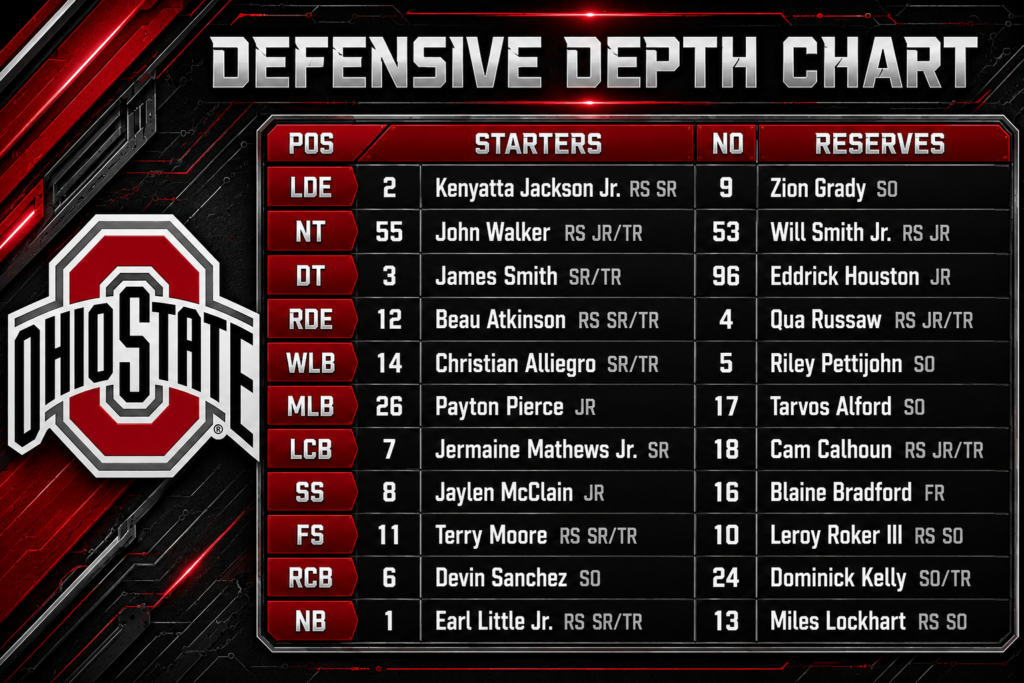
The defense presents more uncertainty, but that’s relative to an absurdly high standard. In Matt Patricia’s first season as defensive coordinator, Ohio State allowed only 9.3 points and 219.1 total yards per game, including just 129.7 passing yards and 89.4 rushing yards per game. The Buckeyes finished No. 1 nationally in scoring defense and surrendered only 4.0 yards per play. Replicating those numbers will be extremely difficult because the NFL took a massive chunk out of the unit. Ohio State lost seven defensive starters to the draft, including elite talents Caleb Downs, Sonny Styles and Arvell Reese, along with defensive linemen Caden Curry and Kayden McDonald.
There is still far too much talent here to expect anything resembling a defensive collapse. Kenyatta Jackson Jr., who recorded 6.5 sacks last season, gives Patricia an established pass rusher, while Eddrick Houston returns inside. Ohio State also attacked the portal, most notably adding former Alabama defensive tackle James Smith, edge defender Qua Russaw, linebacker Christian Alliegro, safety Terry Moore and nickel Earl Little Jr. The secondary could become the strength of the unit. Devin Sanchez has star potential at corner, Jermaine Mathews Jr. provides experience opposite him and Jaylen McClain returns at safety. McClain and linebacker Payton Pierce were both selected as preseason first-team All-Big Ten players.
The question isn’t whether Ohio State will have a good defense—it almost certainly will. The question is whether Patricia can turn an extremely talented but substantially reconstructed group into an elite defense quickly enough. That’s particularly important because the Buckeyes won’t have the luxury of spending half the season figuring things out. If the defensive front can replace the disruptive ability of last year’s NFL departures and the transfers integrate quickly, Ohio State has the personnel to field another top-tier unit. I wouldn’t expect another 9.3 points per game, but they don’t need to reproduce that historic level of dominance for this team to contend for a championship.
Overview and Projection
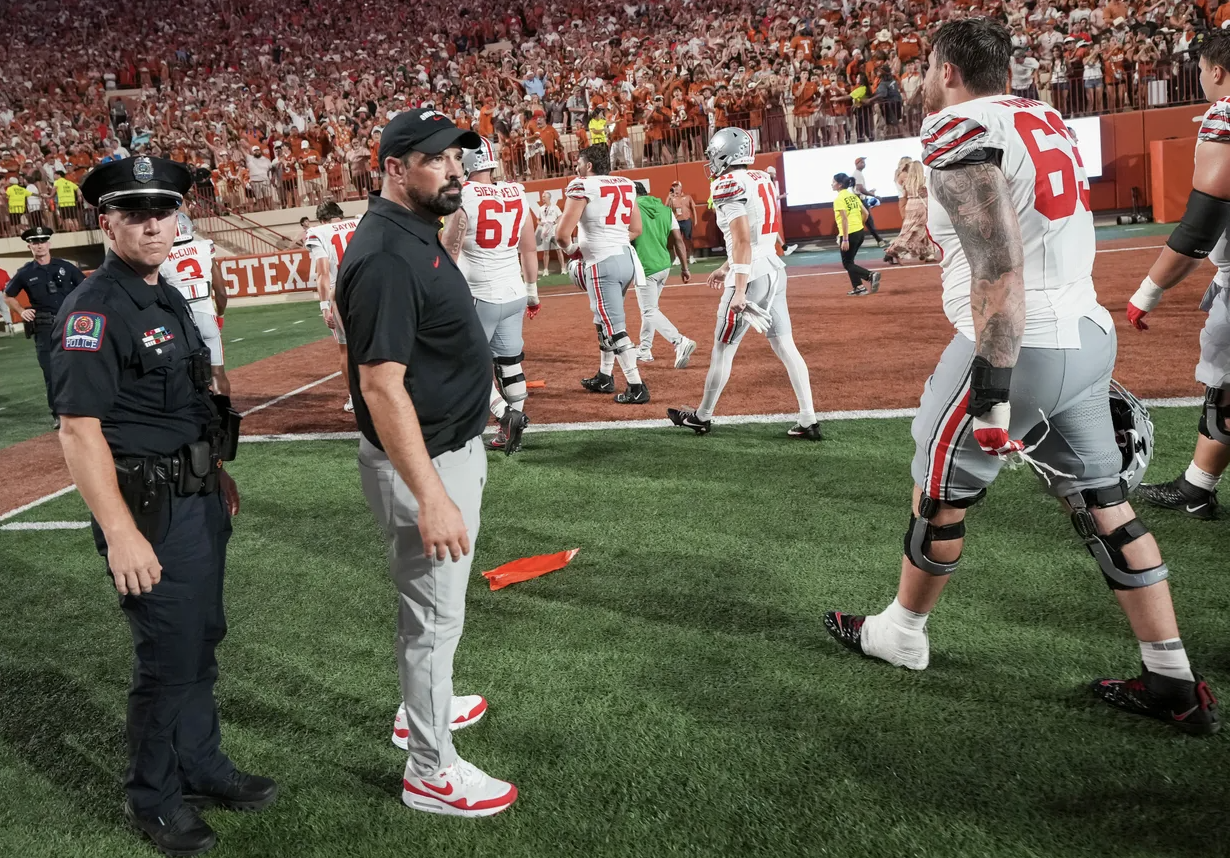
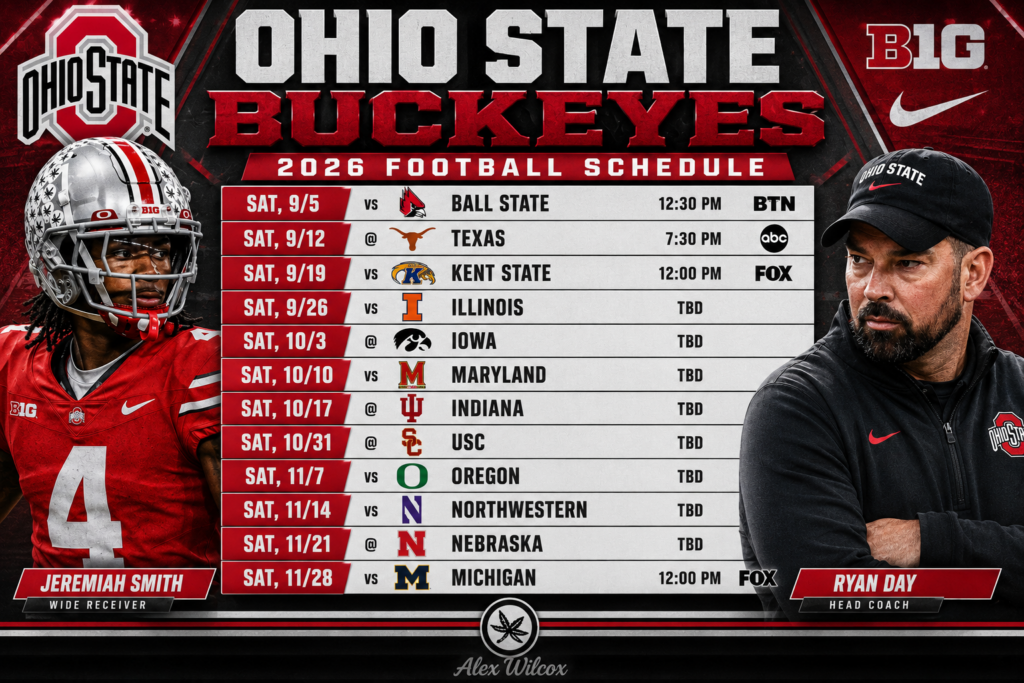
There may not be a more complete roster in college football, which is why Ohio State begins the season ranked No. 1 in the preseason AP and Coaches Poll. The ceiling is obvious: Big Ten champion and national champion. Sayin is a legitimate Heisman candidate, Smith is perhaps the most dominant individual player in college football, Jackson gives the offense the running threat it occasionally lacked last year, and the offensive line should be better equipped to survive elite defensive fronts. The variable separating Ohio State from simply being a playoff team and becoming the last team standing is Patricia’s rebuilt defense. If that group develops as expected, there are very few weaknesses to attack. I have Ohio State losing to Texas early, but ultimately going undefeated in Big Ten play and entering December as one of the primary favorites to win the national championship.
Projected Record: 11-1 (9-0)
Oregon Ducks
Offensive Outlook
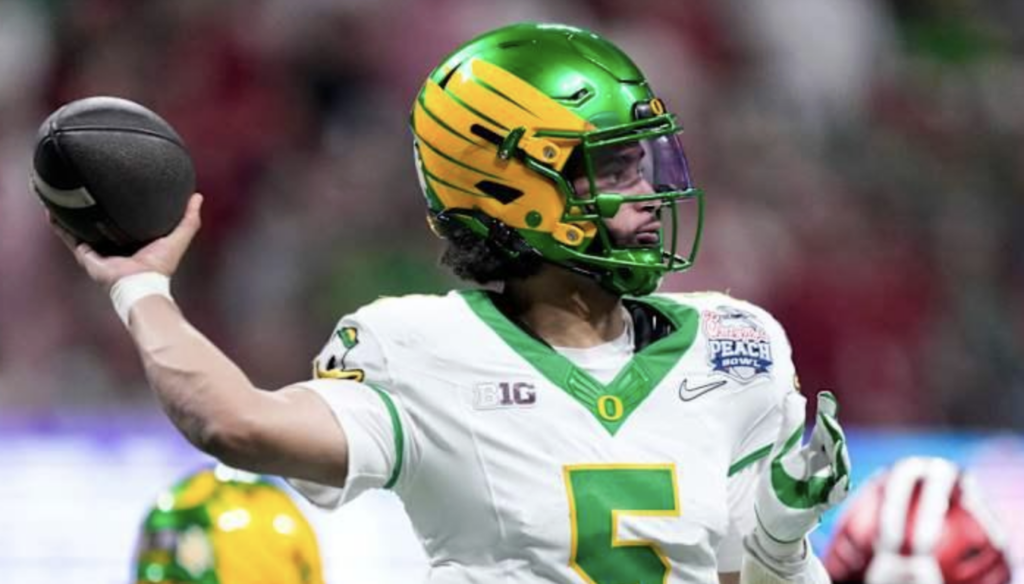
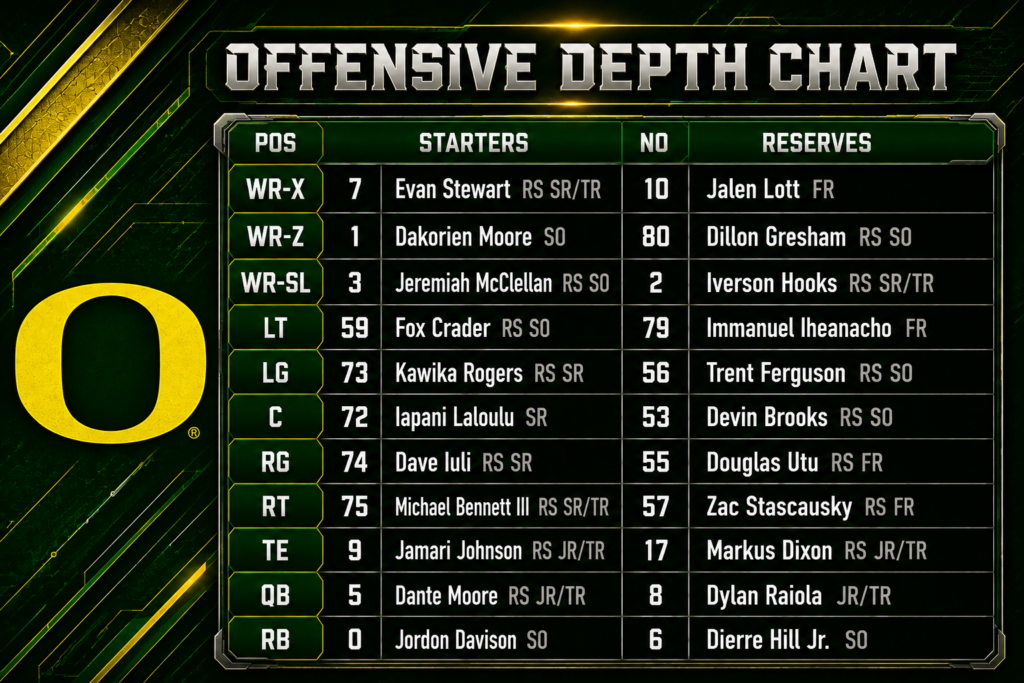
Oregon enters 2026 with almost everything necessary to field the best offense in college football, beginning with Dante Moore. Rather than become what many projected to be the No. 2 overall pick in the 2026 NFL Draft, Moore returned to Eugene specifically because he believes there is unfinished business. In his first full season as Oregon’s starter, Moore completed 71.8% of his passes for 3,565 yards, 30 touchdowns and 10 interceptions, leading the Ducks to a 13–2 record and the College Football Playoff semifinal. Moore has one of the strongest arms in college football, showed tremendous growth as a decision-maker last season and enters the year as a Heisman Trophy favorite.
The supporting cast is equally electric. Jordon Davison emerged as one of the country’s most dangerous young running backs as a freshman, rushing for 667 yards and 15 touchdowns on only 113 carries, while Dierre Hill Jr. gives Oregon another explosive option in the backfield. The Ducks averaged 198.6 rushing yards per game and 5.4 yards per carry last season, scoring 35 times on the ground. At receiver, Dakorien Moore has breakout-star potential, Jeremiah McClellan returns and Oregon gets former Texas A&M Aggie Evan Stewart back after he missed the entire 2025 season due of injury. Tight end Jamari Johnson is another player I expect to become significantly more prominent after catching 32 passes for 510 yards and three touchdowns behind Kenyon Sadiq last season.
There are departures to overcome—particularly the aforementioned Sadiq and some turnover along the offensive line—but center Iapani Laloulu returning rather than entering the NFL Draft is a big score for Lanning. Oregon averaged 36.9 points and 452.2 yards per game last season, gaining 6.9 yards per play, and there is an argument to be made that this year’s personnel is more dangerous. Moore’s return is the centerpiece, but the combination of an explosive running game, exceptional skill talent and Lanning’s relentless roster building leaves very few obvious weaknesses. If Moore takes another step in his pre-snap processing—the area he has specifically identified as something he wants to improve—Oregon could have the No. 1 offense in the country.
Defensive Outlook
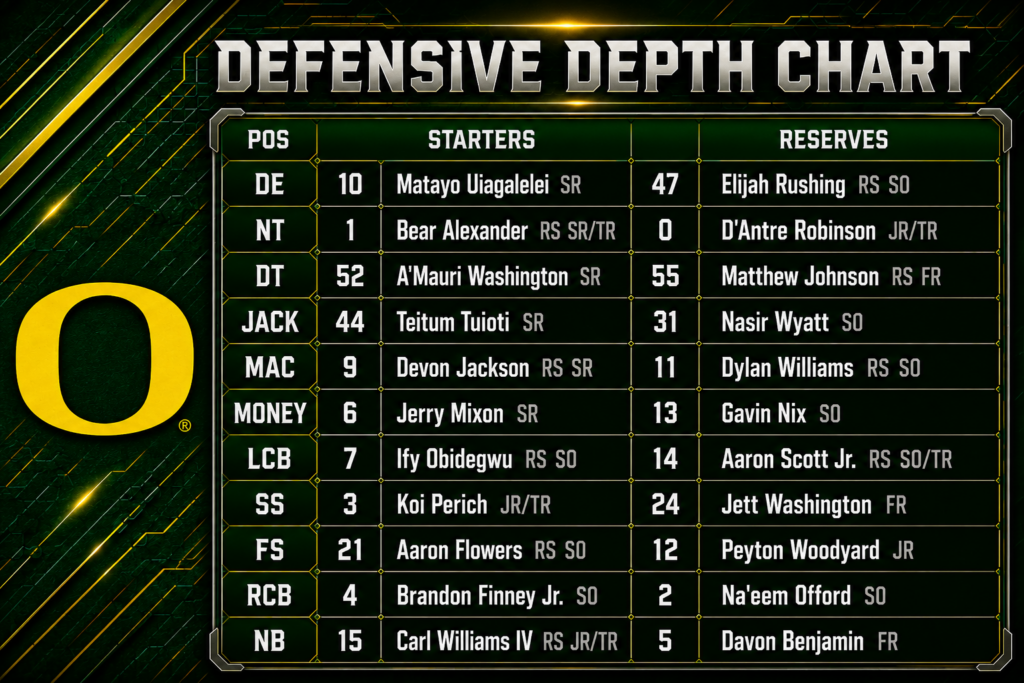
As tremendous as the offense is, Oregon’s defense is the reason I believe this team can win a national championship. The Ducks allowed only 17.9 points and 273.7 total yards per game last season, including just 157.9 passing yards per game, while holding opponents to 4.4 yards per play. Instead of watching that unit get gutted by the NFL, Lanning received a remarkable series of return announcements. Matayo Uiagalelei, Teitum Tuioti, Bear Alexander and A’Mauri Washington all elected to come back, essentially preserving the core of one of the best defensive fronts in college football. Washington is a preseason second-team Walter Camp All-American, Tuioti a first-team selection, and Washington, Alexander, Uiagalelei and Tuioti all appear on major preseason award watch lists.
That front should allow Oregon to control games without constantly committing additional defenders to the box. Jerry Mixon returns at linebacker, while cornerbacks Brandon Finney Jr. and Ify Obidegwu provide continuity on the back end. Finney enters the season as a preseason first-team Walter Camp All-American. The major loss in the secondary is first-round NFL Draft pick Dillon Thieneman, but Oregon found one of the best possible replacements through the portal in former Minnesota safety Koi Perich. Perich recorded 83 tackles in 2025 and arrives as one of the most accomplished defensive transfers in the country; Oregon already has him among its Big Ten preseason honorees and Jim Thorpe Award candidates.
Dan Lanning has built this defense, and this defensive line in particular, to resemble the elite SEC units he coached at Georgia. This is unquestionably his deepest, nastiest defense in his tenure in Eugene. There will be some new responsibilities at linebacker and safety, but the combination of returning production, high-end transfers and elite recruiting gives Oregon remarkably few vulnerabilities. I expect this defense to rank among the nation’s best, and I would not be surprised if the defensive front becomes the defining strength of the entire team.
Overview and Projection
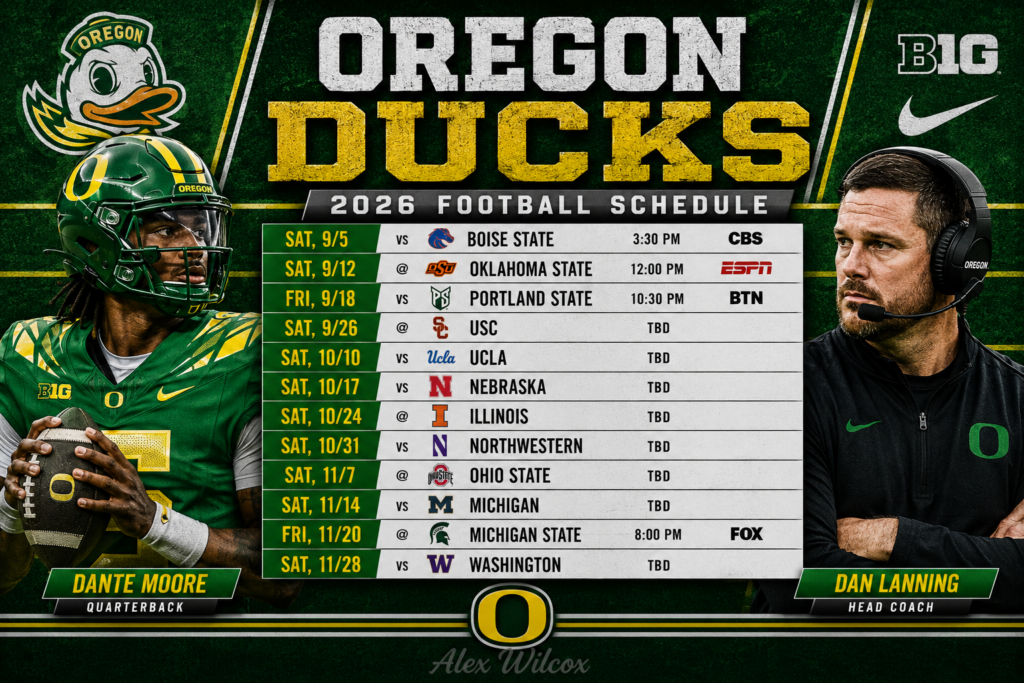
Oregon has already come painfully close under Dan Lanning multiple times. The Ducks went 13–2 last season and reached the CFP semifinal, with their season ultimately ending against eventual national champion Indiana. Moore could have left for the NFL and potentially become one of the first players selected; instead, he returned because he wants to help Oregon win its first national championship. Several of his most talented teammates made the same choice. There is a sense of unfinished business surrounding this roster that is difficult to ignore. I have Oregon losing 1 Big Ten contest on the road at Ohio State, but winning out otherwise, reaching the Big Ten Championship Game and entering the College Football Playoff as one of the handful of teams truly capable of winning it all.
Projected Record: 11-1 (8-1)
Michigan Wolverines
Offensive Outlook
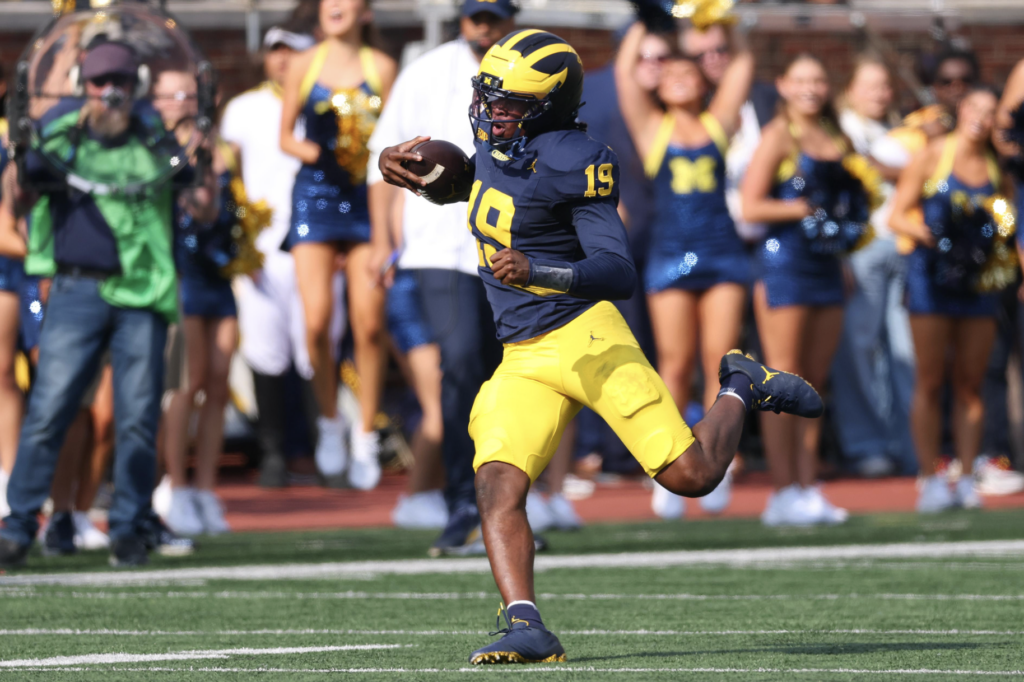
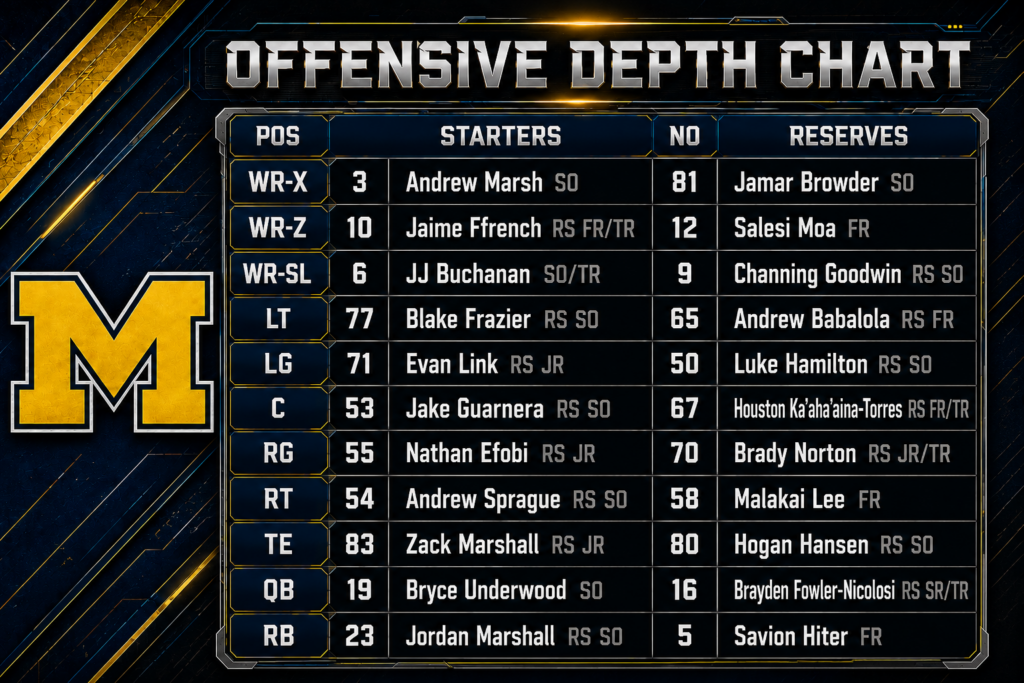
Exit Sherrone Moore, Enter Kyle Whittingham. And to Whittingham and new OC Jason Beck’s delight, welcome back Bryce Underwood. Underwood’s freshman season was uneven but encouraging: he completed 60.3% of his passes for 2,428 yards, 11 touchdowns and nine interceptions, while adding 392 rushing yards and six touchdowns with his legs. Those aren’t superstar numbers yet, but the physical talent remains exceptional. At 6-foot-4 and 230 pounds with a massive arm and legitimate running ability, Underwood possesses tools very few quarterbacks in the country can match. The transition to Jason Beck’s play-calling style could be exactly what unlocks him. Beck is implementing a heavier RPO system designed to utilize Underwood’s mobility, simplify some of his reads and create more opportunities for him to make plays outside the structure of the offense.
Michigan also has the personnel to take pressure off its young quarterback. Jordan Marshall returns to lead a deep running back room after Michigan averaged 210.2 rushing yards per game and 5.4 yards per carry in 2025. He’ll be joined by five-star freshman Savion Hiter, the nation’s top-ranked running back recruit, while Bryson Kuzdzal gives Michigan three-deep quality after producing a 100-yard, three-touchdown performance against Maryland last season.The Wolverines should once again be able to lean heavily on the run, but the real difference needs to come through the air. Michigan averaged only 186.8 passing yards per game and scored just 11 passing touchdowns all season in 2025. Andrew Marsh gives Underwood a returning playmaker, while 6-foot-4 JJ Buchanan adds size and another potential breakout target.
The offensive line remains central to Michigan’s identity. Blake Frazier, Jake Guarnera and Andrew Sprague are among the returning pieces, and the Wolverines have enough depth to continue using the sixth-offensive-lineman packages that became a major part of the offense last season. This is still going to look like Michigan football under new head coach Kyle Whittingham—physical, run-oriented and built around controlling the line of scrimmage—but Beck should bring considerably more creativity than Michigan showed offensively a year ago. The entire ceiling of the unit comes back to Underwood. If he develops from an extremely gifted freshman into one of the Big Ten’s better quarterbacks, Michigan’s offense could make one of the largest jumps in the conference.
Defensive Outlook
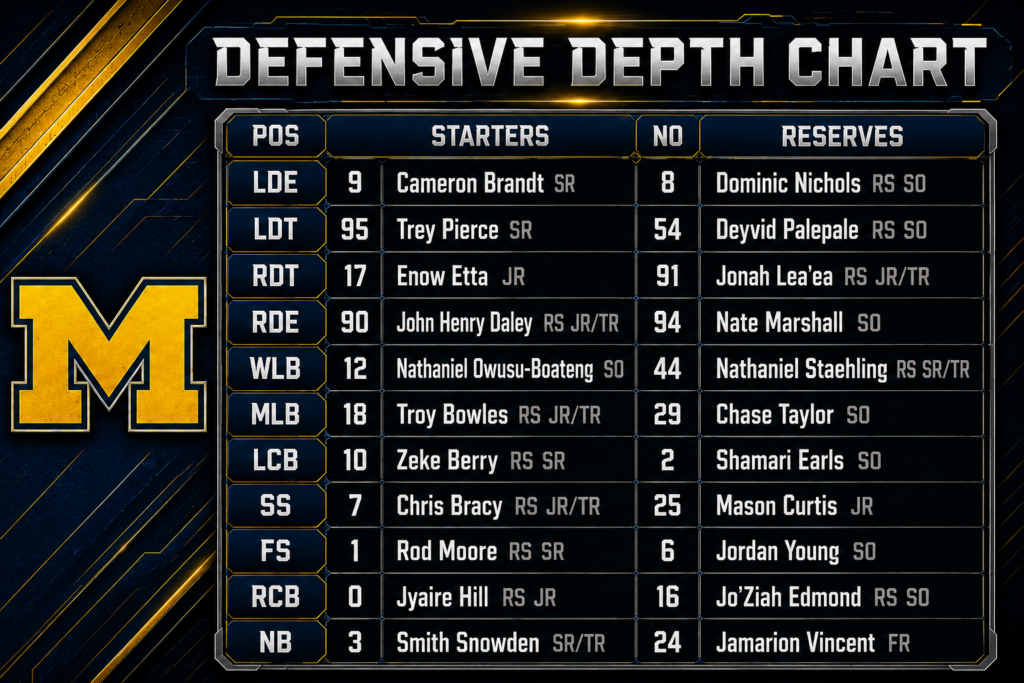
Michigan’s defense was much better than its offense in 2025, allowing 20.4 points and 323.3 yards per game while holding opponents to only 111.9 rushing yards per game and 3.4 yards per carry. But much like Ohio State, Michigan has significant NFL production to replace. The Wolverines lost pass rusher Derrick Moore, who became a second-round pick of the Detroit Lions, and several other veterans from last year’s defense. With that being said, Whittingham inherited enough established pieces—and supplemented them aggressively enough—that I still expect Michigan to field one of the better defenses in the conference.
The most important returner might be Rod Moore. After an injury-plagued stretch of his career, the veteran safety is back for another season and was voted a captain for the third time, the first player in Michigan history to receive that distinction. Moore provides experience and leadership to a secondary that also features Jyaire Hill, Zeke Berry, Smith Snowden, Shamari Earls and Jacob Oden. That’s a deep collection of defensive backs, and Whittingham’s history of producing disciplined, aggressive defenses should make the secondary almost a sure thing.
The bigger question is up front. Enow Etta needs to take a significant step at defensive tackle, while Michigan added former Utah edge defender John Henry Daley, a 6-foot-5, 252-pound pass rusher who should immediately factor into the rotation. Cam Brandt, Dom Nichols, Nate Marshall and a collection of highly recruited younger players give Michigan options, but the Wolverines don’t enter the season with the same collection of proven defensive-line stars they have possessed in recent years. That makes the development of the front seven one of the biggest variables on the entire roster. Still, Kyle Whittingham is one of the coaches I trust most to maximize defensive personnel. Michigan may not have the most talented defense in the conference on paper, but I expect it to be physical, structurally sound and extremely difficult to run against.
Overview and Projection
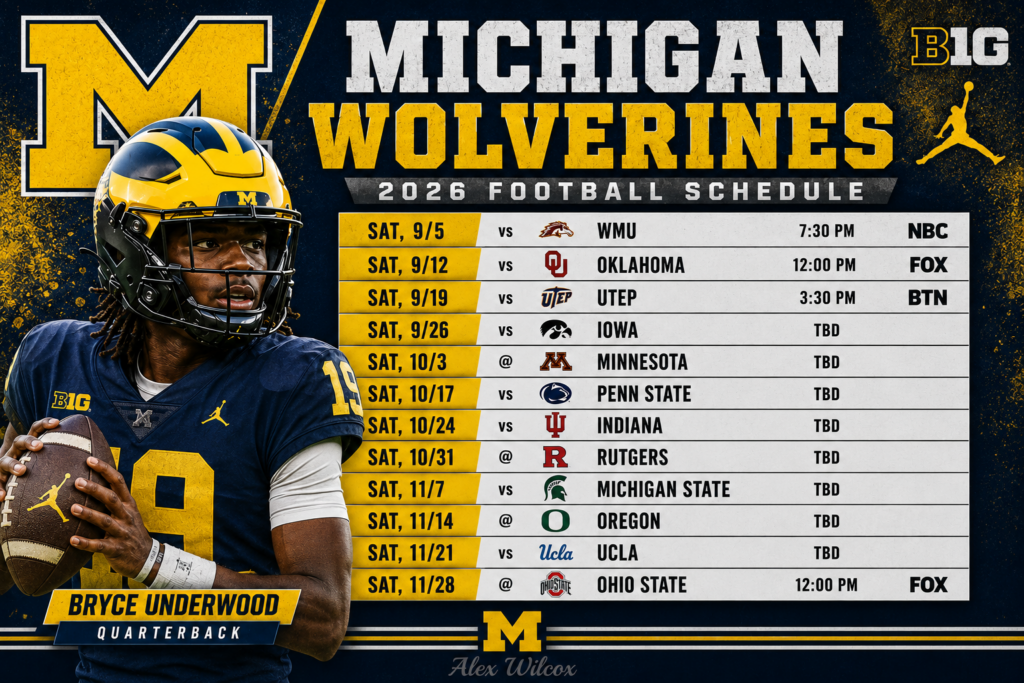
Michigan is one of the hardest teams in the Big Ten to project because of the range of outcomes. There is a version of this season where Underwood makes a massive sophomore leap, Whittingham immediately establishes his culture, the defense reloads and Michigan becomes a College Football Playoff contender. There is also a version where the passing game remains inconsistent, the defensive front takes a step backward and an unforgiving November schedule exposes the roster’s remaining weaknesses.
Ultimately, this season is about whether Bryce Underwood can begin becoming the player everyone envisioned when he arrived in Ann Arbor. Michigan already has the running game, offensive-line philosophy and defensive identity necessary to win high-level Big Ten games. What it hasn’t consistently had is an explosive passing attack capable of changing the geometry of a defense. If Beck unlocks that dimension and Underwood takes the sophomore leap his talent suggests is possible, 9–3 could prove conservative. But with Oregon and Ohio State both waiting on the road in November, I’m sticking with 9–3 and 7–2 in conference play—a meaningful first season for Whittingham and a year that positions Michigan to become an even more serious championship threat as Underwood continues to develop.
Projected Record: 9-3 (7-2)
USC Trojans
Offensive Outlook
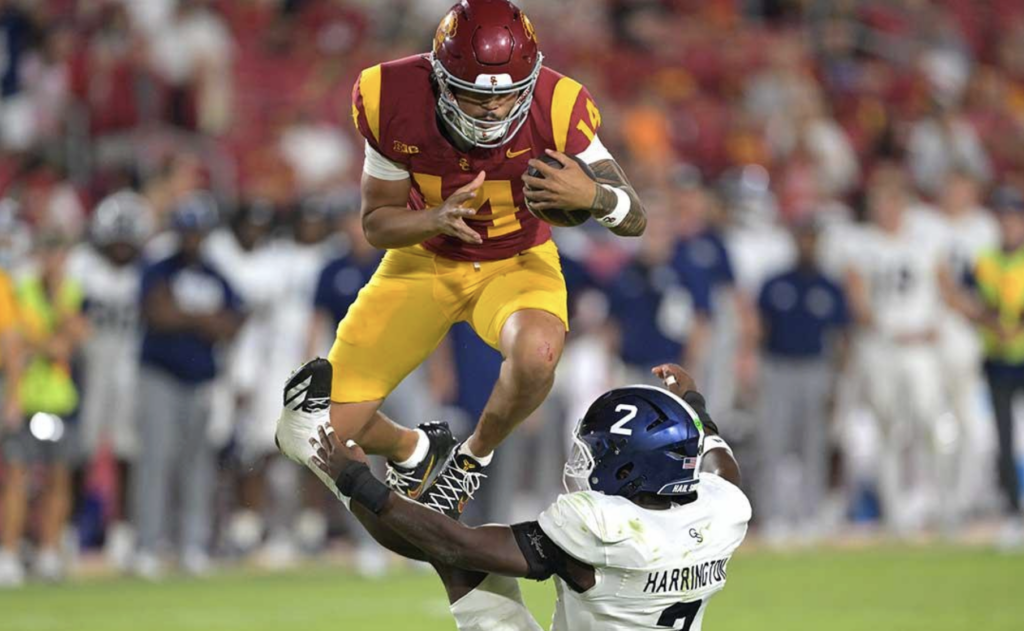
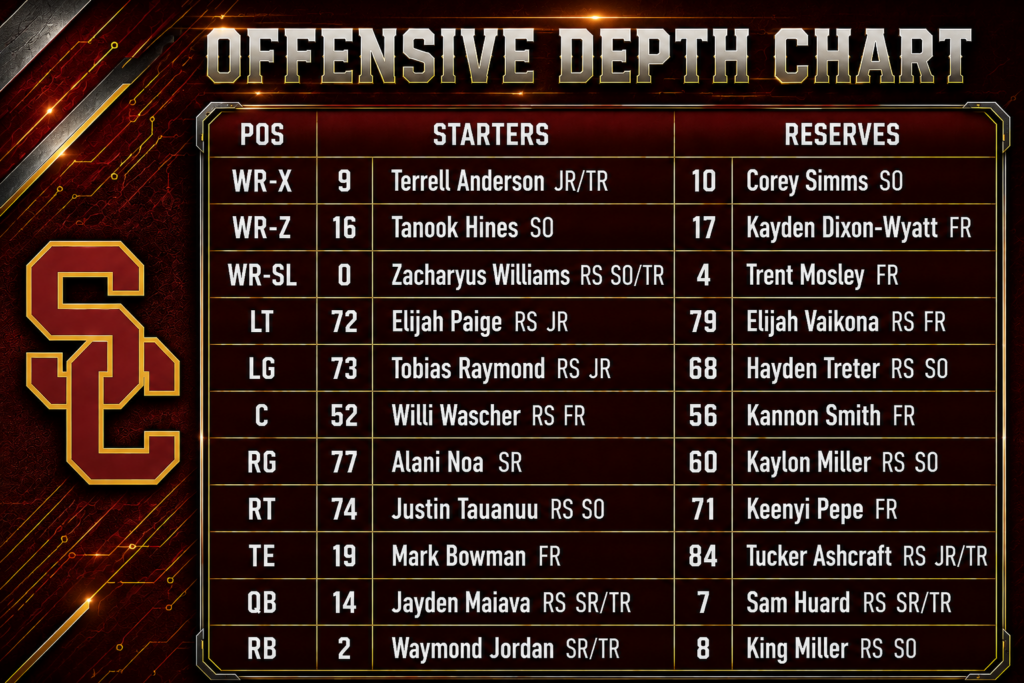
The Trojans are undoubtedly at a crossroads in 2026. With that being said, they will continue to boast an offense among the Big Ten’s best thanks to Lincoln Riley and Jayden Maiava. Maiava took a substantial step forward last season, completing 65.8% of his passes for 3,711 yards, 24 touchdowns and 10 interceptions, while adding six rushing touchdowns. Most impressively, he finished No. 1 nationally with a 91.2 QBR. He now enters his second full season as USC’s starter with 31 career starts, and there aren’t many quarterback-head coach combinations in the country I trust more offensively than Maiava and Lincoln Riley. USC averaged 35.8 points, 465.5 yards and an outstanding 7.1 yards per play last season, and the Trojans converted more than 51% of their third downs.
The challenge is replacing Makai Lemon, and that shouldn’t be understated. Lemon won the 2025 Biletnikoff Award before becoming the 20th overall pick in the NFL Draft, taking an elite No. 1 receiver away from Maiava. USC will replace him by committee with a young but extremely talented receiver room featuring Corey Simms, Tanook Hines, Trent Mosley, Kayden Dixon-Wyatt, Zacharyus Williams and five-star freshman Ethan “Boobie” Feaster. The current depth chart illustrates just how young this group is—USC doesn’t list a senior among its top six outside receivers. That creates uncertainty, but it also gives Riley a collection of explosive athletes he can develop around an established quarterback. I particularly expect one of USC’s highly regarded young receivers to emerge as a national name by midseason.
The running game provides more stability. USC rushed for 169.5 yards per game and 5.1 yards per carry last season, and King Miller returns after emerging as the Trojans’ showcase back. He’s joined atop the depth chart by Waymond Jordan, giving USC a powerful one-two combination. Up front, Elijah Paige, Hayden Treter, Tobias Raymond, Alani Noa and Justin Tauanuu currently comprise the starting offensive line, with Paige and Noa providing the bulk of the experience. The larger point is continuity: USC brought back 17 starters, the most in the Big Ten, while its portal additions arrived with 56 combined career starts. With Maiava operating Riley’s offense behind an increasingly mature line, I don’t expect the loss of Lemon to prevent USC from again producing one of college football’s most explosive attacks.
Defensive Outlook
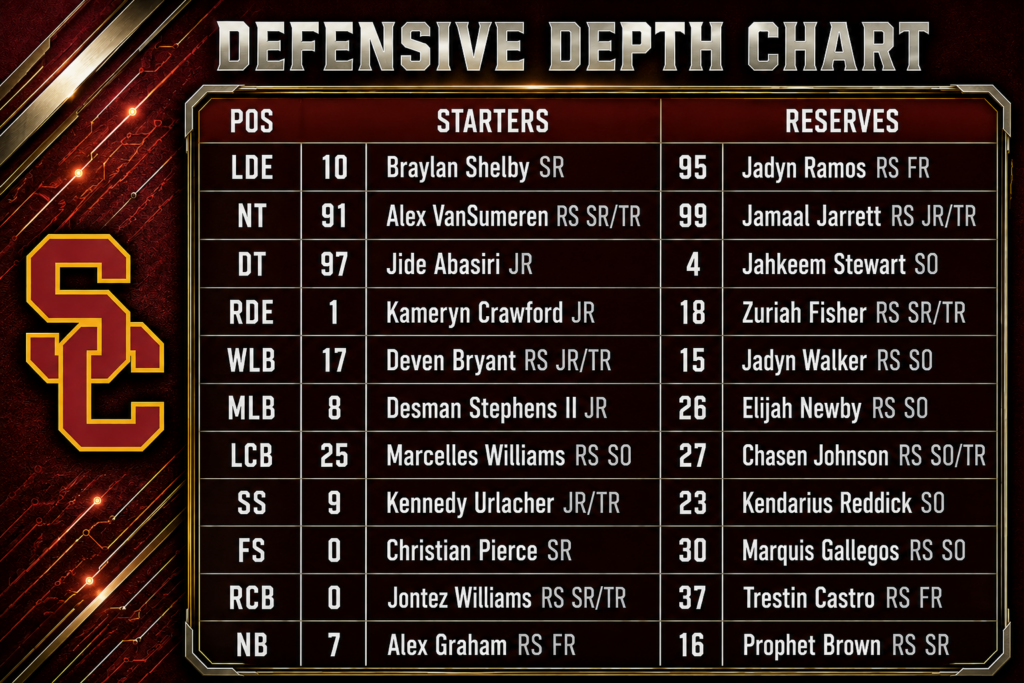
This is where USC’s season—and perhaps the direction of the Lincoln Riley era—will be decided. The Trojans made some progress defensively in 2025, allowing 23.0 points and 350.8 yards per game while holding opponents to 5.5 yards per play. USC was especially improved against the pass, allowing only 207.5 passing yards per game, and intercepted 12 passes. Those aren’t dominant numbers, but they’re a long way from the defensive performances that undermined Riley’s early USC teams. Now Riley has made perhaps his most fascinating staff move yet by hiring legendary former TCU head coach Gary Patterson as defensive coordinator. Patterson won 181 games at TCU and built his reputation around aggressive, adaptable defenses.
More importantly, Patterson actually has personnel to work with. Jide Abasiri returns as the veteran leader of the defensive line after recording 26 tackles, four tackles for loss and 3.5 sacks last season. USC also added former Michigan State defensive tackle Alex VanSumeren, who produced 52 tackles in 2025, while sophomore Floyd Boucard gives the interior another high-upside piece. And then there is freshman defensive end Luke Wafle, one of the crown jewels of USC’s loaded recruiting class. Wafle recorded an absurd 23 sacks and 37 tackles for loss as a high school senior and has already climbed all the way to the top of USC’s opening depth chart. That’s an enormous statement about both his talent and USC’s willingness to play its young stars immediately.
The secondary is similarly intriguing. Christian Pierce provides veteran leadership at safety, while former Notre Dame safety Kennedy Urlacher adds another experienced option and redshirt freshman Alex Graham brings major upside. Patterson’s defense will retain elements of his famous 4-2-5 structure while incorporating concepts USC already executed well last season, rather than simply installing his old TCU playbook wholesale. That adaptability matters. USC doesn’t need to become the 2009 TCU defense overnight; it simply needs to turn an improving unit into a consistently good one. Riley has already demonstrated that he can produce championship-level offenses. If Patterson can push this defense from average-to-good into the top tier of the Big Ten, USC’s ceiling changes dramatically.
Overview and Projection
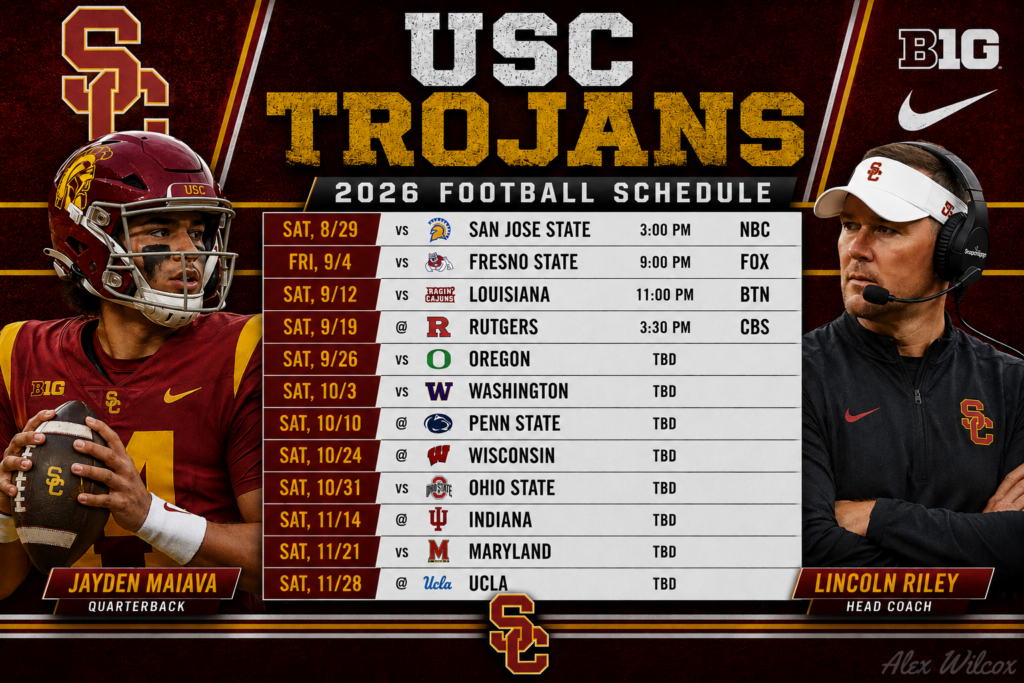
USC is one of my favorite teams in the Big Ten, and the country, but the schedule is brutal enough that I’m stopping short of predicting a full-fledged championship breakthrough. My projection is 9–3 overall and 6–3 in the Big Ten, which would keep USC firmly in the upper tier of the conference and potentially in the College Football Playoff discussion depending on where those losses occur. The September 26 Oregon game is particularly fascinating because it’s in Los Angeles. If USC starts 4–0 as expected and beats Oregon at the Coliseum, the entire national perception of this team changes overnight. The same applies when Ohio State visits on Halloween.
Ultimately, I believe this is the most important season of Lincoln Riley’s career. The roster is now deeper, the recruiting operation has taken a major step forward, Maiava is one of the best quarterbacks in America, and Patterson gives Riley an accomplished defensive mind with enough talent to make a genuine difference. The excuses are disappearing. 9-3 this season, with this slate, would keep the critics off of his back for one more season… and might just be good enough for a trip to the College Football Playoff depending on how the other conferences shake out.
Projected Record: 9-3 (6-3)
Washington Huskies
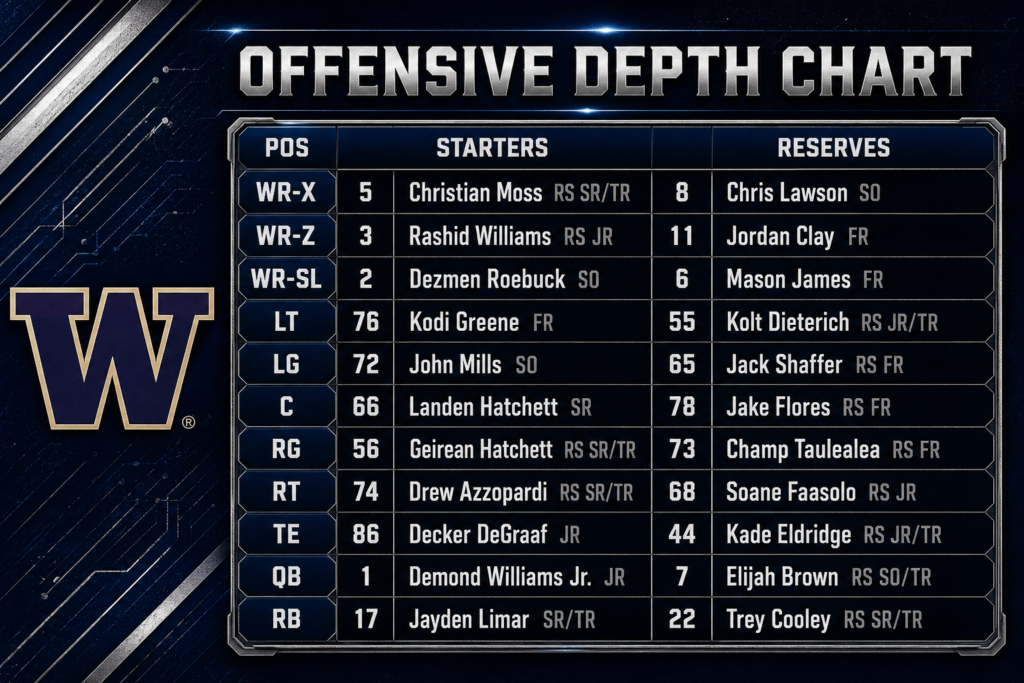
Offensive Outlook
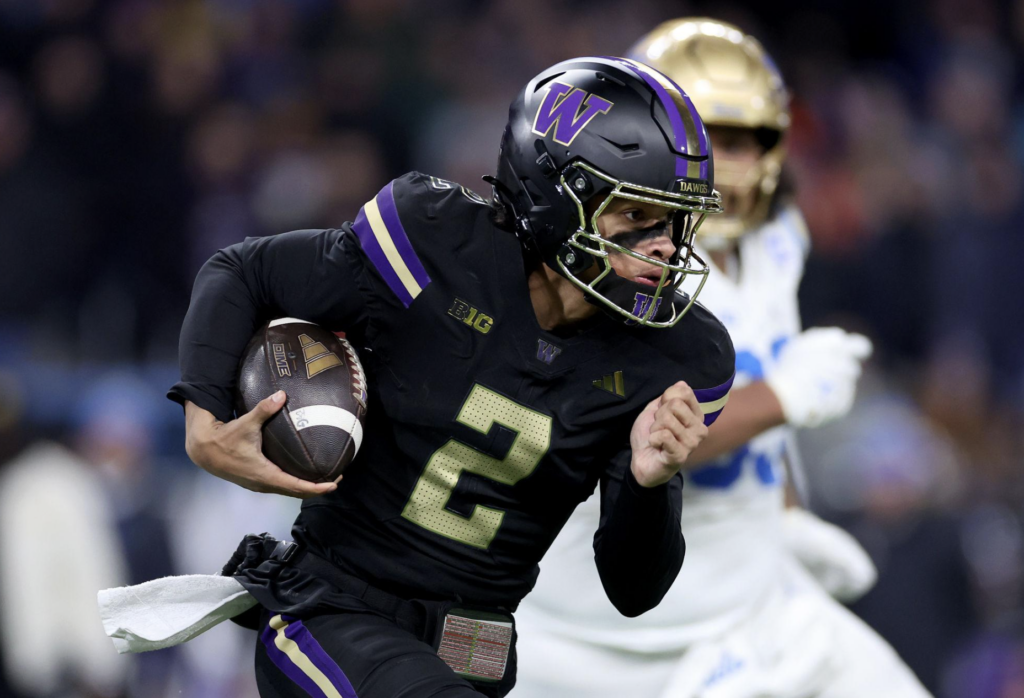
The Huskies enter 2026 as one of the teams I believe have a real chance to outperform its broader preseason expectations, and the chief reason is Demond Williams Jr. Williams made the leap Washington needed in his first full season as the starter, completing 69.5% of his passes for 3,065 yards, 25 touchdowns and eight interceptions while earning honorable mention All-Big Ten recognition. His dual-threat ability makes him even more dangerous than those passing numbers suggest. Against Rutgers, Williams became just the 16th quarterback in FBS history to throw for 400 yards and rush for 100 in the same game, setting Washington’s single-game total-offense record with 538 yards. I think Williams enters 2026 with a chance to establish himself as one of the conference’s premier players. He is already on the Maxwell, Davey O’Brien, Johnny Unitas Golden Arm and Manning Award preseason watch lists.
The challenge is that Williams will be operating without Denzel Boston, who was an integral part of Washington’s passing game, meaning Jedd Fisch needs a new hierarchy to emerge at receiver. Washington has recruited aggressively at the position, and the 2026 class includes Jordan Clay, Trez Davis and Mason James, giving the Huskies several talented young options to develop around their quarterback. The larger story of Washington’s recruiting is important here: Fisch signed what the school describes as its highest-ranked recruiting class of the modern era, a 25-player group that upgraded the athletic ceiling throughout the roster. Freshman tackle Kodi Greene, a 6-foot-6, 320-pound Mater Dei product, is already on the Shaun Alexander Freshman of the Year watch list and could become an important piece of the offensive line immediately.
What encourages me most is the trajectory of the offense under Fisch. Washington went from 104th nationally in scoring offense in 2024 to 17th in 2025, while its red-zone offense jumped from 104th to seventh and its third-down offense from 101st to 10th. That’s meaningful development rather than simply statistical noise. Fisch is an offensive coach, Williams is now an experienced third-year quarterback, and Washington’s overall talent level is beginning to resemble what Fisch envisioned when he took the job. There are legitimate questions about replacing established skill production and incorporating young players up front, but Williams gives Washington an enormous margin for error. If the young receiving corps develops quickly, this offense has the potential to be one of the Big Ten’s most explosive units.
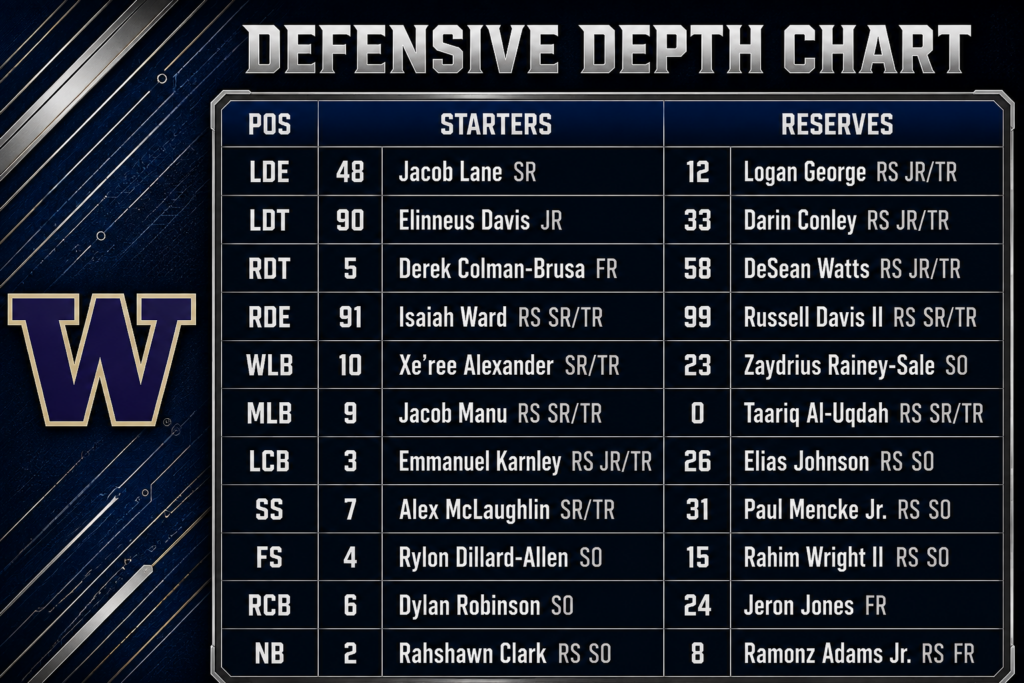
Defensive Outlook
Washington’s defensive improvement in 2025 was arguably just as impressive. The Huskies finished inside the top 15 nationally in both scoring defense and rushing defense, and remarkably never allowed more than 26 points in a game all season. That’s an encouraging foundation because Washington isn’t trying to build a competent defense from scratch anymore. The question is whether the Huskies can replace departed veterans while continuing to raise the talent level enough to hold up against the elite teams on their schedule.
Xe’ree Alexander is the player I expect to become the face of the unit. He played all 13 games last season, finished second on the team with 70 tackles and five tackles for loss, and closed the year by earning defensive MVP honors in Washington’s 38–10 LA Bowl victory over Boise State. In that game alone, Alexander produced seven tackles, a sack, an interception and two pass breakups. He’s now on the preseason Butkus Award watch list. Washington also has intriguing young talent throughout the defense, and Fisch’s recruiting class added players such as edge defender Derek Colman-Brusa, defensive lineman JD Hill, linebackers Ramzak Fruean and a collection of highly regarded defensive backs including Rylon Dillard-Allen, Dylan Robinson, Rashawn Clark and Jeron Jones.
This is where Washington’s long-term rebuild under Fisch is beginning to become visible. The Huskies had enough quality veteran players to field a good defense last season, but the recruiting operation is now adding the type of depth necessary to survive a nine-game Big Ten schedule. I don’t necessarily expect Washington to again go an entire regular season without allowing 27 points—the back half of this schedule makes that an extraordinarily difficult standard—but I do expect the defense to remain good enough that Williams doesn’t have to win shootouts every week. That’s important because Washington doesn’t need an elite defense to become a dangerous team; it needs a defense capable of keeping games within Williams’ reach. Based on the improvement we saw last season, I believe it can do that.
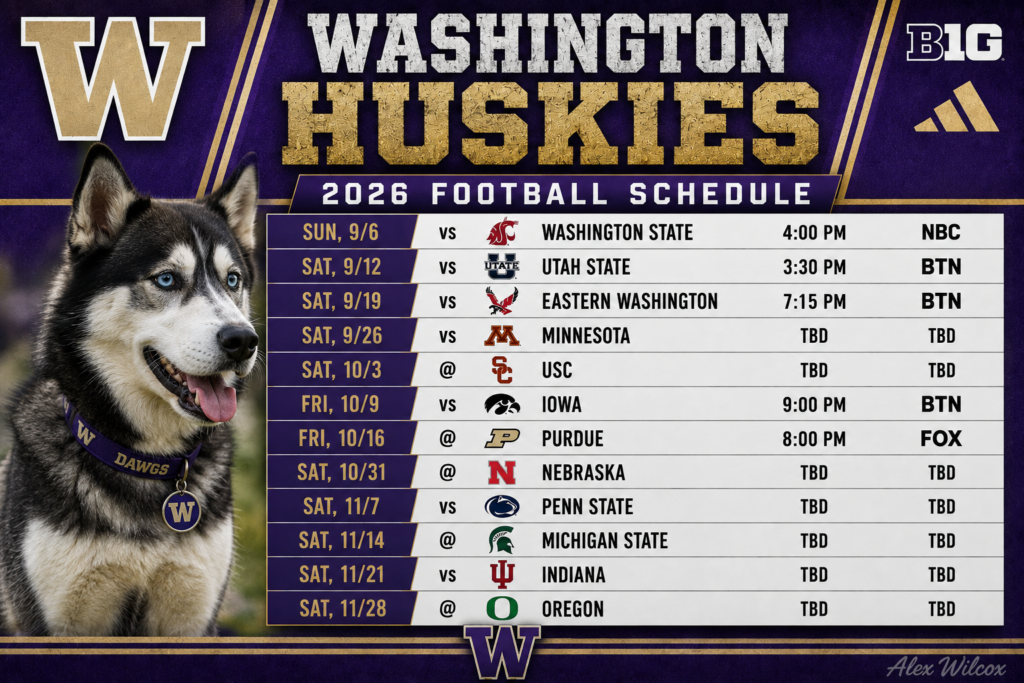
Overview and Projection
My projection is 9–3 overall and 6–3 in Big Ten play, and I think Washington is one of the conference’s most interesting dark horses. The October 3 game at USC will tell us a lot. Both teams have veteran quarterbacks, explosive offensive systems and aspirations of breaking into the conference’s upper tier. Washington then has enormous opportunities at home against Penn State and Indiana. Husky Stadium matters here. Washington gets seven home games overall, including several of its most important conference matchups, while its road slate outside of USC and Oregon consists of Purdue, Nebraska and Michigan State… all very winnable games.
Demond Williams gives Washington the ability to beat teams with superior overall rosters, and Husky Stadium gives the Huskies legitimate upset opportunities against Penn State and Indiana. I don’t believe Washington is quite ready to consistently beat the Ohio State/Oregon caliber of team yet, but the gap is shrinking. If Williams develops from a very good quarterback into a true superstar, Washington could be one of the teams that completely disrupts the expected hierarchy of the Big Ten, and the nation, in 2026.
Projected Record: 9-3 (6-3)
Indiana Hoosiers
Offensive Outlook
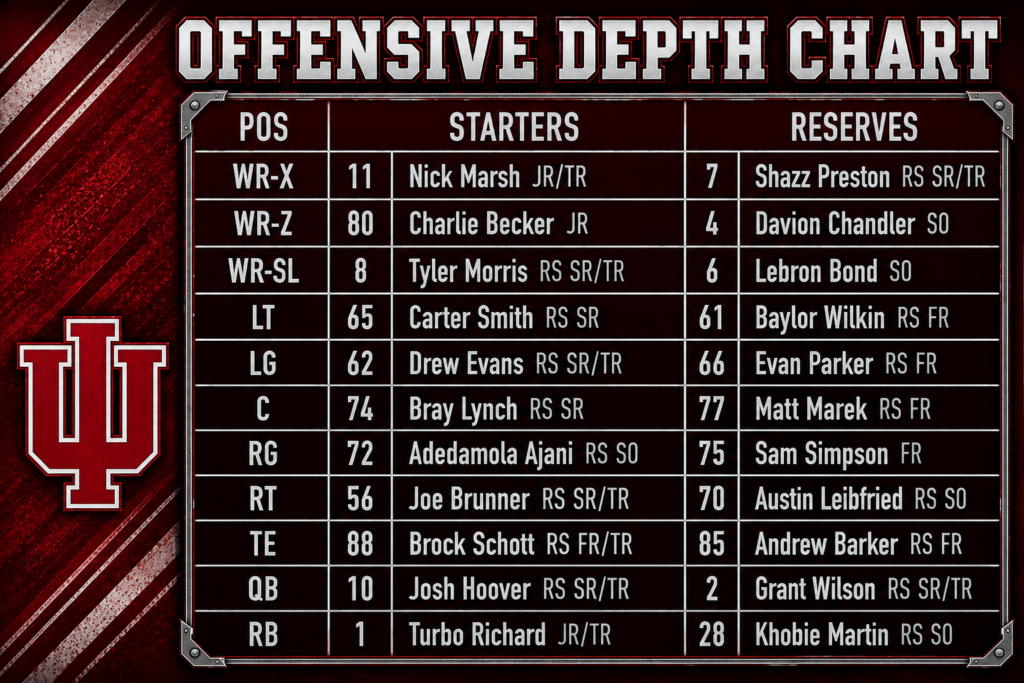
The Indiana Hoosiers aren’t trying to prove that last season’s breakthrough was legitimate anymore—they are the reigning national champions, coming off a perfect 16–0 season in which they averaged 41.6 points and 452.0 yards per game and defeated Miami 27–21 to complete one of the most remarkable seasons in college football history. The challenge now is replacing the player who drove that offense. Fernando Mendoza completed 72.0% of his passes for 3,535 yards, 41 touchdowns and only six interceptions, won the Heisman Trophy and departed after delivering Indiana its first national championship. Those are the biggest of shoes to fill, but if there is one coach I trust right now to identify the right veteran quarterback for his system, it is Curt Cignetti.
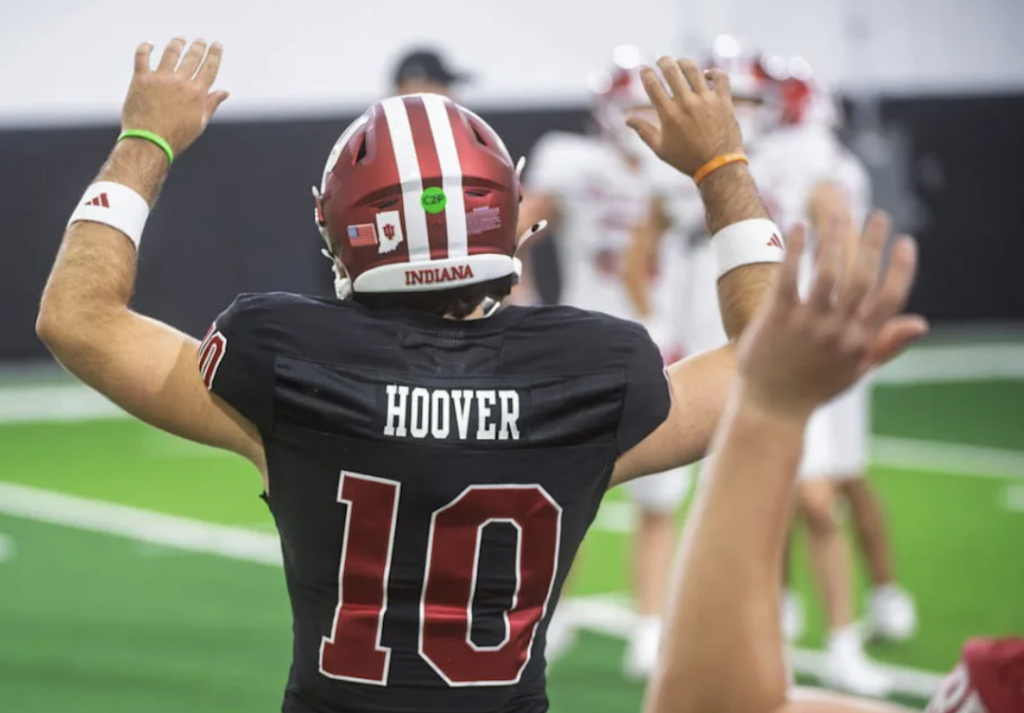
Enter Josh Hoover. The former TCU quarterback arrives in Bloomington with 9,629 career passing yards and 71 touchdowns, 31 career starts and 16 different 300-yard passing performances. His interception total—33 over his career—is the obvious concern, and ball security becomes especially important after Mendoza threw only six interceptions during Indiana’s championship run. But Cignetti has now successfully developed consecutive transfer quarterbacks in Kurtis Rourke and Mendoza. Hoover arrives with more career passing production than either had when they entered the program, and I expect Indiana’s system to make him a more efficient player than he was at TCU.
Indiana also did an excellent job surrounding Hoover with proven weapons. The headline addition is former Michigan State receiver Nick Marsh, who produced 100 receptions for 1,311 yards and nine touchdowns during two seasons in East Lansing. At 6-foot-3 and 210 pounds, Marsh gives Hoover the type of physical outside target who can immediately become a No. 1 receiver. Veteran Tyler Morris returns as another established option, while Indiana’s running game should remain a major strength. Khobie Martin averaged more than 6.5 yards per carry while rushing for 506 yards and six touchdowns on only 77 attempts behind Indiana’s two 1,000-yard rushers last season. The offensive line also retains important experience, particularly Bray Lynch, who is moving from guard to center after making 29 consecutive starts. Indiana’s offensive line has been a Joe Moore Award semifinalist in each of the past two seasons.
This offense probably isn’t going to reproduce last year’s ridiculous efficiency immediately. Indiana converted 56.5% of its third downs, averaged 6.8 yards per play and scored 87 offensive touchdowns in 2025. Those numbers are difficult for anyone to replicate, particularly after losing a Heisman-winning quarterback. But I don’t expect Indiana’s offense to suddenly disappear either. Hoover is experienced, Marsh gives him an excellent new weapon, the offensive line remains a strength and Cignetti’s system has repeatedly demonstrated that it can elevate veteran quarterbacks. Indiana may take a small step backward offensively and still have one of the best offenses in the Big Ten.
Defensive Outlook
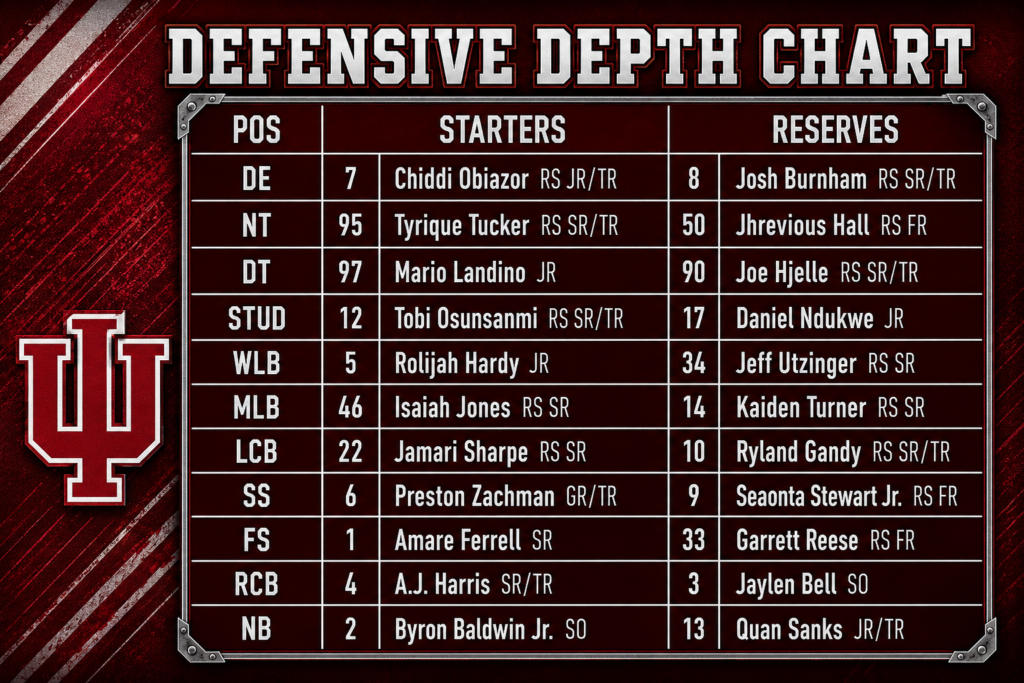
As great as Mendoza and the offense were last season, Indiana’s defense was every bit as important to the national championship. The Hoosiers allowed only 11.7 points and 266.0 yards per game, surrendered just 3.0 yards per rushing attempt, intercepted 19 passes and recorded 46 sacks. Opponents converted only 30.1% of their third downs. Indiana didn’t accumulate those numbers against an easy postseason path, either. Bryant Haines’ defense held up against teams such as Oregon, Ohio State, Alabama and Miami on the way to the championship. Haines subsequently won the Broyles Award as the nation’s top assistant coach, and his continued presence is one of the biggest reasons I believe Indiana’s defensive success is sustainable.
There are substantial losses. Aiden Fisher, D’Angelo Ponds, Mikail Kamara, Kellen Wyatt and Stephen Daley were among the major pieces from last year’s defense, and replacing that combination of leadership and production won’t be automatic. But Indiana retains legitimate difference-makers. Rolijah Hardy returns after leading the national champions in tackles, while Isaiah Jones produced 78 tackles, 15.5 tackles for loss and seven sacks and scored on a blocked punt in the national championship game. That gives Haines an excellent foundation at linebacker.
Up front, Mario Landino is positioned for an even larger role after recording 32 tackles, six tackles for loss and five sacks last season. Indiana supplemented the defensive line through the portal with Kansas State transfers Chiddi Obiazor and Tobi Osunsanmi, former Notre Dame defender Josh Burnham and Tulsa transfer Joe Hjelle. The secondary also has experience returning and added former Pittsburgh defensive back Ryland Gandy, while Indiana’s overall roster contains 60 returning players and 18 incoming transfers.
I don’t expect Indiana to allow 11.7 points per game again. That’s an extraordinarily high standard, and the Hoosiers lost too many elite pieces to simply assume there will be no regression. What I do believe is that Haines’ defense has reached the point where the system itself deserves respect. This isn’t a collection of overachievers anymore. Indiana plays fast, tackles well, creates negative plays and has become exceptionally disciplined within its scheme. The personnel changes, but the identity doesn’t. I expect some statistical regression while still viewing Indiana as a top-15 defense nationally.
Overview and Projection
This is where Indiana becomes one of the most difficult teams in the country to evaluate. How do you project the encore to 16–0 and a national championship when the Heisman Trophy-winning quarterback is gone? My answer is to respect what Cignetti has built without assuming that one historic season automatically becomes the new baseline.
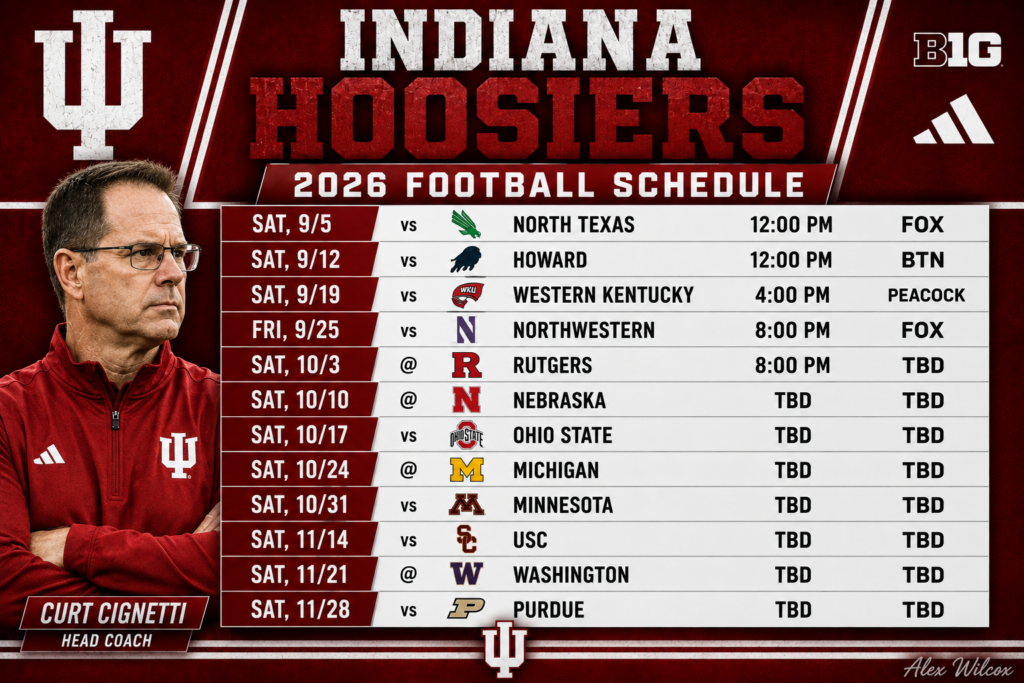
The schedule gives Indiana a chance to settle in. The Hoosiers open with North Texas, Howard and Western Kentucky, then begin Big Ten play at home against Northwestern before traveling to Rutgers and Nebraska. Indiana will enter the October 17 matchup vs. Ohio State at 6–0, with the majority of those wins being by very wide margins. And then comes the stretch that will determine whether a repeat championship run is realistic.
Ultimately, I’m expecting some considerable regression from perfection. Mendoza was extraordinary. Last year’s defense was historically efficient. Indiana went 16–0 in a sport where even the best teams almost inevitably stumble somewhere. Hoover doesn’t need to become Mendoza for this season to be successful, but asking a new quarterback and a partially rebuilt defense to navigate Ohio State, Michigan, USC and Washington without multiple losses is asking a lot.
I have Indiana finishing 9–3 and 6–3 in conference play, remaining one of the best teams in the Big Ten but falling short of repeating last year’s magical run. And perhaps the greatest compliment I can give Cignetti is that a nine-win regular season at Indiana can now legitimately be described as a step backward. Two years ago that sentence would have sounded ridiculous. After a 16–0 national championship season, the standard in Bloomington has fundamentally changed. Indiana isn’t college football’s Cinderella anymore. It’s one of the programs everyone else now has to prepare to beat.
Projected Record: 9-3 (6-3)
Penn State Nittany Lions
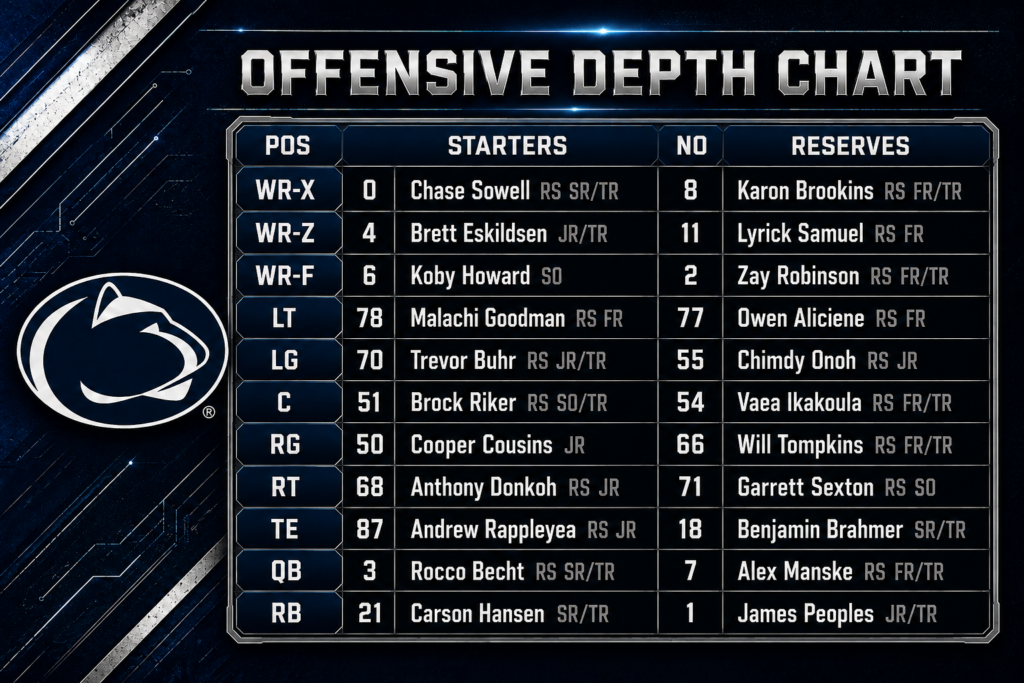
Offensive Outlook
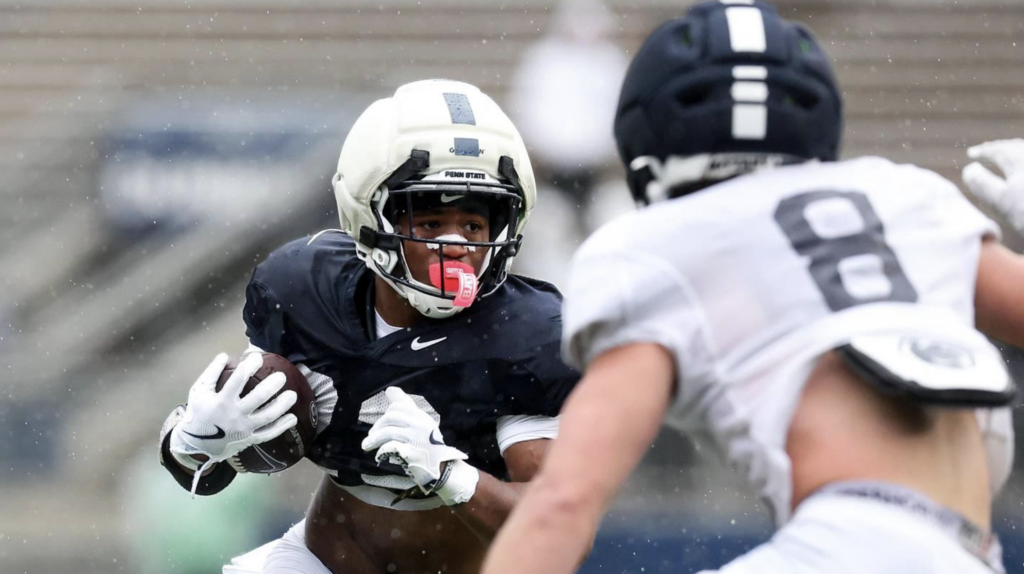
Few teams in the country underwent a more dramatic transformation this offseason than Penn State. The Matt Campbell era begins with a roster that looks almost nothing like the one that finished 2025, but Campbell didn’t arrive in State College alone. Penn State brought in 39 transfers, 34 of whom came from Power Four programs, and a huge portion of Campbell’s Iowa State infrastructure followed him east. That makes Penn State’s low traditional returning-production numbers somewhat misleading. This is technically a team with enormous roster turnover, but many of its most important newcomers have already spent years playing together in Campbell’s system. That’s an important distinction when evaluating how quickly this offense can come together.
The most important of those familiar faces is Rocco Becht. Becht started 39 consecutive games for Campbell at Iowa State and finished his Cyclone career with 9,274 passing yards, 64 passing touchdowns and 19 rushing touchdowns, giving Penn State one of the most experienced quarterbacks in the Big Ten. His 2025 season was more pedestrian… 2,584 passing yards, 16 touchdowns and nine interceptions, along with eight rushing scores. I don’t view Becht as the type of quarterback who is going to carry Penn State past Ohio State or Oregon by himself, but that’s not really what Campbell needs him to be. He knows the offense, understands Campbell’s expectations and has already led seven career game-winning drives. For a program undergoing this much change, having an experienced quarterback who essentially arrives already fluent in the system is enormously valuable.
The most fascinating newcomer might actually be former Ohio State running back James Peoples. Peoples arrives after rushing for 541 yards and five touchdowns on 110 career carries, averaging 4.9 yards per attempt, and finally gets an opportunity to become the featured back rather than sharing touches in Ohio State’s loaded backfield. At receiver, Campbell brought several familiar options with him, including former Iowa State wideouts Chase Sowell, Zay Robinson and Brett Eskildsen. That continuity should allow Penn State to install its offense much more quickly than a typical first-year staff working with dozens of transfers.
The question is whether familiarity can compensate for the loss of Penn State’s previous high-end talent. This isn’t the same roster that entered recent seasons expecting to overpower opponents with NFL-caliber players throughout the depth chart. Campbell is essentially trying to merge Penn State’s recruiting ceiling with the developmental culture he established at Iowa State, and offensively I think that process will take some time. Becht provides a relatively high floor, Peoples is an intriguing breakout candidate and there is enough experience around them to be functional immediately. But compared with Ohio State, Oregon, USC and even Michigan, I don’t see the same level of proven offensive explosiveness. Penn State should be efficient and physical; I’m less convinced it will be consistently dynamic.
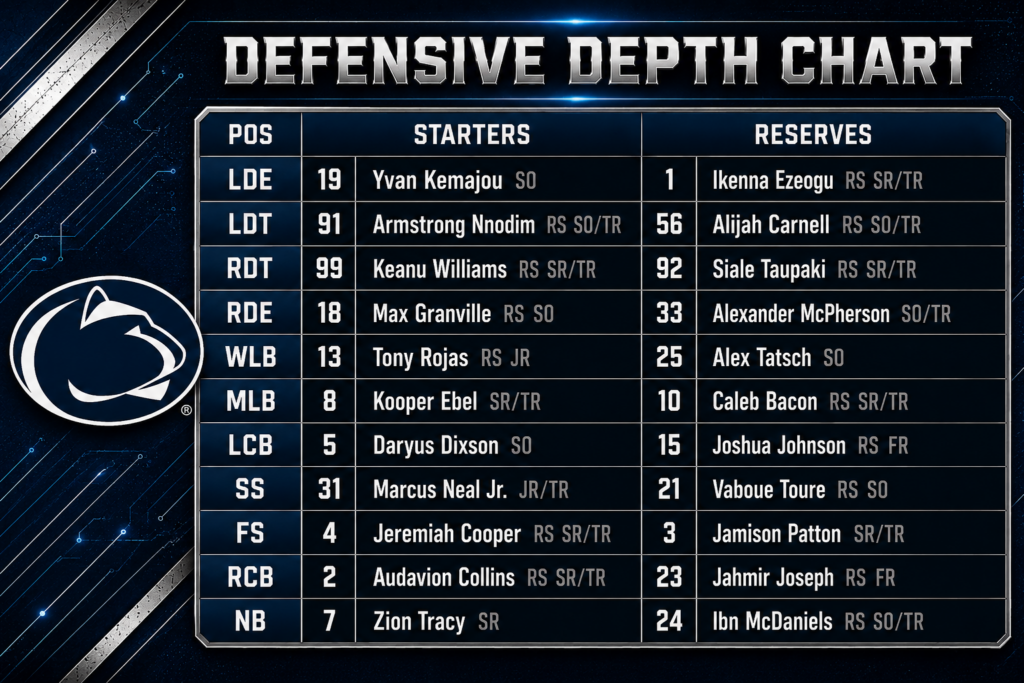
Defensive Outlook
The defensive side may be where Campbell’s approach translates most quickly. Campbell brought several of his most trusted Iowa State defenders to Happy Valley, including defensive end Ikenna Ezeogu, linebackers Kooper Ebel and others, and safeties Jeremiah Cooper and Jamison Patton. Ebel is particularly important because he arrives with 26 career starts, 146 tackles and 14 tackles for loss over the past two seasons and immediately gives the Nittany Lions an experienced leader in the middle of the defense.
Cooper may be the most important player in the secondary. He already understands the system Campbell wants to run, and pairing those Iowa State veterans with the talent Penn State retained creates an interesting combination. Unlike an ordinary portal rebuild where dozens of players are learning each other and learning a new scheme simultaneously, Penn State has effectively imported an established core. That’s why I’m less concerned about the raw continuity numbers here than I would be for almost any other team undergoing this degree of roster turnover.
There is still an undeniable talent question. Penn State traditionally entered seasons with future NFL players scattered across the defensive front and secondary, and this year’s roster doesn’t have as many proven stars. Campbell’s Iowa State teams were consistently difficult to play because of their structure, discipline and ability to maximize personnel, but the Big Ten’s elite offenses present a different challenge. Ohio State and Oregon can overwhelm even well-coached defenses with sheer talent, while USC has one of the conference’s best quarterbacks. Penn State fortunately avoids both Ohio State and Oregon during the regular season, which makes the transition considerably easier.
That is ultimately why I expect the defense to be the more reliable half of this team early. Campbell knows exactly what he wants structurally, many of the players already know how he wants it executed, and Penn State still possesses a stronger overall recruiting base than Campbell generally had available at Iowa State. The ceiling depends on whether Campbell can combine Iowa State’s developmental strengths with Penn State-level athletes. If he can, the defense could become one of the most difficult units in the Big Ten to prepare for as the season progresses.
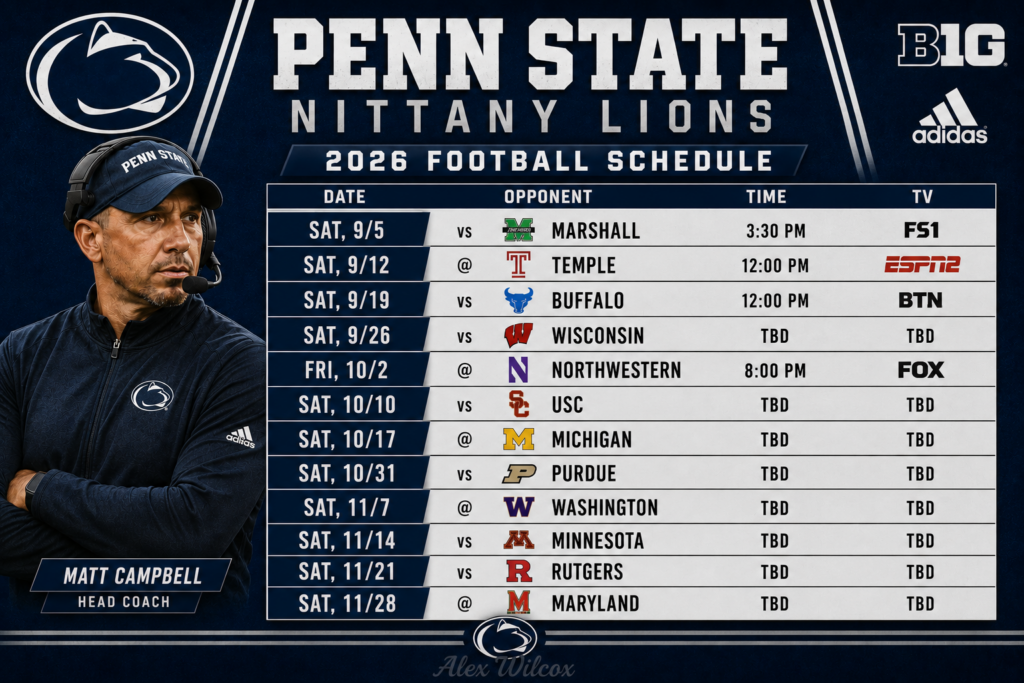
Overview and Projection
The schedule is the main reason I’m comfortable projecting nine wins. Penn State opens against Marshall, Temple and Buffalo before beginning Big Ten play at home against Wisconsin and traveling to Northwestern. There is a very realistic path to 5–0, giving Campbell an excellent runway to establish his program before the schedule becomes substantially more difficult. Penn State avoids Ohio State, Oregon and Indiana entirely, meaning USC, Michigan and Washington essentially become the measuring-stick games for determining where Campbell’s first team belongs within the Big Ten hierarchy.
After Washington, the finish is favorable: Minnesota and Rutgers at home followed by Maryland on the road. That’s why I have Penn State at 9–3 overall and 6–3 in the Big Ten. I don’t believe this roster is talented enough yet to consistently beat the best teams in the conference, but the schedule doesn’t require it to. If Penn State merely wins the games it should win, nine victories becomes extremely realistic.
For 2026, this looks like a good team rather than a great one. Long term, if Campbell can take the culture, player development and schematic identity that made Iowa State consistently competitive and combine it with Penn State’s recruiting resources, 9–3 may eventually become the floor rather than the preseason expectation in Happy Valley.
Projected Record: 9-3 (6-3)
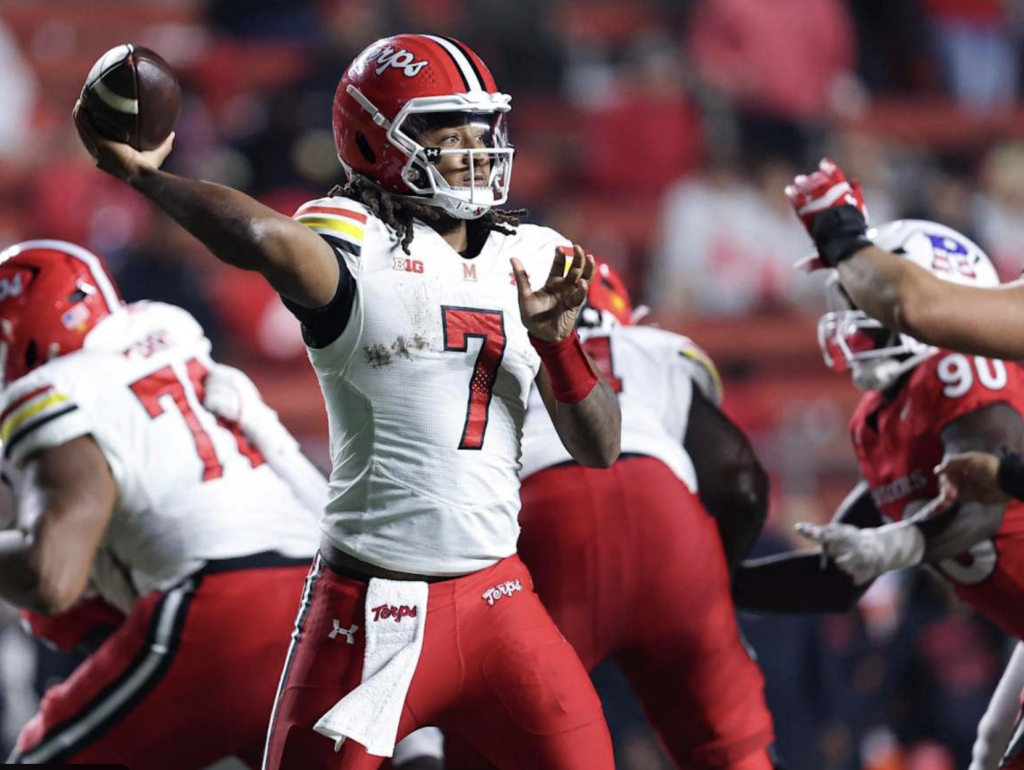
Maryland Terrapins
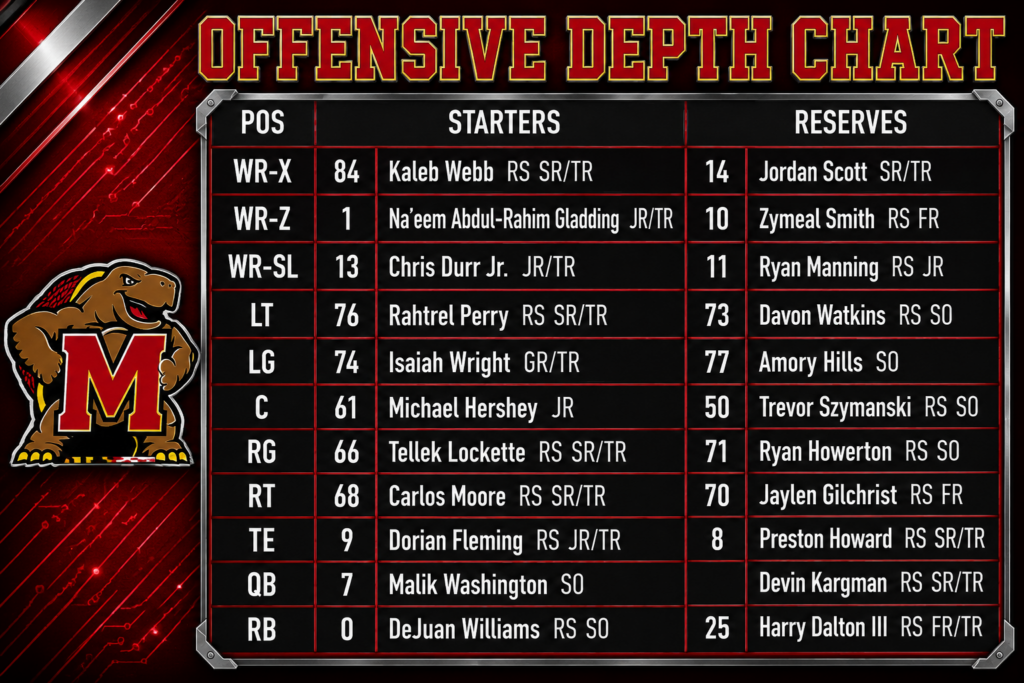
Offensive Outlook
Maryland comes into this season as one of my favorite candidates to make a meaningful jump in the Big Ten, and almost all of that optimism begins with Malik Washington. Washington was thrown directly into the fire as a true freshman and responded by completing 273 passes for 2,963 yards and 17 touchdowns, setting Maryland freshman records for both completions and passing yards. He surpassed 200 passing yards in 11 of 12 games and finished the season by throwing for 459 yards against Michigan State, the second-highest single-game total in program history. At 6-foot-5 and 231 pounds, he has the size, arm talent and athletic ability to develop into one of the conference’s better quarterbacks.
The most exciting part is that Maryland deliberately kept the training wheels on Washington last season. Mike Locksley has acknowledged that the Terps simplified the offense so their freshman quarterback could concentrate on protections, defensive fronts and processing rather than being asked to execute the entire system immediately. Washington’s running ability was also largely held back despite his athleticism—something that should change under new offensive coordinator Clint Trickett, who plans to install a more aggressive spread attack and utilize Washington as a legitimate running threat. That makes Washington one of my favorite sophomore breakout candidates in the conference. We saw flashes of what happens when Maryland lets him create with his legs when he rushed for 164 yards against Rutgers.
There are legitimate questions surrounding his supporting cast. Maryland had to rebuild its receiving corps following the departures of Octavian Smith Jr., Shaleak Knotts and Jalil Farooq, and Locksley attacked the portal for experience. Wyoming transfer Chris Durr Jr. and Old Dominion transfer Na’eem Gladding were specifically targeted to bring proven production into a young receiver room. DeJuan Williams should play a major role in the backfield, while veteran tight end Preston Howard gives Washington a 6-foot-5 target over the middle.
The offensive line will ultimately determine how dramatic the improvement can be. Center Michael Hershey is one of the established leaders of the team and joined Washington as one of Maryland’s three representatives at Big Ten Media Days. There is a pathway to a significant offensive improvement here. Washington produced nearly 3,000 passing yards while playing within a deliberately restricted offense as an 18-year-old freshman. Now he’s bigger, more experienced and being given substantially more responsibility. If his decision-making catches up with his physical ability, Washington could become one of the breakout stars of the entire Big Ten.
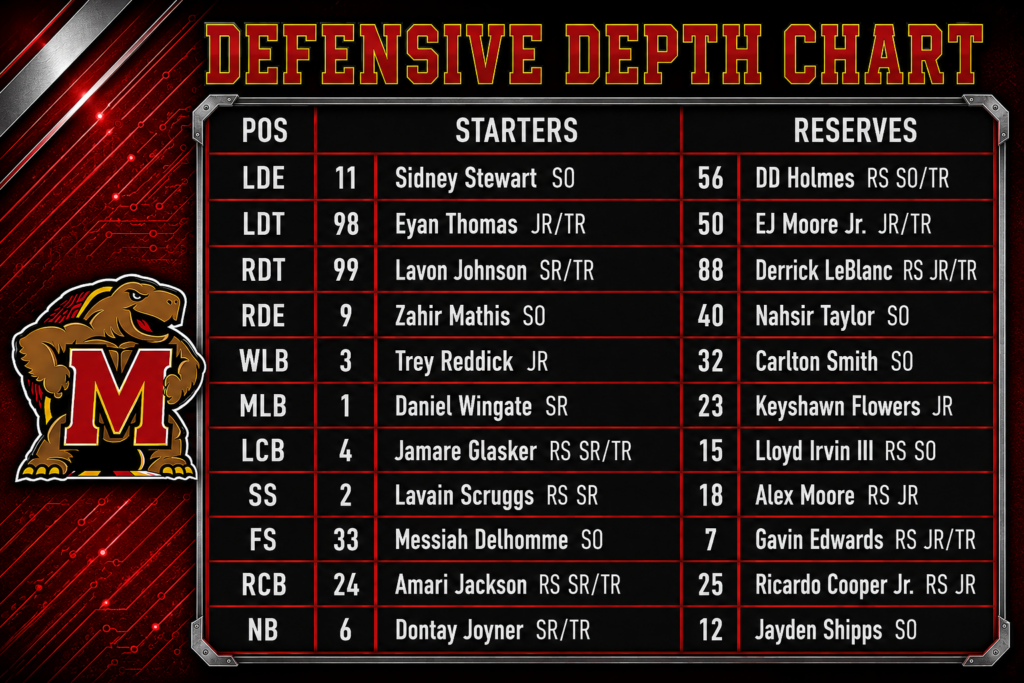
Defensive Outlook
Maryland’s defense is where I have considerably more concern. The Terps started 2025 4–0, including an impressive 27–10 road victory at Wisconsin, but proceeded to lose their final eight games. During that collapse, Maryland allowed 34 points to Nebraska, 35 to Rutgers, 45 to Michigan and 38 to Michigan State, while eventual national champion Indiana overwhelmed the Terps 55–10. If Maryland is going to turn close-game competitiveness into a winning season, the defense has to become more reliable.
Daniel Wingate is an important piece of that effort and was selected alongside Washington and Hershey to represent Maryland at Big Ten Media Days. Zahir Mathis gives the Terps a particularly intriguing piece off the edge at 6-foot-6 and 222 pounds, while Trey Reddick returns at linebacker. The secondary contains a combination of returning players and transfer experience, including former Wake Forest defensive back Jamare Glasker, West Virginia transfer Jordan Scruggs and Austin Peay transfer Gavin Edwards.
Maryland also added one of the most interesting freshmen in its recent recruiting history in edge defender Zion Elee. Elee headlines a defensive recruiting class that also includes 305-pound IMG Academy defensive tackle Cam Brickle II, edge Jianni Davis and defensive backs Darrell Carey and Zahir Cobb. Locksley’s ability to recruit the DMV has never really been the central concern at Maryland; turning that talent into a consistently physical Big Ten defense has been the more difficult challenge.
There is also meaningful change schematically. Ted Monachino takes over as defensive coordinator and outside linebackers coach, with Aazaar Abdul-Rahim serving as co-defensive coordinator and associate head coach for defense. I’m not expecting Maryland to suddenly field one of the Big Ten’s best defenses, and that distinction is important when evaluating the ceiling of this team. The offense could legitimately become dangerous enough to stress almost anyone on the schedule. The defense simply needs to become competent and opportunistic enough to stop wasting those performances. If Maryland can turn some of last year’s fourth-quarter losses into wins, the improvement in record could be much larger than the improvement in underlying defensive statistics.
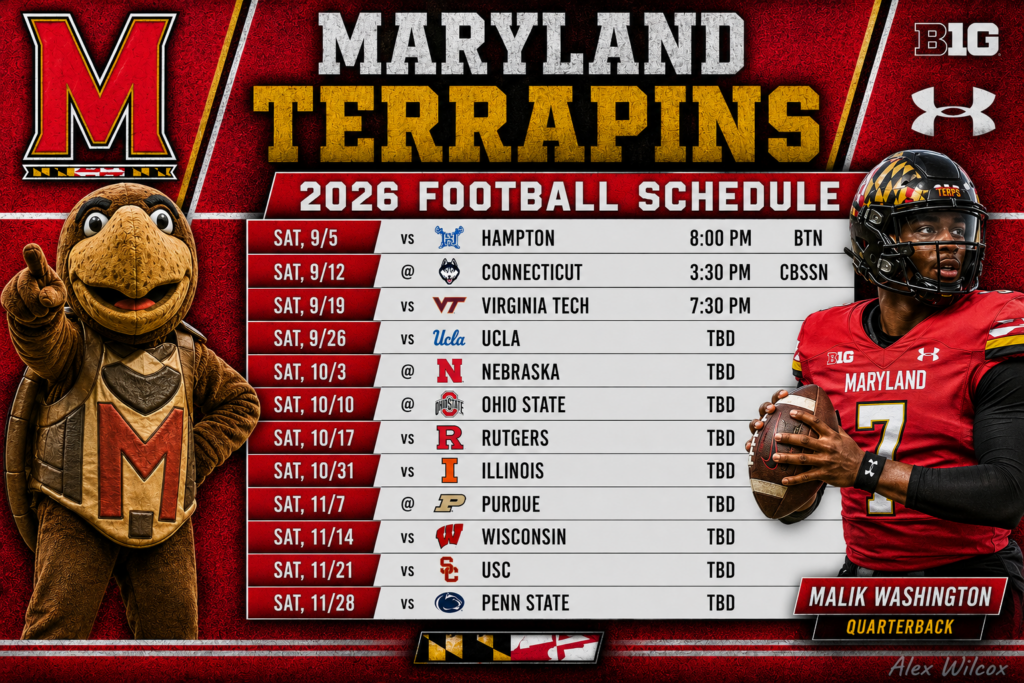
Overview and Projection
Maryland is exactly the type of team where last year’s 4–8 record doesn’t tell the entire story. The Terps began 4–0 before losing eight straight, but three of their first four defeats during that slide came by four points to Washington, three to Nebraska and three at UCLA. A young quarterback and young roster repeatedly found themselves in winnable games and couldn’t finish them. That was painful in 2025, but it also creates a reasonable argument for improvement in 2026.
That’s why my final projection of 7–5 overall and 5–4 in the Big Ten is intentionally more aggressive than a purely national-power-rating view of Maryland might produce. I’m betting on Washington. Sophomore quarterbacks with his combination of size, arm talent, mobility and freshman experience don’t come around often, and Maryland spent an entire season developing him without even fully utilizing everything he can do. If Trickett successfully opens the offense and Washington makes the leap I expect, the Terps are going to be extremely uncomfortable to play.
Projected Record: 7-5 (5-4)
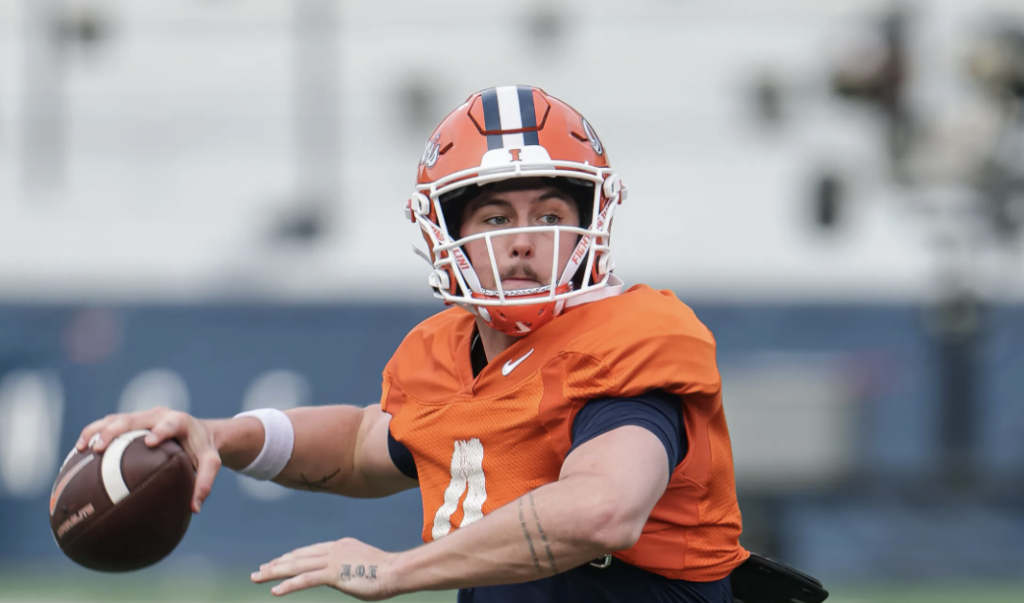
Illinois Fighting Illini
Offensive Outlook
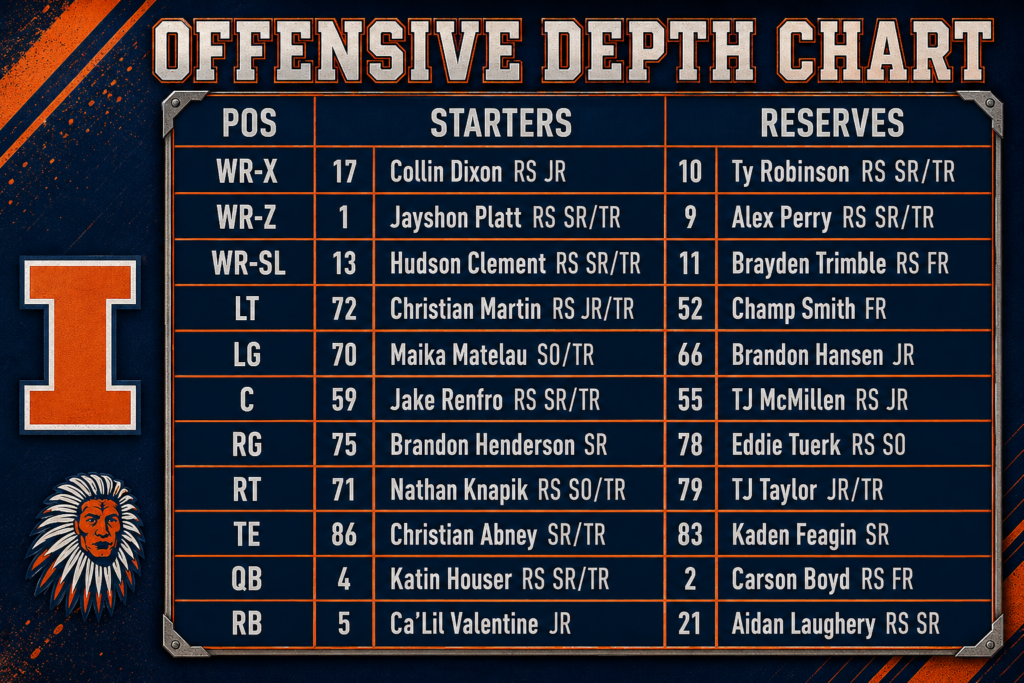
Illinois enters 2026 in an interesting position offensively. The Illini are coming off consecutive successful seasons under Bret Bielema, but the identity of the offense changes with Luke Altmyer gone and East Carolina transfer Katin Houser taking over at quarterback. Houser is one of the more experienced transfer quarterbacks in the conference, entering the year with 26 career starts, 6,438 passing yards and 43 passing touchdowns, plus another 15 touchdowns on the ground. His 2025 season at East Carolina was particularly encouraging: Houser completed 65.9% of his passes for 3,300 yards, 19 touchdowns and only six interceptions, while adding nine rushing scores. He’s not the type of quarterback I expect to single-handedly elevate Illinois into the conference’s elite, but he is experienced, protects the football and gives Bielema a relatively high floor at the most important position.
The supporting cast gives him some legitimate weapons. Collin Dixon is Illinois’ leading returning receiver after catching 35 passes for 548 yards and five touchdowns last season, averaging 15.7 yards per reception. Hudson Clement also returns after recording 36 catches for 454 yards and three scores in his first season at Illinois, and the Illini have additional options in Alex Perry and Jayshon Platt. There may not be an obvious superstar in that group, but there’s enough size and experience for Houser to distribute the football without the passing game becoming overly dependent on one target.
Running back should again be central to Illinois’ identity. Aidan Laughery enters his fifth season with 1,061 career rushing yards on 191 carries—5.6 yards per attempt—and eight career rushing touchdowns, while Ca’Lil Valentine gives the Illini another experienced option and enters the year on the Doak Walker Award watch list. That’s exactly the type of backfield Bielema wants: multiple runners behind an offense built around physicality and controlling the line of scrimmage.
Up front, center Jake Renfro is especially important. He’s healthy again, has extensive starting experience and enters 2026 on the Rimington Trophy watch list. Illinois also added Christian Martin from Colorado State through the portal to bolster the offensive line. I don’t expect Illinois to suddenly become one of the Big Ten’s most explosive offenses, but I do expect it to be efficient. Houser’s experience and low interception rate fit Bielema’s preferred style extremely well. Illinois doesn’t need Houser to become Julian Sayin or Dante Moore. It needs him to protect the football, sustain drives and capitalize when defenses become too aggressive against the running game. If he does that, the offense should be good enough to win plenty of games.
Defensive Outlook
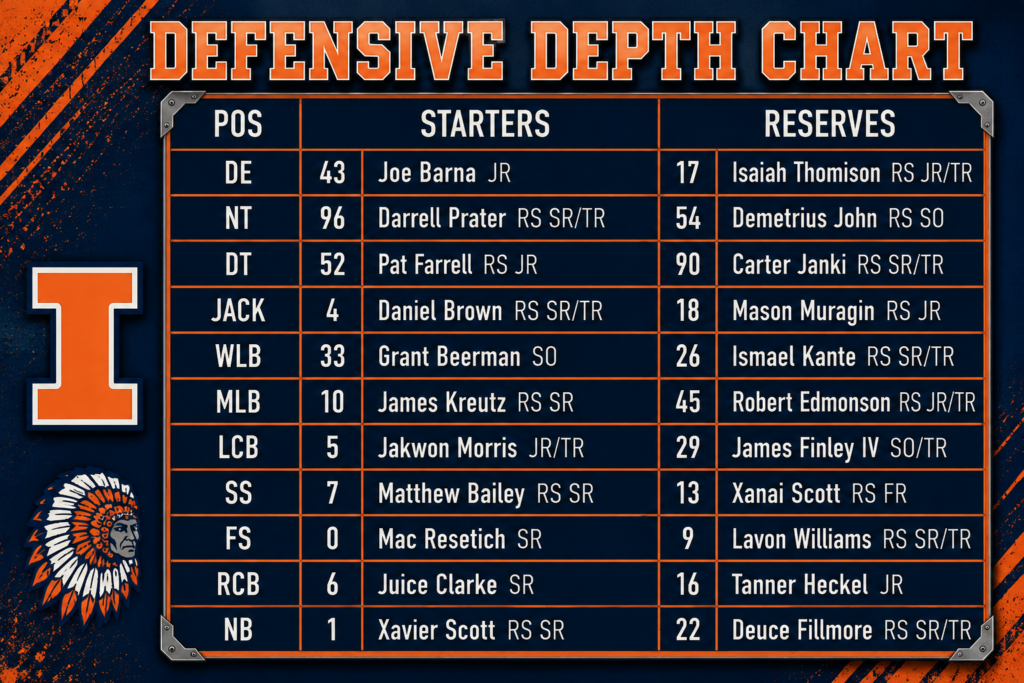
This is the side of the ball where I have greater confidence in Illinois because there is both experience and an established identity. Bielema has steadily built the Illini into the kind of team he wants them to be: physical, disciplined and difficult to overwhelm at the line of scrimmage. The secondary in particular contains two players who could become the faces of the entire defense in Matthew Bailey and Xavier Scott.
Bailey has led Illinois in tackles in each of the past two seasons and enters 2026 with 185 career tackles, four interceptions and four forced fumbles. He’s already a two-time All-Big Ten selection and gives the defense exactly the kind of veteran presence Bielema values. Juice Clarke is another important returning defensive back after earning honorable mention All-Big Ten recognition despite missing the first four games last season. He still led Illinois with seven pass breakups in only nine games. Add Scott to that group and Illinois has enough proven talent in the secondary to make life difficult on opposing quarterbacks.
The questions are more significant closer to the line of scrimmage, which is why Illinois was active in the portal. Robert Edmonson arrives from Colorado State at linebacker, Will Holmes comes from Utah State as an outside linebacker/edge option and 6-foot-5, 290-pound Carter Janki transfers in from Penn to add size inside. Fifth-year linebacker Daniel Brown also gives Illinois experience in the middle of the defense. None of those additions individually changes how I view the Big Ten race, but collectively they reinforce one of Bielema’s greatest strengths: building a roster with enough experienced, physically mature players that Illinois rarely gets bullied.
The Illini have enough to win through development, experience, physicality and execution. Bielema has demonstrated throughout his career that he understands how to build that type of team. I don’t expect this to be the most talented defense in the Big Ten. But with Bailey, Scott and Clarke providing experience on the back end and Bielema’s continued emphasis on the trenches, I expect Illinois to field another fundamentally sound defense capable of keeping it competitive against almost everyone outside the conference’s true heavyweight tier.
Overview and Projection
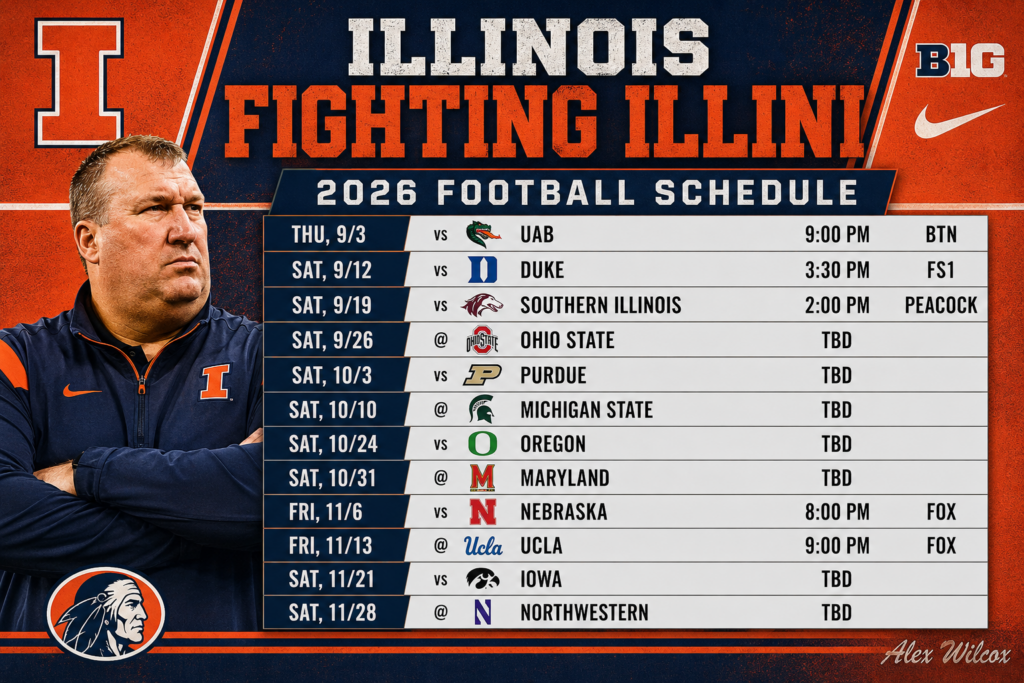
My final projection is 8–4 overall and 5–4 in the Big Ten, and I think that accurately reflects both the floor Bielema has established and the limitations of this particular roster. Illinois isn’t rebuilding. Houser gives the Illini an experienced quarterback, the secondary has legitimate veteran talent, the running game should remain reliable and Bielema is one of the conference’s most trustworthy coaches. At the same time, the schedule includes two opponents in Ohio State and Oregon that possess substantially more talent, and Illinois will probably drop another couple of games among the collection of relatively even matchups elsewhere on the schedule.
An eight-win Illinois season no longer feels like a surprise… it feels normal. Give the lion share of the credit to Bret Bielema, who consistently remains one of the more underrated coaches in all of college football.
Projected Record: 8-4 (5-4)
Iowa Hawkeyes
Offensive Outlook
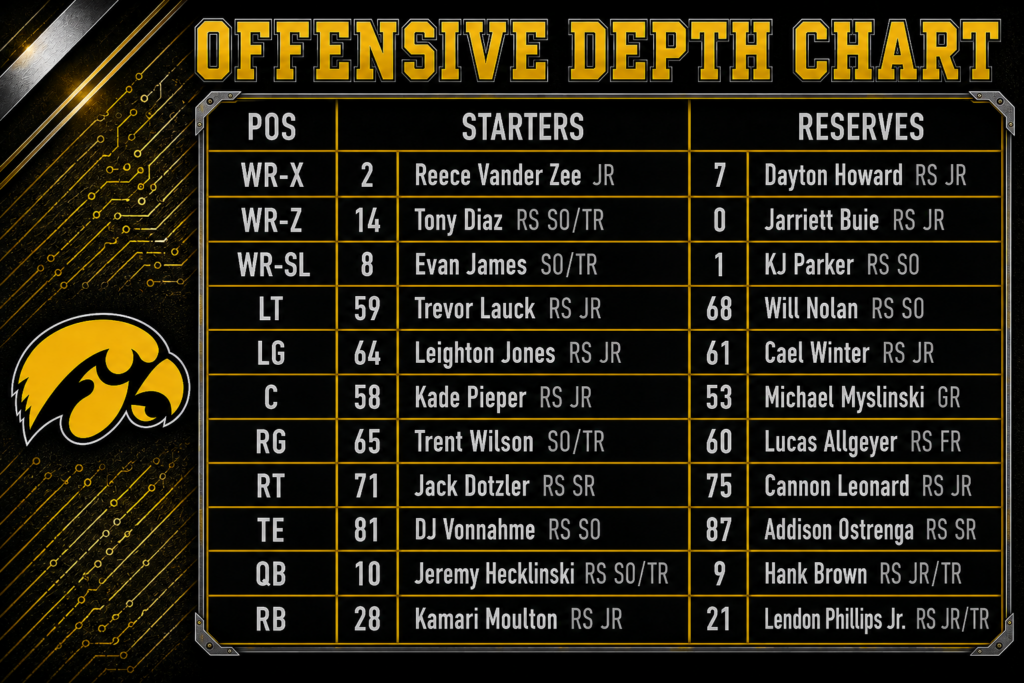
Iowa enters 2026 coming off a 9–4 season in which all four losses came by a combined 15 points, but the biggest question is once again the position that has defined nearly every recent Iowa offseason: quarterback. Mark Gronowski is gone, leaving Jeremy Hecklinski and Hank Brown battling for the starting job. Kirk Ferentz acknowledged at Big Ten Media Days that Iowa didn’t yet have an answer at quarterback, although Hecklinski appears to have created some separation late in fall camp. At Iowa’s open practice, Hecklinski completed 17 of 25 passes for 205 yards and five touchdowns, compared with Brown’s 9-of-21 performance for 42 yards. That’s why, for purposes of this preview, I’m treating Hecklinski as the most likely starter.
Hecklinski transferred from Wake Forest before the 2025 season but spent last year behind Gronowski, so Iowa is asking a largely unproven quarterback to take over an offense that was finally beginning to show signs of becoming more functional under offensive coordinator Tim Lester. I’m intrigued by Hecklinski’s upside more than his skillset might indicate, particularly after what we’ve seen in camp. He doesn’t need to become an elite Big Ten quarterback. If Iowa can simply produce a competent passing attack that forces defenses to respect something beyond the running game, this offense becomes significantly more difficult to handle.
Fortunately, the supporting cast is more experienced. Kamari Moulton returns as the centerpiece of the backfield after leading Iowa’s running backs down the stretch last season; through the first 11 games he had 690 yards on 138 carries, averaging 5.0 yards per attempt. Moulton gives Iowa exactly the kind of dependable runner Ferentz has historically built offenses around. Tight end DJ Vonnahme returns after emerging as Iowa’s leading receiver in 2025, while Reece Vander Zee gives the Hawkeyes a 6-foot-4 target on the outside. Iowa also used the portal to improve the receiving corps with Tony Diaz from UTRGV and Evan James from Furman. There is actually some optimism that this could become one of Iowa’s better collections of pass catchers in recent memory—which admittedly isn’t the highest bar, but would still represent meaningful progress.
The offensive line is where I’m most interested. Iowa lost three important players up front, including consensus All-American center Logan Jones, but Ferentz believes the Hawkeyes have seven to nine linemen capable of playing significant snaps. Jack Dotzler, Trevor Lauck, Kade Pieper and Michael Myslinski give the unit experience, and if Iowa can maintain its traditional physicality despite the departures, the running game should remain reliable. This offense isn’t suddenly going to resemble USC or Oregon. That’s not the goal. Iowa just needs its offense to stop making life unnecessarily difficult for one of the best defenses in America. If Hecklinski can provide even league-average quarterback play, I think this could quietly become one of the more competent Iowa offenses we’ve seen in several years.
Defensive Outlook
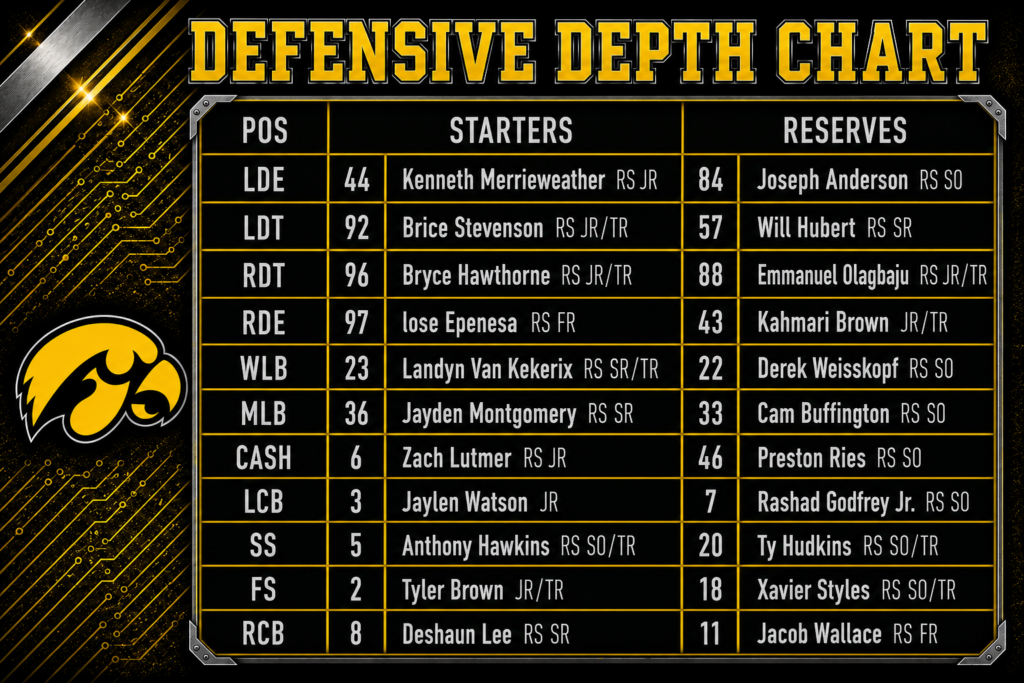
There are certain things in college football you can almost pencil in before the season begins, and Phil Parker fielding an excellent Iowa defense is one of them. The Hawkeyes finished 2025 eighth nationally in scoring defense at 15.6 points per game, ninth in total defense at 280.4 yards per game, 10th in passing defense at 172.7 yards and 17th in rushing defense at 107.7 yards. Even more impressive was how Iowa performed against elite competition. The Hawkeyes held eventual national champion Indiana to a season-low 20 points, limited Oregon to 18 points—23.3 below the Ducks’ season average—and held USC 147 yards below its normal offensive output.
That’s exactly why I continue to give Iowa more respect than its raw roster talent might otherwise warrant. Parker has produced a top-20 scoring defense for 11 consecutive seasons, and Iowa has allowed fewer than 20 points per game for 10 straight years. At some point, that level of consistency stops being something we need to project and becomes part of the program’s identity. Personnel changes, NFL players leave and new starters step in—and Iowa still plays excellent defense.
Zach Lutmer is one of my favorite returning players on this roster. He was everywhere in 2025, recording 71 tackles, 5.5 tackles for loss, seven pass breakups and a team-high three interceptions, including a pick-six against Minnesota. He returns to a secondary that also includes experienced defensive backs Deshaun Lee, Jaylen Watson, Rashad Godfrey Jr. and Alex Mota, giving Parker plenty of pieces to work with. Iowa’s ability to develop defensive backs remains one of the most dependable developmental pipelines in college football.
The front seven will have some production to replace, but Drew Campbell is an intriguing young edge defender, while linebackers Jayden Montgomery, Landyn Van Kekerix and Cam Buffington give Iowa a combination of experience and developmental upside. Kenneth Merrieweather and Will Hubert provide veteran leadership along the defensive line as well. This may not be the most individually star-studded Iowa defense we’ve seen, but I’ve learned not to bet against Parker’s ability to turn experienced developmental players into excellent Big Ten defenders.
I don’t see any reason for that formula to suddenly stop working. Iowa will tackle well, limit explosive plays and force opponents to execute long drives without making mistakes. Last season, the Hawkeyes allowed only seven runs of 20-plus yards and 10 pass plays of 30-plus yards all year. That is quintessential Iowa football. I expect another top-20 national defense, and it wouldn’t surprise me whatsoever if Parker once again produces a top-10 unit.
Overview and Projection
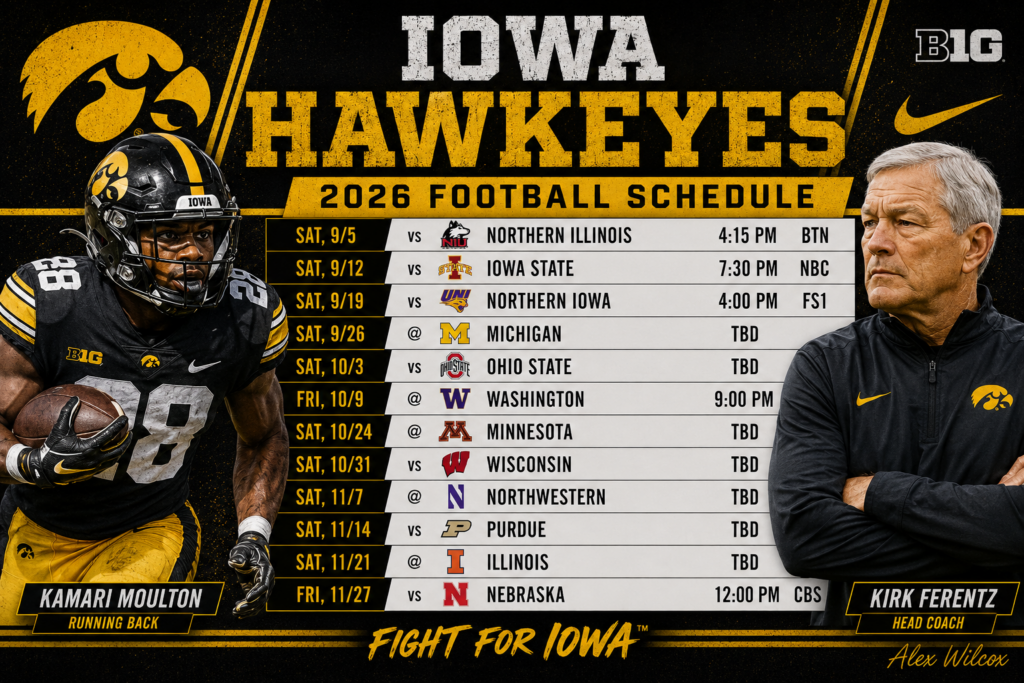
I have Iowa finishing 8–4 and 5–4 in conference play, remaining one of the Big Ten’s most dependable teams without quite possessing the quarterback play necessary to seriously contend for the conference championship.
The consistency of the Hawkeyes remains the remarkable thing about Iowa entering Year 28 under Ferentz: the formula is completely predictable, yet opponents still struggle to beat it. Play suffocating defense, control the football, avoid self-inflicted mistakes and force the opponent to win an ugly game. In a sport that changes almost by the month, Iowa remains Iowa—and more often than not, Iowa wins.
Projected Record: 8-4 (5-4)
UCLA Bruins
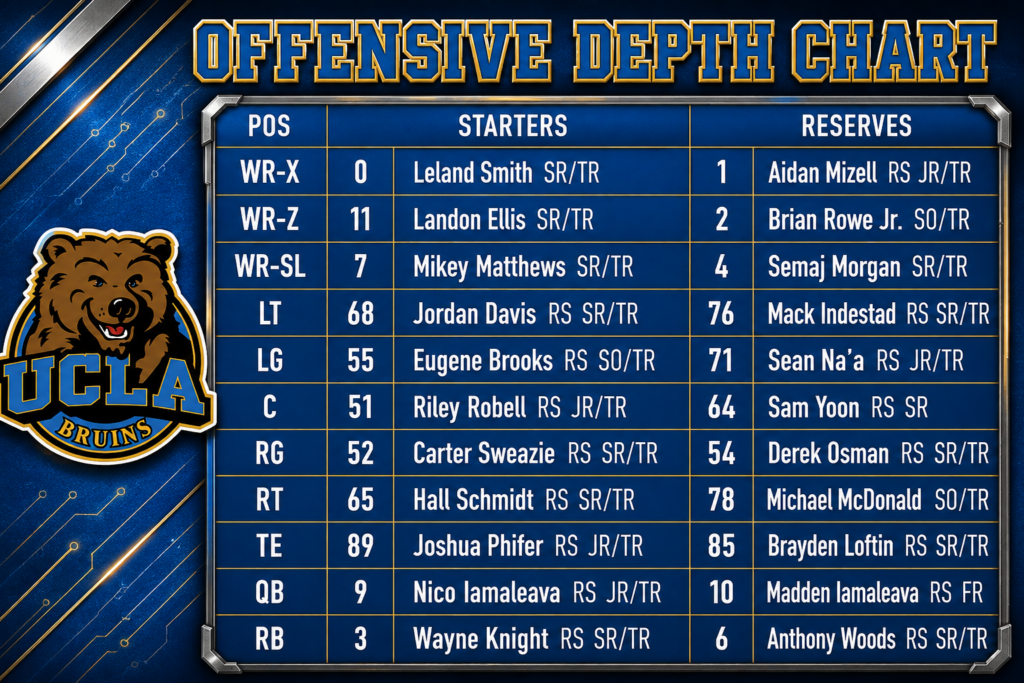
Offensive Outlook
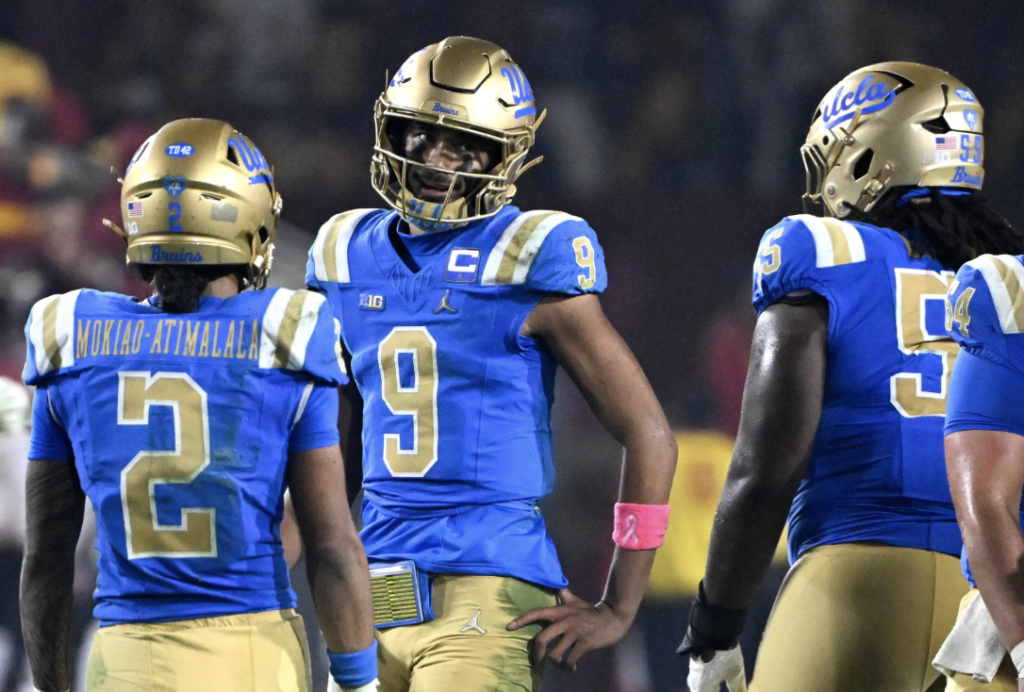
UCLA enters 2026 as one of the most intriguing teams in the middle of the Big Ten because Nico Iamaleava is back, but virtually everything around him has changed. Iamaleava’s first season in Westwood was hardly perfect, yet the raw numbers don’t completely capture what he meant to the offense. In 11 starts, he completed 64.4% of his passes for 1,928 yards, 13 touchdowns and seven interceptions, while also leading UCLA in rushing with 505 yards and four touchdowns. He accounted for 17 of the Bruins’ 24 touchdowns and led the team in rushing in five different games. I’ve always been somewhat higher on his physical talent than his statistical production—at 6-foot-5 with a strong arm and legitimate open-field athleticism, there are things he can do that most quarterbacks simply can’t.
We saw the ceiling against Penn State. Iamaleava led UCLA to a stunning 42–37 victory over No. 7 Penn State, throwing two touchdowns while rushing for 128 yards and three more scores. One week later, he threw three touchdowns in a 38–13 road victory over Michigan State. Those performances are why I haven’t given up on the idea that Iamaleava can develop into a high-level Big Ten quarterback. The problem has always been consistency. UCLA needs the version that showed up against Penn State more frequently rather than in isolated flashes.
New head coach Bob Chesney should help. Chesney arrives after going 21–6 in two seasons at James Madison, culminating in an 8–0 Sun Belt record, conference championship and College Football Playoff berth in 2025. His final JMU team ranked ninth nationally in scoring offense and 15th in total offense. He has won eight conference championships during his career and owns a 132–52 record as a head coach. This is obviously a massive jump in competition, but UCLA is betting on a coach whose teams have consistently improved wherever he has been.
Chesney also brought one of his most dangerous players with him. Running back Wayne Knight arrives from James Madison after earning second-team AP All-America honors in 2025, giving UCLA an explosive piece for the new offense. Anthony Woods returns in the backfield as well, while the receiving corps has been rebuilt around transfers Leland Smith, Aidan Mizell, Semaj Morgan and Brian Rowe Jr., with former Utah Ute Mikey Matthews also returning. There isn’t a proven superstar in that group, but there is significantly more experience than UCLA had available at several points last season.
Iamaleava also has an unusual resource available to him this year: former NFL quarterback Derek Carr, who joined Chesney’s staff as a special advisor and will work directly with UCLA’s quarterbacks while assisting with game planning. I wouldn’t overstate the impact of one staff addition, but for a quarterback whose development remains the single biggest variable on this team, having an 11-year NFL veteran working with the position certainly doesn’t hurt.
The offensive line is where my concern remains. UCLA can add receivers and build an offense around Iamaleava’s mobility, but the Bruins can’t ask him to be their leading rusher again while simultaneously expecting major growth as a passer. The best version of this offense makes Nico’s running ability an additional weapon rather than the foundation holding everything together. If Chesney can establish Knight and Woods in the running game and give Iamaleava cleaner situations, I think UCLA’s offense can take a noticeable step forward.
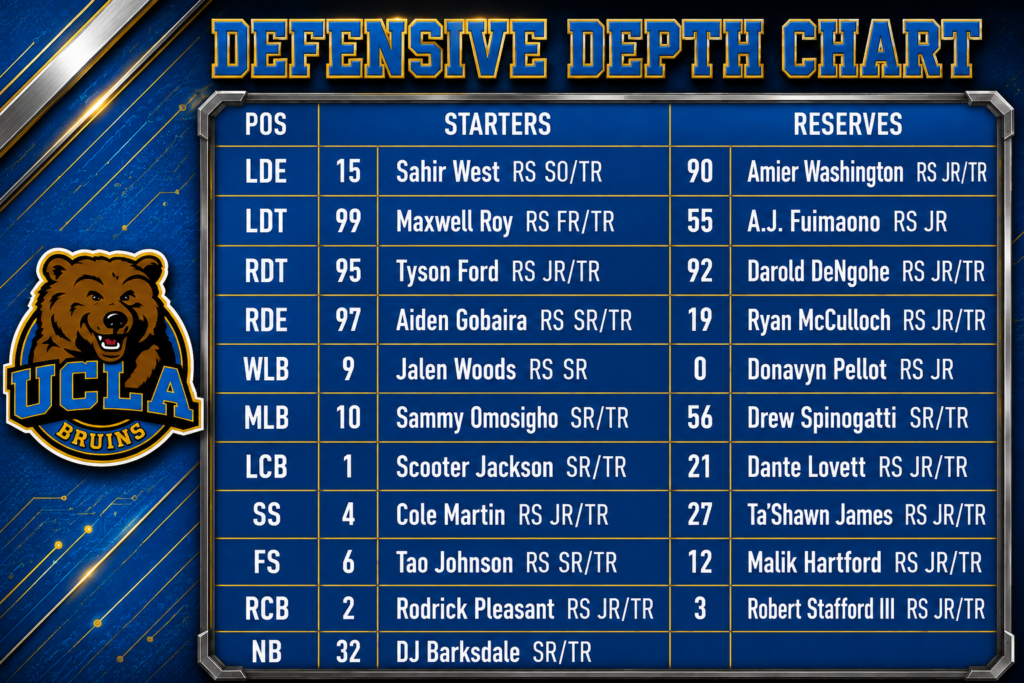
Defensive Outlook
Chesney’s arrival might ultimately make an even larger difference defensively. His final James Madison team ranked fifth nationally in total defense and 13th in scoring defense, and UCLA badly needs some of that identity to translate to Westwood. The Bruins were too inconsistent defensively last season, and their inability to consistently control games placed even more pressure on an offense that was already struggling to generate points.
One of the most important additions is former Oklahoma linebacker Sammy Omosigho. He appeared in 36 games for the Sooners and finished fifth on Oklahoma with 50 tackles in 2025, despite operating in a reserve role, while adding 4.5 tackles for loss, two sacks and three pass breakups. At 6-foot-2 and 239 pounds, Omosigho gives UCLA exactly the kind of experienced Power Four linebacker it needed. He was one of three players Chesney selected to represent the program at Big Ten Media Days, which tells you how quickly he has become an important part of the team.
The secondary may be the most interesting position group on the defense. UCLA added former Oregon corner Rodrick Pleasant, former Miami defensive back Robert Stafford III, former Ohio State safety Malik Hartford and former Louisville defensive back Aaron Williams. Returning pieces include starting safeties Cole Martin and Tao Johnson. That’s a lot of transfer movement, but it also gives Chesney a collection of players who have already competed at major programs.
Up front, Nico Davillier returns to provide experience, while the larger challenge will be developing enough depth to survive against Big Ten offensive lines for nine conference games. That’s where UCLA still looks different from Ohio State, Oregon, Michigan or even some of the better developmental programs in the conference. The Bruins can put a competitive starting group on the field. The concern is what happens after injuries accumulate and opponents begin cycling eight or nine quality offensive linemen and defensive linemen throughout games.
Still, this is one area where I’m willing to give Chesney some benefit of the doubt. His teams have consistently played disciplined defense, and his 2025 James Madison team demonstrated that his success wasn’t dependent exclusively on overwhelming opponents offensively. I don’t expect UCLA to suddenly field an elite Big Ten defense, but I do expect it to become more organized, more physical and more difficult to exploit. For a team trying to get back to bowl eligibility, that improvement could be enough.
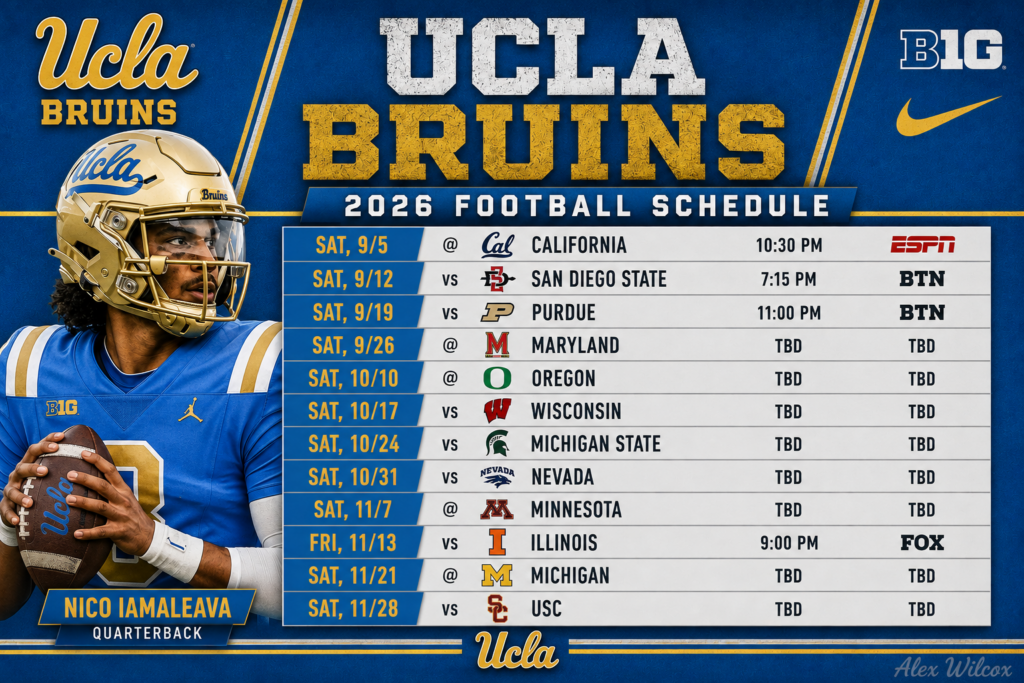
Overview and Projection
I have UCLA finishing 6–6 and 4–5 in conference play, returning to a bowl game and establishing a solid foundation in Chesney’s first season. That’s not a spectacular prediction, but I think the trajectory matters more than the raw win total this year. UCLA needs to rediscover a coherent identity, develop its roster and determine whether Iamaleava can finally turn his enormous physical potential into consistent quarterback play.
If Nico does that faster than I’m expecting, 6–6 could become 7–5 or even 8–4 because there are enough winnable games on this schedule. But for now, I’m treating 2026 as the beginning of the Chesney rebuild rather than its finished product. And given his track record, UCLA may finally have the coach capable of turning the program’s considerable potential into something sustainable.
Projected Record: 6-6 (4-5)
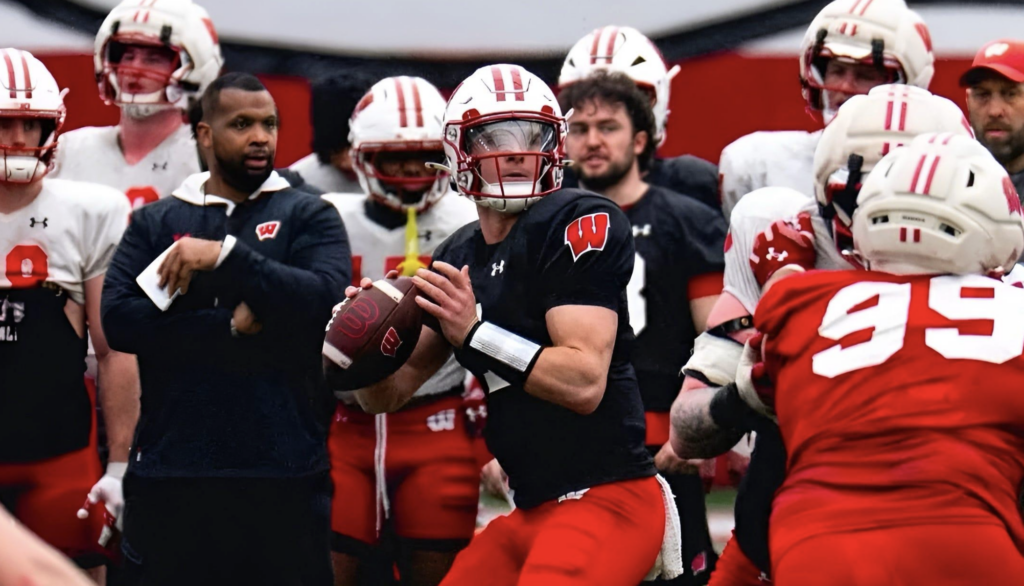
Wisconsin Badgers
Offensive Outlook
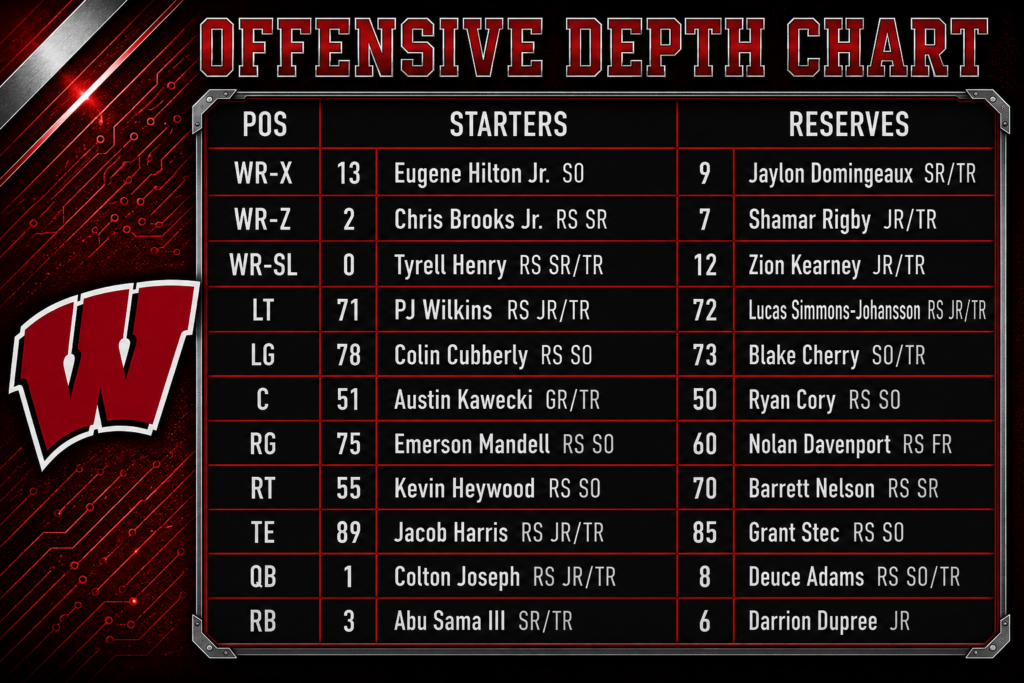
There may not be an offense in the Big Ten that needs a fresh start more than Wisconsin’s. The Badgers were genuinely dreadful offensively in 2025, averaging only 12.8 points and 253.1 total yards per game, while producing just 136.4 passing yards per game and 4.4 yards per play. Wisconsin scored only 19 offensive touchdowns all season, converted 32.3% of its third downs and was shut out by both Iowa and Ohio State. Injuries and instability at quarterback certainly contributed—four different quarterbacks attempted at least 16 passes—but regardless of the explanation, that level of offensive production simply isn’t sustainable in the modern Big Ten.
That’s why Colton Joseph is the most important player of the Luke Fickell era. The Old Dominion transfer arrives after winning Sun Belt Offensive Player of the Year in 2025, when he threw for 2,624 yards while rushing for 1,007, becoming one of only two FBS quarterbacks to surpass both 2,000 passing yards and 1,000 rushing yards. He’s a legitimate dual-threat quarterback who can create offense when protection breaks down, add an extra number to the running game and turn broken plays into positive yardage. After watching Wisconsin struggle to manufacture virtually anything explosive last season, that athleticism alone changes the complexion of the offense.
The other major change is philosophical. Jeff Grimes takes over as offensive coordinator, with Kenny Guiton coaching the quarterbacks and Eric Mateos handling the offensive line. This feels like an important correction for Fickell. The attempt to completely reinvent Wisconsin’s offensive identity never really worked, and Grimes’ approach gives the Badgers an opportunity to reconnect with what historically made this program successful: run the football, use size up front and create explosive passes off that foundation. Joseph’s mobility adds another dimension to that formula.
Wisconsin was aggressive in rebuilding the supporting cast as well. The transfer class includes receivers Malachai Coleman, Jaylon Domingeaux and Zion Kearney, tight end Jacob Harris, Oklahoma State offensive lineman Austin Kawecki and 230-pound running back Bryan Jackson. Returning receivers such as Tyrell Henry provide additional experience, and the goal should be to build an offense where Joseph doesn’t have to carry everything himself.
I’m not expecting Wisconsin to suddenly become an offensive juggernaut. Going from 12.8 points per game to even an average Big Ten offense would represent enormous improvement. But Joseph gives Wisconsin something it simply didn’t have consistently last year: a quarterback capable of creating offense on his own. If Grimes can rebuild the running game around him and the offensive line stabilizes, Wisconsin should be substantially more functional. For this team, merely becoming competent offensively could change several results.
Defensive Outlook
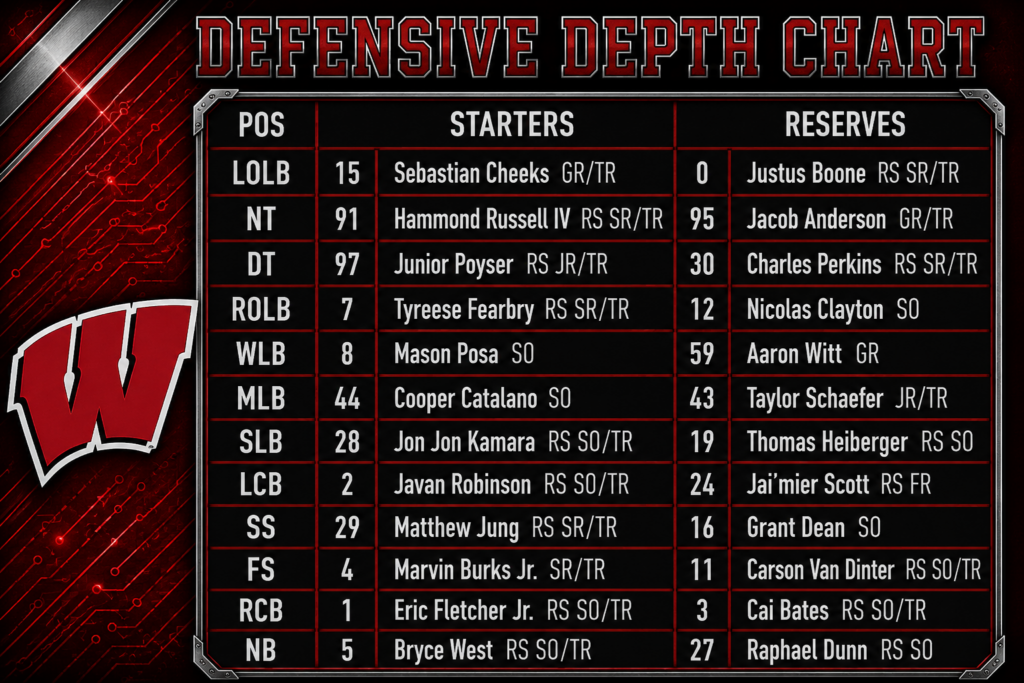
The frustrating part about Wisconsin’s 4–8 season is that the defense was often good enough to win. The Badgers allowed 21.6 points and 323.5 yards per game, including only 105.2 rushing yards per game and 3.4 yards per carry. Those numbers become more impressive when you consider how little help the unit received from an offense that routinely failed to sustain drives.
There were flashes against quality competition that showed what this defense can be. Wisconsin went to Oregon and held the Ducks to 21 points, then upset No. 23 Washington 13–10 and later beat No. 21 Illinois 27–10. The Badgers weren’t losing exclusively because they were physically incapable of competing with good Big Ten teams. Too often, the defense simply had almost no margin for error.
Mike Tressel remains defensive coordinator, and Wisconsin supplemented his roster aggressively through the portal. Former Arkansas edge defender Justus Boone brings excellent size at 6-foot-5 and 278 pounds, Appalachian State transfer DeNigel Cooper adds another 260-pound piece up front, and Jon Jon Kamara arrives from Kansas as a versatile 6-foot-4 linebacker capable of playing inside or on the edge. Wisconsin also added former Oklahoma State cornerback Eric Fletcher, giving the secondary another experienced option.
What I like about this side of the roster is that Wisconsin doesn’t need a dramatic transformation. The defense already demonstrated that it could keep the Badgers competitive. Holding opponents to 3.4 yards per rushing attempt in a conference built around physical football is a legitimate strength. The objective now is to create more negative plays and force more turnovers—Wisconsin intercepted only five passes all of last season. An offense capable of occasionally building a lead would also allow Tressel to be more aggressive rather than constantly defending games where one mistake could effectively end Wisconsin’s chances.
I expect the defense to once again be the strength of this team. It isn’t talented enough to become an Ohio State-level unit, but it doesn’t have to be. If Wisconsin can remain strong against the run, generate a little more pressure and get even an average offense on the other side, this defense is good enough to get the Badgers back to a bowl game.
Overview and Projection
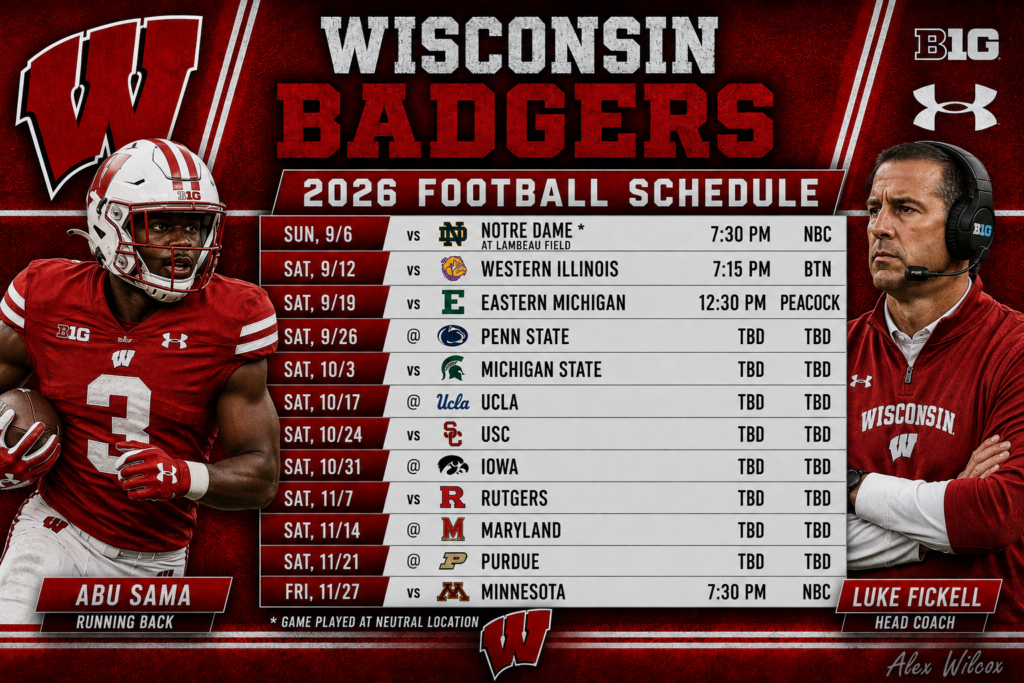
I have Wisconsin finishing 6–6 and 4–5 in conference play, returning to a bowl game but remaining firmly in the Big Ten’s middle tier. There’s upside beyond that if Joseph becomes one of the conference’s breakout quarterbacks, but I’m not ready to overlook consecutive losing seasons or assume one transfer fixes every offensive problem.
For Luke Fickell, we will see if 6 or 7 wins is enough to keep the critics at bay and ward off Badger donors long enough to earn one more season on the job.
Projected Record: 6-6 (4-5)
Nebraska Cornhuskers
Offensive Outlook
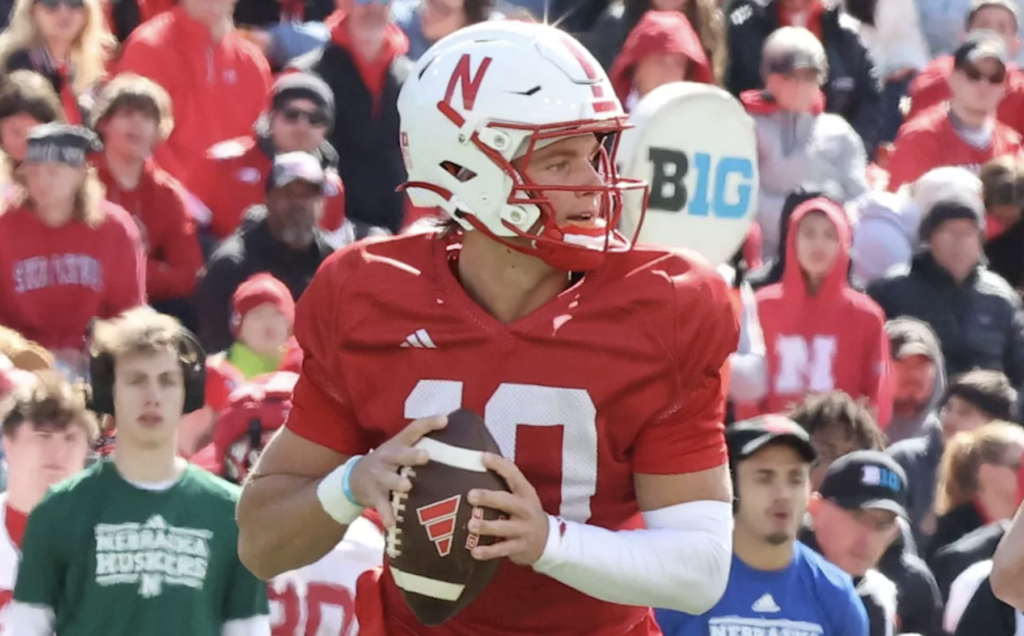
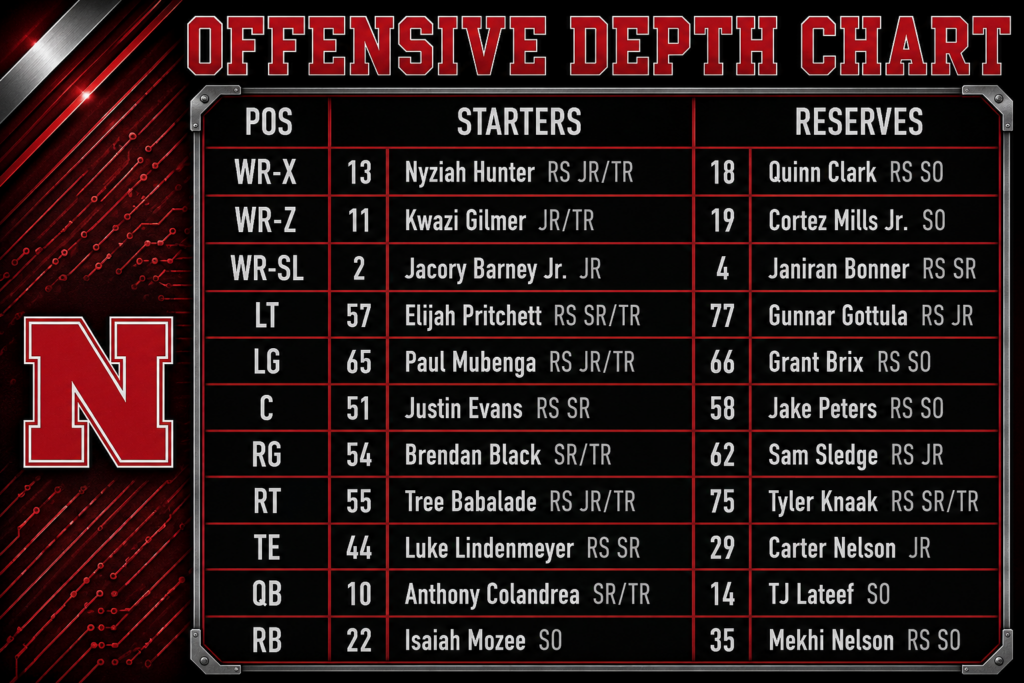
Nebraska enters 2026 at a fascinating point in Matt Rhule’s rebuild. The Huskers have improved their regular-season win total in each of Rhule’s first three seasons, reaching 7–5 in 2025 before losing to Utah in the Las Vegas Bowl. But the biggest storyline entering Year 4 is a major change at quarterback. Dylan Raiola is gone, and Nebraska has replaced him with one of the most productive dual-threat quarterbacks available in the transfer portal: Anthony Colandrea.
I like the fit considerably. Colandrea arrives after winning Mountain West Offensive Player of the Year at UNLV, where he completed 275 of 417 passes for 3,459 yards and 23 touchdowns while adding 649 rushing yards and 10 touchdowns. He enters Nebraska with 31 career starts, 7,542 career passing yards, 49 passing touchdowns and another 1,151 yards on the ground between Virginia and UNLV. That’s why we graded Colandrea at 80 in our Big Ten quarterback evaluation. He isn’t in the Sayin-Moore-Maiava tier as a pure passer, but his mobility gives Nebraska something different. He can extend plays, punish man coverage with his legs and manufacture offense when protection breaks down.
The receiving corps could be one of the more underrated groups in the conference. Jacory Barney Jr. returns as an established playmaker, and Nebraska supplemented him with UCLA transfer Kwazi Gilmer and former Cal Golden Bear Nyziah Hunter. Demitrius Bell, Janiran Bonner and Cortez Mills Jr. give the Huskers additional options, while Luke Lindenmeyer returns at tight end. There’s enough athleticism here that Colandrea shouldn’t have to manufacture the passing game by himself.
Running back is more uncertain. Kwinten Ives, Isaiah Mozee, Conor Booth and Mekhi Nelson are among the options on the current roster, and Nebraska needs someone to emerge as the dependable complement to Colandrea. That’s particularly important because I don’t want Nebraska falling into the trap of using its quarterback as its primary rushing offense simply because he can do it. Colandrea ran effectively at UNLV, but the best version of this offense uses his mobility as a weapon rather than a necessity.
The offensive line remains one of the most important variables. Justin Evans is an established veteran in the middle, while Elijah Pritchett, Tree Babalade, Brendan Black and Ashton Murphy are among the pieces competing up front. Under Dana Holgorsen, Nebraska has enough quarterback experience and skill talent to become considerably more explosive. The concern is whether the offensive line and running backs can create enough consistency that Colandrea isn’t constantly being asked to rescue possessions.
That’s why I think Nebraska’s offense has an interesting ceiling. Colandrea is aggressive, mobile and experienced, and Holgorsen has spent his career building productive offenses around quarterbacks with those characteristics. If Nebraska protects him and develops a reliable running game, this could quietly become one of the more difficult offenses in the middle tier of the Big Ten to defend.
Defensive Outlook
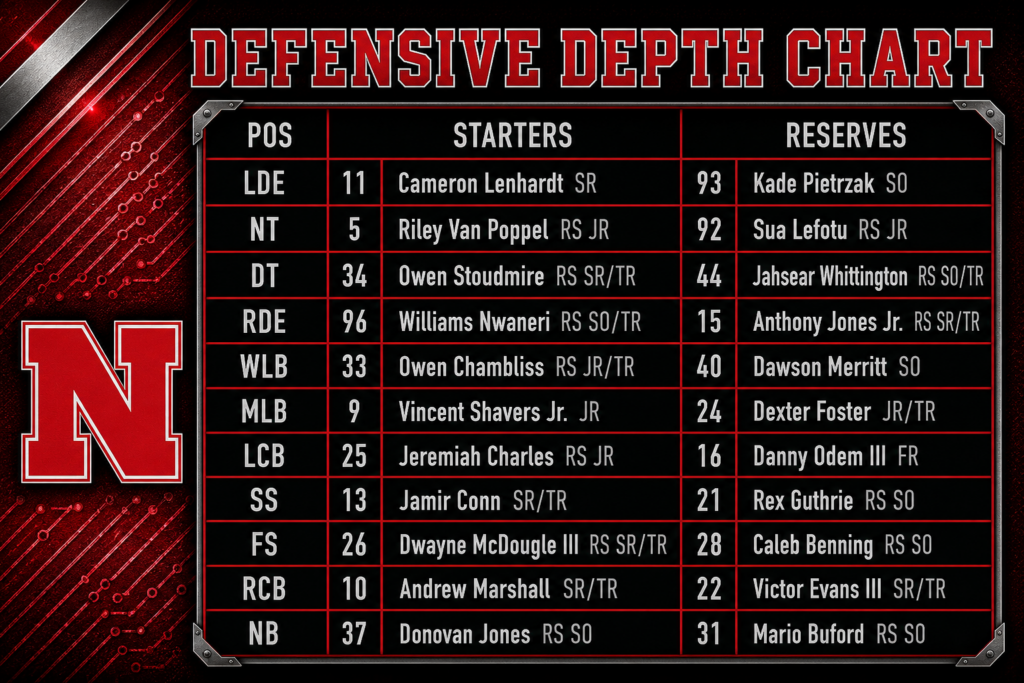
The defense is probably the biggest reason I hesitate to push Nebraska higher than seven wins. There were encouraging elements in 2025, particularly in the secondary. Nebraska finished third nationally in pass defense, and young defensive back Donovan Jones emerged immediately, starting 11 games as a redshirt freshman and recording 59 tackles and five pass breakups. That’s an excellent foundation for a player who still has multiple years of development ahead of him.
Andrew Marshall gives Nebraska another proven piece on the back end after earning honorable-mention All-Big Ten honors in 2025, and he was selected as one of Nebraska’s representatives at Big Ten Media Days. The current roster also includes former Georgia defensive back Justyn Rhett, giving the secondary another physically talented option. With Jones and Marshall leading the group, I’m fairly comfortable with Nebraska’s ability to defend the pass.
The larger concern is the front seven. Riley Van Poppel provides excellent size at 6-foot-5 and 305 pounds, while Cameron Lenhardt returns on the defensive line and Vincent Shavers Jr. gives Nebraska experience at linebacker. There are useful pieces here, but I don’t see the kind of proven disruptive front that would make me comfortable projecting Nebraska against the best offensive lines on its schedule.
That’s especially relevant after the way 2025 ended. Nebraska allowed 37 points to Penn State, 40 to Iowa and 44 to Utah in its final three games, losing all three after reaching 7–3. That finish exposed the remaining gap between Nebraska becoming a respectable Big Ten team and becoming a genuinely good one. The Huskers have improved their overall talent level under Rhule, but they still need greater consistency when games become physical late in the season.
The secondary gives Nebraska a chance to be good defensively, but the front seven needs to take a meaningful step. If the Huskers can become more disruptive at the line of scrimmage without sacrificing what made their pass defense successful, this unit has upside. If not, the elite teams on this schedule are going to create serious problems.
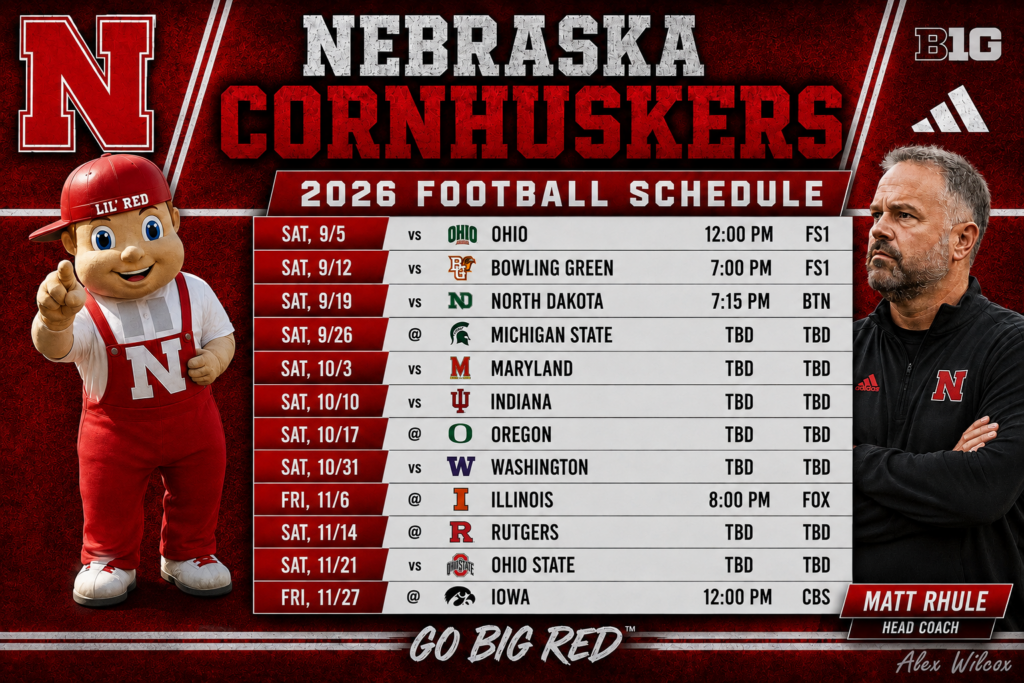
Overview and Projection
I have Nebraska finishing 7–5 and 4–5 in conference play, making a third consecutive bowl but remaining firmly outside the Big Ten’s upper tier. I like Colandrea’s fit with Holgorsen enough that I think the offense could be better than many expect, and Nebraska’s secondary gives the defense a legitimate strength. But the combination of questions in the trenches and an unforgiving conference schedule keeps me from pushing the Huskers toward eight or nine wins.
Projected Record: 7-5 (4-5)
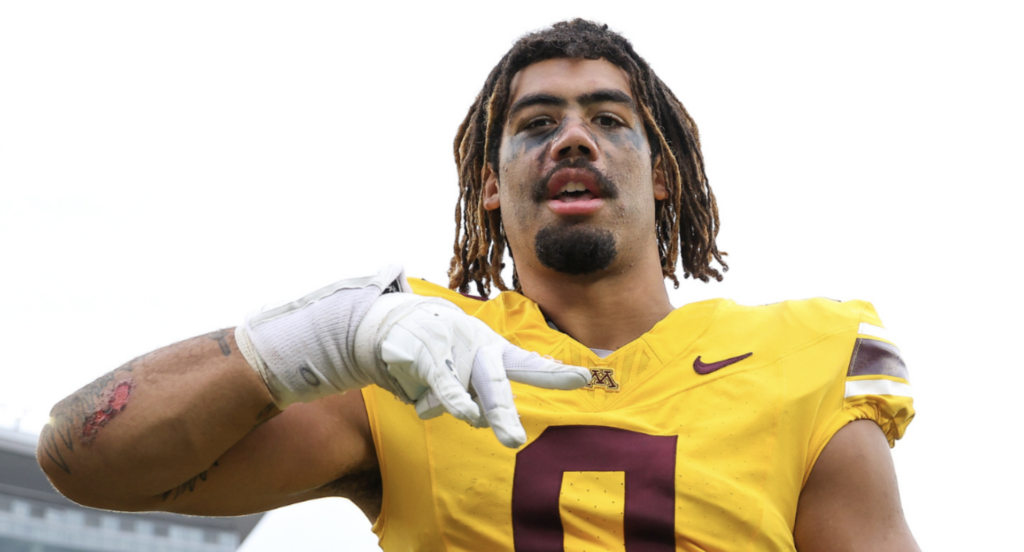
Minnesota Golden Gophers
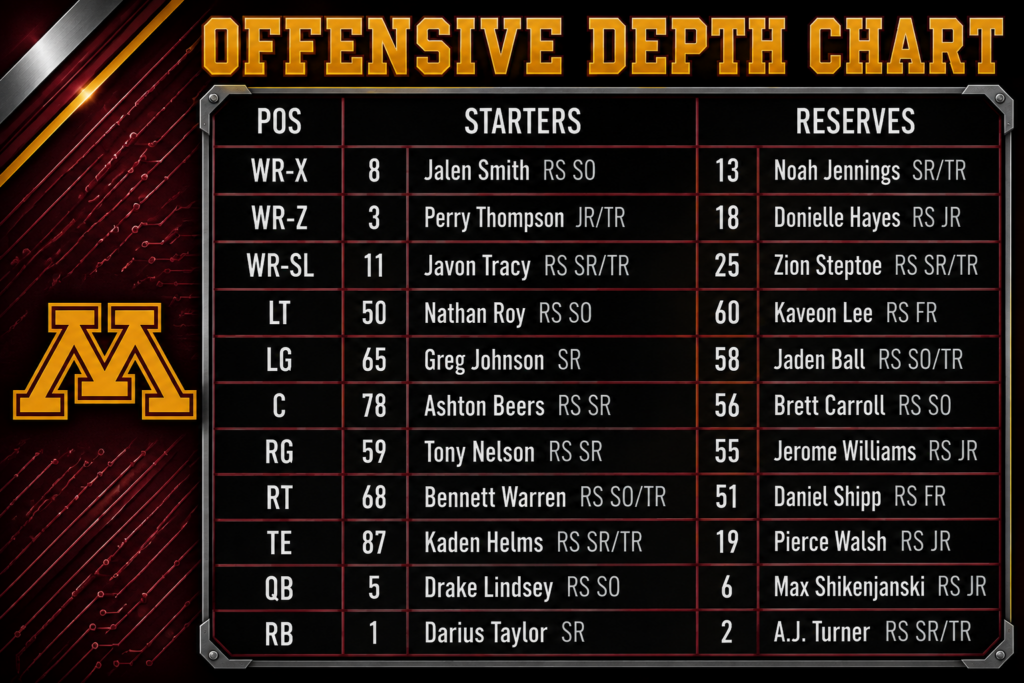
Offensive Outlook
The Golden Gohpers enter 2026 with something that can be extremely valuable in the modern Big Ten: continuity at quarterback. Drake Lindsey is back after starting all 13 games as a redshirt freshman in 2025 and producing one of the better debut seasons by a quarterback in program history. Lindsey completed 63.2% of his passes for 2,382 yards, 18 touchdowns and only six interceptions, setting a Minnesota record with eight wins by a freshman starting quarterback. His 3-to-1 touchdown-to-interception ratio tied for third-best in a single season in school history.
At 6-foot-5 and 230 pounds, Lindsey has prototypical size, and the biggest positive from his freshman season was how rarely he put Minnesota in disastrous situations. He wasn’t spectacular every week, but asking a first-year starter to manage a Big Ten offense while throwing only six interceptions is encouraging. The next step is creating more explosive plays. Minnesota averaged only 23.0 points, 293.2 yards and 4.9 yards per play last season, including just 189.9 passing yards per game. If Lindsey makes the normal sophomore-to-junior developmental jump, those numbers should improve.
The best news for him is that Darius Taylor is back. Taylor remains one of the most complete running backs in the conference when healthy. Despite playing only 10 games last season, he rushed for 670 yards and four touchdowns on 143 carries and caught 34 passes for another 245 yards. He previously rushed for 986 yards and 10 touchdowns in 2024 while catching 54 passes. The issue has never really been Taylor’s ability; it has been keeping him on the field. He missed games in 2025 and was knocked out early against Iowa. If Minnesota gets a healthy 12-game season from him, he gives Lindsey a proven three-down weapon who can become the foundation of the offense.
There’s additional depth behind him. A.J. Turner returns after his 2025 season was cut short by injury, and Minnesota can use his speed to complement Taylor’s more complete skill set. At receiver, Javon Tracy returns after leading Minnesota with six touchdown receptions last season, while former Auburn receiver Perry Thompson gives the Gophers a fascinating addition at 6-foot-3 and 220 pounds. Thompson was a highly regarded recruit coming out of high school, and Minnesota doesn’t need him to immediately become an All-Big Ten receiver. It needs him to provide size and explosiveness on the outside that can help Lindsey push the football vertically.
Up front, Greg Johnson is a particularly important piece. He started all 13 games last season and has experience at center, guard and tackle, giving Minnesota valuable versatility as it assembles its best five. This is where I think the offense ultimately has to improve the most. Minnesota averaged only 103.2 rushing yards per game and 3.6 yards per carry in 2025. For a P.J. Fleck team with Taylor in the backfield, that’s simply not good enough.
Offensive coordinator Greg Harbaugh Jr. now has a second full season with Lindsey as his starter, and that continuity should allow Minnesota to expand what it asks its quarterback to do. I don’t expect the Gophers to suddenly become one of the conference’s most explosive offenses. But Lindsey no longer needs to be protected like a first-year starter. If his development combines with a healthier Taylor and an improved offensive line, Minnesota has a realistic path from 23 points per game toward the upper 20s—and that would make this team substantially more dangerous.
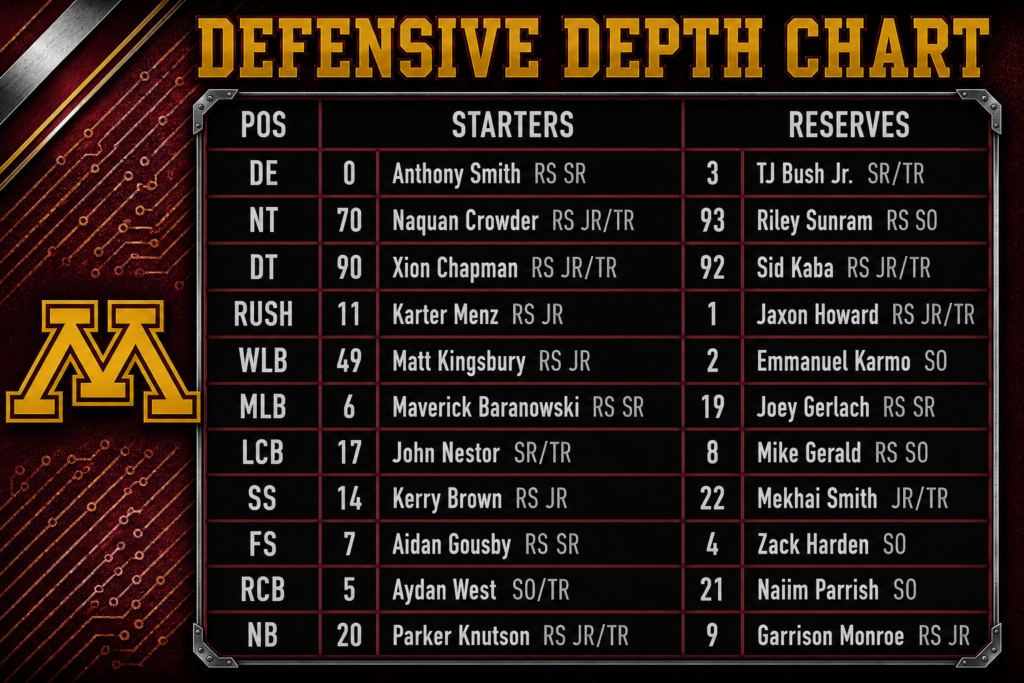
Defensive Outlook
This is the side of the football that gives Minnesota its floor, and the centerpiece is one of the best defensive linemen in the Big Ten.
Anthony Smith was outstanding in 2025. The 6-foot-6, 280-pound defensive end recorded 38 tackles, 17.5 tackles for loss and a Big Ten-leading 12.5 sacks, earning first-team All-Big Ten honors. He became the first Minnesota player since Karon Riley in 2000 to lead the conference in sacks. Smith isn’t merely a good returning starter; he’s the kind of edge defender opposing offenses have to specifically account for in their protection plan.
And Minnesota’s pass rush wasn’t a one-man operation. Under defensive coordinator Danny Collins, the Gophers generated 39 sacks in 2025, tying for sixth nationally at three sacks per game and finishing 11th nationally with 7.1 tackles for loss per game. Those 39 sacks were Minnesota’s most since 1999. Jaxon Howard contributed four sacks, and he returns alongside Smith in 2026. That gives Minnesota one of the more intriguing veteran edge combinations in the conference.
Linebacker Maverick Baranowski is another major reason I trust this defense. He led Minnesota with 103 tackles last season, becoming the program’s first 100-tackle player since Blake Cashman in 2018. Baranowski, Lindsey and Smith were chosen to represent Minnesota at Big Ten Media Days, which tells you exactly who Fleck views as the central veteran leaders of this roster. Sophomore Emmanuel Karmo is another player worth watching at linebacker as Minnesota tries to replace production around Baranowski.
The secondary is where there is more uncertainty. Minnesota allowed 210.5 passing yards per game and opponents completed 67% of their passes last season, although the Gophers intercepted nine passes. The current roster includes Aydan West, Zack Harden, Jay’Quan Stubbs and Elisha West among the defensive backs who will be asked to help reshape the unit. Minnesota doesn’t necessarily need an elite secondary if Smith and the defensive front continue generating pressure, but it can’t afford to give away explosive plays against the quarterbacks on this year’s schedule.
Overall, Minnesota’s 2025 defense allowed 22.9 points and 331.6 yards per game, including only 121.1 rushing yards per game and 3.7 yards per carry. Those aren’t dominant numbers, but they’re solid—and the pass rush gives this year’s group something around which Collins can build.
Smith is the difference-maker. There simply aren’t many 280-pound defensive ends who can produce 12.5 sacks in Big Ten football. With him returning alongside Howard and Baranowski, I expect Minnesota to remain physical against the run and disruptive up front. The secondary will determine whether this is merely a solid defense or something better.
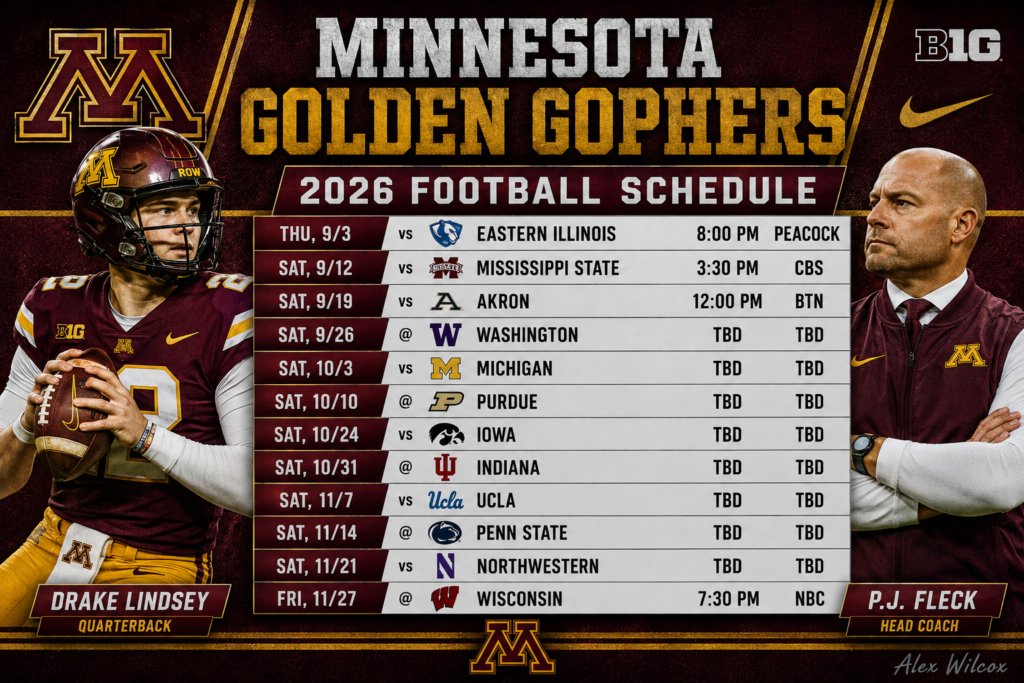
Overview and Projection
I have Minnesota finishing 6–6 and 3–6 in conference play, reaching another bowl game but getting squeezed by one of the more difficult Big Ten schedules in the league. The record doesn’t fully reflect how much I respect the roster. Smith gives Minnesota an elite defensive centerpiece, Baranowski anchors the middle, Taylor remains a proven offensive weapon and Lindsey gives the program legitimate long-term hope at quarterback.
Minnesota isn’t talented enough to consistently beat the Big Ten’s heavyweights. But under Fleck, it has become exactly the kind of team those heavyweights don’t enjoy playing. The Gophers are physical, experienced and rarely easy to put away—and if Lindsey makes the leap I think he’s capable of making, six wins could prove to be the floor rather than the ceiling.
Projected Record: 6-6 (3-6)
Northwestern Wildcats
Offensive Outlook
Northwestern enters 2026 in a much different place than it did a year ago. The Wildcats quietly went 7–6 overall and 4–5 in the Big Ten in 2025, then finished the season by beating Central Michigan in the GameAbove Sports Bowl. Now David Braun has made two moves that make Northwestern considerably more interesting than its preseason profile might suggest: bringing in former Michigan State quarterback Aidan Chiles and hiring Chip Kelly as offensive coordinator.
Chiles is the centerpiece. Chiles completed 63.1% of his passes for 1,392 yards, 10 touchdowns and only three interceptions across nine appearances and eight starts for Michigan State before an injury ended his season. He also rushed for 227 yards and six touchdowns. That three-interception figure is particularly important after he threw 11 interceptions in 2024.
At 6-foot-4 and 225 pounds, Chiles has always possessed the tools. He has a strong arm, legitimate mobility and enough athletic ability to create outside structure. His problem has been turning those traits into consistent quarterback play. That’s what makes the pairing with Kelly fascinating. Kelly has spent decades building offenses around quarterback mobility and creating favorable numbers in the running game, and Chiles may actually be a better schematic fit for him than his previous statistics indicate. Northwestern doesn’t need Chiles throwing 40 times every Saturday. It needs Kelly to simplify his decisions, weaponize his legs and reduce the high-risk plays that have defined stretches of his career.
And unlike many quarterbacks arriving at rebuilding programs, Chiles inherits a legitimate No. 1 receiver. Griffin Wilde was excellent in 2025, catching 71 passes for 880 yards and eight touchdowns. He finished third in the Big Ten in receptions, sixth in receiving yards and seventh in receiving touchdowns, while his 880 yards were the most by a Northwestern receiver since 2016. He then capped the year with 10 catches for 97 yards and two touchdowns in the bowl victory. Wilde gives Chiles an established target he can trust immediately.
Running back Joseph Himon II is another important returner. Himon rushed for 486 yards on 99 carries last season—4.9 yards per attempt—and added 21 receptions for 118 yards. He showed his versatility in Northwestern’s road win at Penn State, producing 103 yards from scrimmage on 17 touches. I expect Kelly to find creative ways to use him, particularly alongside a quarterback whose rushing ability forces defenses to account for an additional gap.
The offensive line also has a legitimate building block in Jackson Carsello. He started every game at center last season and earned a 79.8 PFF grade, which ranked fourth nationally among centers, while his run-blocking grade ranked fourth nationally and second in the Big Ten at the position. = That’s exactly the type of veteran presence Northwestern needs while transitioning into Kelly’s system.
I’m still cautious about the overall talent level. Northwestern doesn’t have Ohio State’s receivers, Oregon’s depth or Michigan’s ability to simply overwhelm opponents at the line of scrimmage. But this offense has more intriguing pieces than people may realize. Chiles, Wilde, Himon and Carsello give Kelly a legitimate core around which to build.
And Chiles is the wild card. I’ve been skeptical of him because the mistakes have been impossible to ignore throughout his career, but his 2025 improvement was real. If Kelly finally unlocks the player Chiles has always looked capable of becoming, Northwestern’s offense could outperform my expectations considerably.
Defensive Outlook
If the offense provides the intrigue, Northwestern’s defense provides the stability.
The Wildcats have developed several experienced defenders under Braun, and Robert Fitzgerald enters 2026 as the leader of the unit. Fitzgerald was outstanding last season, recording 115 tackles, 70 solo tackles, six tackles for loss, an interception and four pass breakups. His 115 tackles ranked second in the Big Ten, while his 70 solo tackles led the conference and tied for second nationally.
That’s remarkable production from a defensive back. Since 2005, Fitzgerald became only the fifth Northwestern defensive back to record at least 100 tackles in a season. Ideally, Northwestern probably doesn’t want a defensive back making quite that many tackles again, because it can indicate too many plays reaching the second and third levels. But Fitzgerald’s ability to clean up plays gives this defense a proven veteran centerpiece.
Linebacker Braydon Brus provides another. Brus started all 13 games last season and finished with 81 tackles, 4.5 tackles for loss, 2.5 sacks, four pass breakups and two forced fumbles, all career highs. He finished the season by leading Northwestern with 11 tackles in its bowl victory. Between Brus and Fitzgerald, Northwestern has two experienced tackling machines in the middle and back end of the defense.
Braun’s defensive background matters here. Northwestern isn’t going to consistently win individual matchups against the conference’s most talented offenses, so structure and discipline become essential. The Wildcats have to force opponents to execute, limit explosive plays and create enough negative situations to get off the field.
There were stretches last season when that formula worked extremely well. Northwestern shut out Purdue 19–0, holding the Boilermakers scoreless while generating 10 quarterback hurries and forcing turnovers. That’s the version of Northwestern’s defense that gives me confidence against the lower and middle portions of the Big Ten.
The issue is what happens when the talent gap becomes overwhelming. Northwestern’s 2026 schedule includes several offenses with dramatically more speed and depth than the Wildcats can reasonably match player-for-player. That’s where the defensive line becomes critical. If Northwestern can’t generate pressure without committing extra defenders, quarterbacks like Dante Moore and Julian Sayin are eventually going to find openings.
Still, I trust Braun’s ability to field a competent defense. Fitzgerald and Brus give Northwestern veteran leadership at the heart of the unit, and I expect the Wildcats to remain fundamentally sound enough to keep themselves competitive against teams in their own tier. The question isn’t whether Northwestern can play defense. It’s whether the defense can survive a schedule featuring several teams that simply possess substantially more talent.
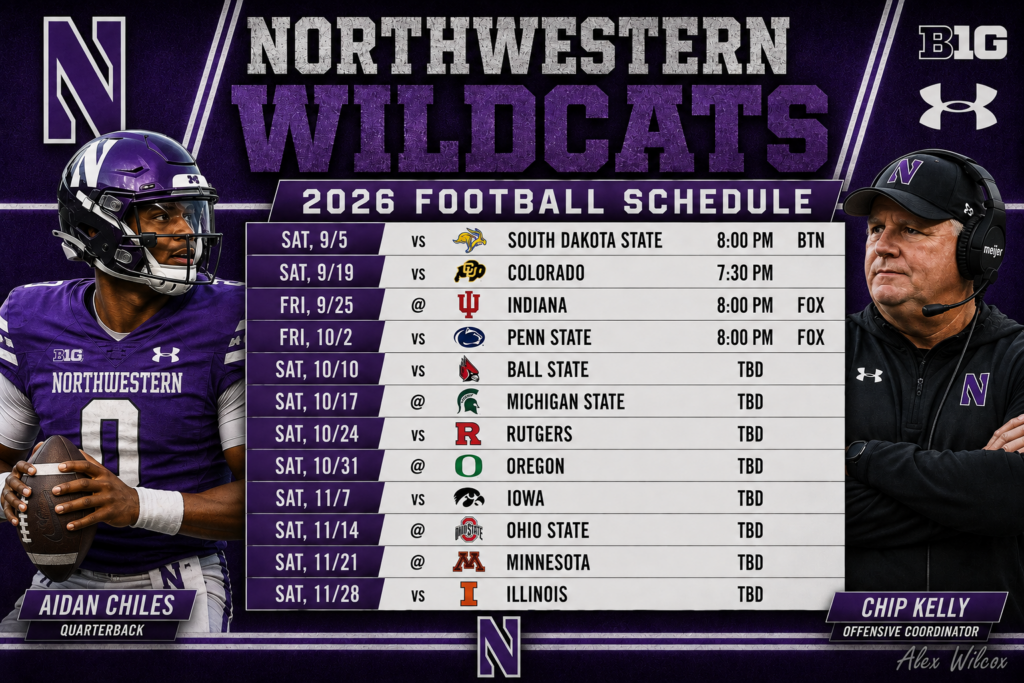
Overview and Projection
I have the Wildcats finishing 4–8 overall and 1–8 in the Big Ten.
I have Northwestern taking a step backward in the standings without necessarily taking a step backward as a program. Chiles and Kelly make the offense worth watching, Fitzgerald gives the defense an established leader and the opening of the new Ryan Field gives Northwestern another important piece of its long-term rebuild.
If there’s one team near the bottom of my Big Ten standings that I could see making this prediction look overly pessimistic, Northwestern is probably it. The schedule says four wins. But if Kelly unlocks Chiles, the Wildcats have enough pieces to make things much more interesting than that.
Projected Record: 4-8 (1-8)
Rutgers Scarlet Knights
Offensive Outlook
Rutgers enters 2026 with an unusual combination: legitimate high-end skill talent and major uncertainty at quarterback. The Scarlet Knights finished only 5–7 overall and 2–7 in the Big Ten last season, but offense wasn’t really the primary problem. Rutgers averaged 28.7 points and 407.1 yards per game, its best offensive yardage average since joining the Big Ten, while averaging 5.8 yards per play and converting 42.5% of its third downs. For a program that has spent much of its Big Ten existence struggling to generate offense, those numbers represented real progress under OC Kirk Ciarrocca.
Now Ciarrocca has to replace Athan Kaliakmanis, who surpassed 3,000 passing yards last season, and Rutgers has officially settled on Boston College transfer Dylan Lonergan as its starting quarterback. Lonergan started 10 games for Boston College in 2025, completing 66.9% of his passes for 2,025 yards and 12 touchdowns. He produced five 200-yard games and three 300-yard performances, including 390 yards against Michigan State.
The good news is that Lonergan inherits one of the best quarterback-friendly supporting casts Rutgers has had in years.
It starts with Antwan Raymond, who has developed into a legitimate star. Raymond rushed 244 times for 1,241 yards and 13 touchdowns last season while scoring two more touchdowns as a receiver. His 1,241 rushing yards ranked third in the Big Ten and 14th nationally, and he produced four 100-yard games, including a massive 240-yard performance against Maryland. Raymond gives Rutgers a player it can legitimately build an offense around. He isn’t merely a dependable Big Ten running back anymore; he’s one of the better returning backs in the conference.
Then there’s KJ Duff, who may be even more valuable. The 6-foot-6 receiver exploded for 60 catches, 1,084 yards and seven touchdowns in 2025, averaging an outstanding 18.1 yards per reception. His 90.3 receiving yards per game ranked third in the Big Ten, fourth among Power Four receivers and seventh nationally, while Pro Football Focus credited him with a nation-leading 22 contested catches. Duff enters 2026 as a Walter Camp preseason second-team All-American, and he’s exactly the kind of receiver who can make life easier for an inexperienced quarterback. Lonergan doesn’t always have to be perfect when he can throw the ball in Duff’s direction and let a 6-foot-6 receiver win.
Rutgers also returns Ben Black III and adds Jourdin Houston to the receiving corps, giving Ciarrocca more options beyond Duff. And the offensive line has a legitimate centerpiece in Kwabena Asamoah, who enters the season with 25 consecutive starts and earned All-America recognition last year. Tyler Needham provides additional experience and versatility up front.
Raymond gives Rutgers a 1,200-yard running back. Duff gives it a 1,000-yard receiver. The offensive line has experience, and Ciarrocca just coordinated the program’s most productive offense by yardage since it entered the Big Ten. Lonergan doesn’t need to carry Rutgers. He needs to distribute the football, protect it and allow the established playmakers around him to do the heavy lifting.
If he does that, I think Rutgers could once again have an offense capable of scoring enough points to reach a bowl game. Unfortunately, that wasn’t enough last season—and unless the defense changes dramatically, it may not be enough this year either.
Defensive Outlook
The Scarlet Knights were simply not good enough defensively in 2025. Rutgers allowed 31.8 points and 432.8 yards per game, including an alarming 209.9 rushing yards per game and 6.8 yards per rushing attempt. Opponents averaged 7.6 yards per play overall. Those numbers are almost impossible to overcome consistently in the Big Ten.
The contrast with the offense was striking. Rutgers controlled possession for more than 32 minutes per game and generated 407 yards offensively, yet still finished 5–7 because opponents could move the ball far too easily. That isn’t the type of football you normally associate with a Greg Schiano team. If anything, Rutgers’ identity historically has been the opposite: win with defense, special teams, physicality and field position while doing enough offensively to survive.
Schiano has responded with a significant change, installing Travis Johansen as defensive coordinator. The challenge is considerable because Rutgers also has to replace several of last season’s most productive defenders. Jett Elad led the team with 80 tackles and two interceptions, while Dariel Djabome recorded 71 tackles, 4.5 tackles for loss and two sacks. Losing established production from a defense that already struggled creates obvious concerns.
There are still useful pieces returning. Kaj Sanders recorded 65 tackles last season and gives the secondary an experienced player around whom Johansen can build. But Rutgers clearly understood it needed more immediate help, which is why the portal became so important.
One addition I particularly like is former Rice linebacker Ty Morris. Morris arrives with 153 career tackles, 17.5 tackles for loss and seven sacks across 37 collegiate games. In 2025 alone, he produced 88 tackles and 9.5 tackles for loss, earning honorable mention all-conference recognition. That’s exactly the type of experienced player Rutgers needed in the front seven: someone who has already played significant college football and can immediately help stabilize a unit that was gashed repeatedly last season.
The defensive line includes veterans such as Rondo Porter, Malachi Davis and J’Dan Burnett, while Sanders, Zahmir Dawud and Bradlee Jones are among the experienced options in the secondary. The question isn’t whether Rutgers has enough bodies. It’s whether Johansen can turn those pieces into a defense that stops surrendering explosive plays and, most importantly, stops the run.
That last point is non-negotiable. You cannot allow 6.8 yards per rushing attempt and expect to survive a Big Ten schedule. Rutgers doesn’t need to suddenly become a top-20 defense. If it can simply move from one of the conference’s weakest units toward average, the entire complexion of the team changes because the offense has enough legitimate weapons to win games.
Until I see it, though, this remains the biggest reason I’m bearish on Rutgers.
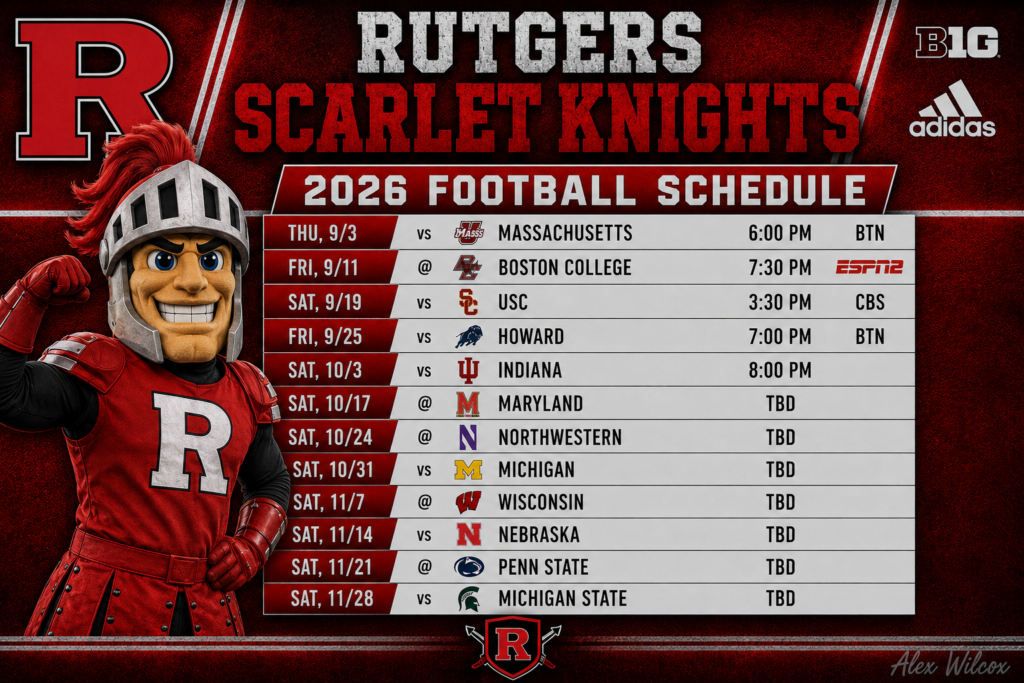
Overview and Projection
I have Rutgers finishing 4–8 and 1–8 in conference play, missing a bowl for the second consecutive season. But unlike some teams I’ve projected near the bottom of the conference, I can clearly see how Rutgers beats that number. If Lonergan provides stability and the defense improves from awful to merely average, six wins isn’t unrealistic.
Ultimately, though, Schiano has built his reputation on physical football and defense. Rutgers finally found an offense in 2025. Now it has to rediscover what a Greg Schiano defense is supposed to look like. Until that happens, it’s difficult for me to see the Scarlet Knights climbing very far in a Big Ten that gives them almost no margin for error.
Projected Record: 4-8 (1-8)
Michigan State Spartans
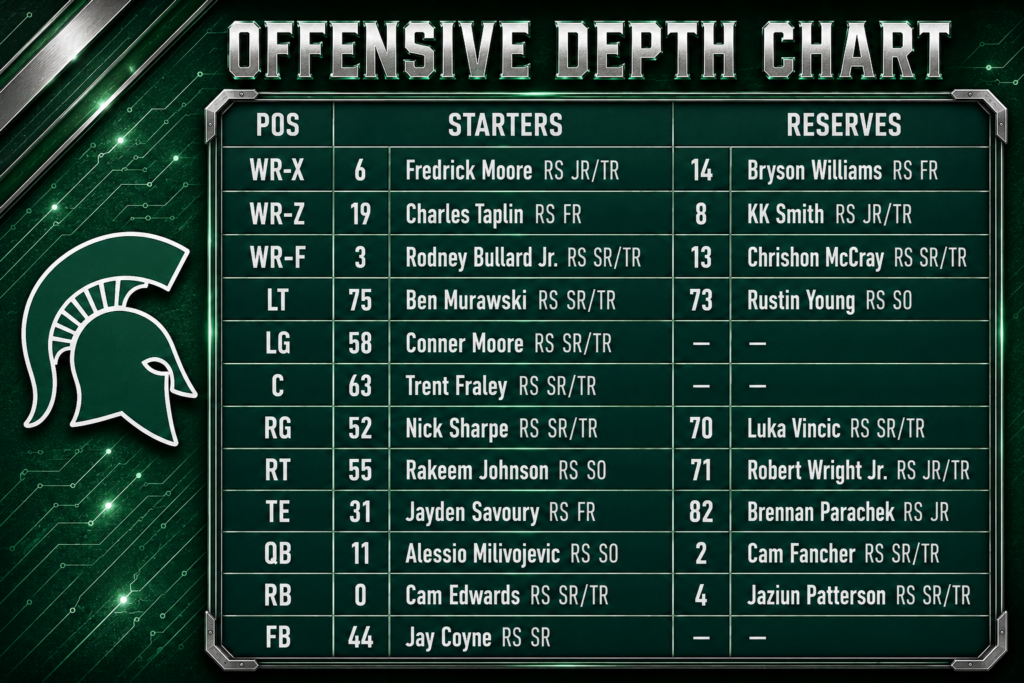
Offensive Outlook
Michigan State begins a new era in 2026 under Pat Fitzgerald, and unlike some first-year coaching situations, the Spartans aren’t starting completely from scratch offensively. The most important reason is quarterback Alessio Milivojevic, who gained valuable experience after taking over late last season. Milivojevic appeared in nine games and completed 64.2% of his passes for 1,267 yards, 10 touchdowns and only three interceptions. More importantly, he started Michigan State’s final four games, throwing for 986 yards and seven touchdowns during that stretch.
I think Milivojevic is one of the more interesting young quarterbacks in the bottom half of the conference. He isn’t an established star, but the late-season sample gives Michigan State something it didn’t have entering last year: a quarterback who has already taken meaningful Big Ten snaps and shown he can protect the football. His final start was particularly encouraging, as Michigan State snapped an eight-game losing streak with a 38–28 victory over Maryland. Fitzgerald also named Milivojevic one of Michigan State’s six captains this week, which is significant for a redshirt sophomore taking over a program undergoing such a substantial transition.
New offensive coordinator Nick Sheridan now gets the opportunity to build around him. Sheridan previously coordinated offenses at Indiana and Alabama, with his 2024 Crimson Tide offense averaging 33.8 points per game, third in the SEC. I like the hire because Michigan State desperately needs a more consistent offensive identity. The Spartans averaged only 24.6 points and 345.5 yards per game in 2025, rushed for just 122.8 yards per game, converted 34.8% of their third downs and surrendered 37 sacks. There were flashes of competent offense, but never enough consistency to survive a nine-game Big Ten schedule.
The most important transfer on this side of the ball may be running back Cam Edwards. Edwards arrives from UConn after rushing for 1,240 yards and 15 touchdowns on 210 carries last season—an excellent 5.9 yards per attempt—while adding 19 receptions for 187 yards and another touchdown. That is a major addition for an offense that struggled to run the football in 2025. Brandon Tullis returns after rushing for 301 yards on 69 carries, while transfers Jaziun Patterson, Marvis Parrish and Kenneth Williams give Sheridan considerably more depth in the backfield.
The receiving corps is much less proven. Michigan State added Jameel Gardner Jr. from Jackson State, Fredrick Moore from Michigan and KK Smith from Notre Dame, while younger receivers Bryson Williams and Charles Taplin are candidates for expanded roles. Gardner brings the most established production of the transfer group with 72 career receptions for 926 yards and four touchdowns. Four-star freshman Samson Gash is another name I’ll be watching closely because Michigan State needs somebody in this group to emerge as a legitimate difference-maker.
The offensive line may actually be where Fitzgerald made his most important upgrades. Michigan State added four experienced transfers, headlined by former North Dakota State center Trent Fraley, who won the Rimington Award as the top center in the FCS last season after starting every game for the Bison. Former UConn tackle Ben Murawski started all 12 games in 2025, while Conner Moore returns after starting all 12 games for Michigan State. All three have received preseason All-Big Ten recognition.
That’s encouraging because this offense has to become more physical. Fitzgerald’s best Northwestern teams were built around controlling games rather than winning shootouts, and I expect that philosophy to carry over to East Lansing. Edwards gives the Spartans a proven 1,000-yard back, Milivojevic showed legitimate promise late last year and the offensive line has been reinforced.
I don’t think Michigan State suddenly becomes a good Big Ten offense, but I do think it can become more coherent. Milivojevic’s development is the key. If he turns those encouraging late-season starts into a full year of competent quarterback play, Michigan State should be better offensively than its eventual record suggests.
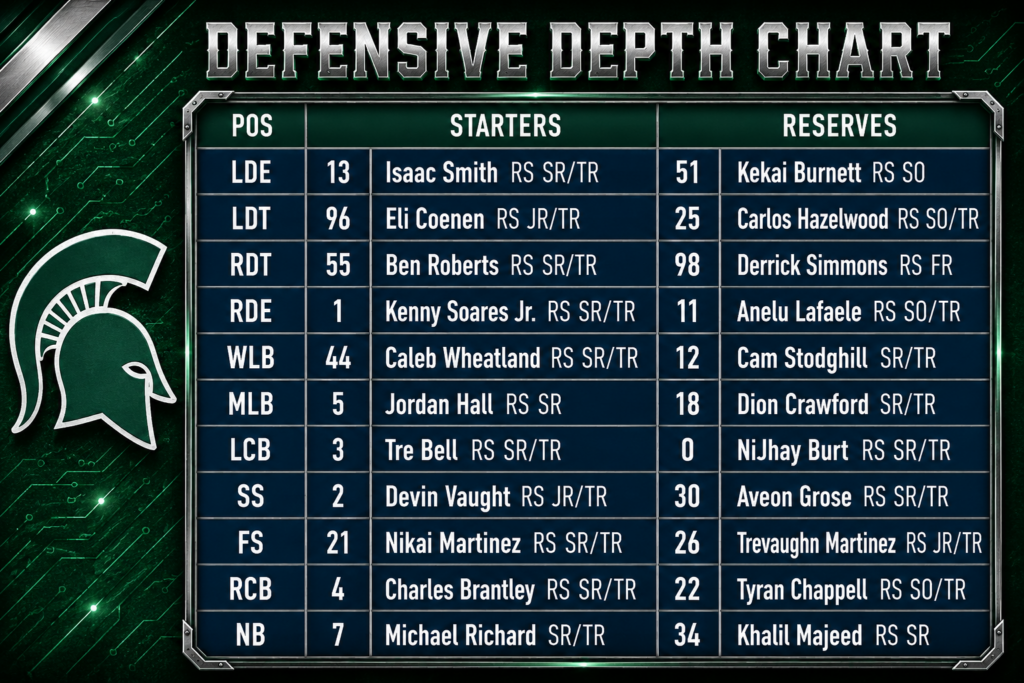
Defensive Outlook
Michigan State allowed 29.9 points and 378.7 yards per game in 2025, including 147.3 rushing yards and 231.3 passing yards per game. The Spartans recorded only 22 sacks, intercepted just five passes and allowed opponents to convert 41.7% of their third downs. Those aren’t catastrophic numbers, but they aren’t nearly good enough for a program trying to win with Fitzgerald’s preferred style.
The most important decision of the offseason may have been retaining defensive coordinator Joe Rossi. Rather than completely tearing down the existing system, Fitzgerald kept Rossi and paired him with a heavily revamped defensive staff. That matters particularly for linebacker Jordan Hall, who specifically cited his trust in Rossi and familiarity with the system as important reasons for returning.
Hall is unquestionably the centerpiece. He led Michigan State with a career-high 88 tackles in 2025, adding 4.5 tackles for loss, 2.5 sacks, three forced fumbles, an interception and a fumble recovery. He earned honorable mention All-Big Ten honors and enters 2026 as a preseason first-team All-Big Ten selection by Phil Steele. He’s exactly the kind of experienced, physical linebacker Fitzgerald can build around.
Safety Nikai Martinez provides another veteran leader and joined Hall and Milivojevic as Michigan State’s representatives at Big Ten Media Days. Fitzgerald also named Martinez a captain alongside Hall and transfer edge defender Kenny Soares Jr., giving the defense experienced leadership at all three levels.
The portal overhaul was enormous. Michigan State added 15 defensive transfers who had combined for 181 career starts. Soares arrives to strengthen the edge, while Keahnist Thompson, Aidan Boehle and Trey Lisle add additional pass-rush options. Linebackers Caleb Wheatland, Dion Crawford and Cam Stodghill deepen the second level, and Fitzgerald added Tre Bell, Charles Brantley (yes, that Charles Brantley) and Tyran Chappell at cornerback. Safeties Michael Richard, Devin Vaught and Trevaughn Martinez further remake the secondary.
Richard is particularly interesting. He started 22 games at Louisiana Tech and arrives with 104 career tackles, 7.5 tackles for loss, three interceptions and 11 pass breakups while having played more than 1,500 defensive snaps. That’s the kind of experienced portal addition I prefer for a rebuilding team—not simply a former highly ranked recruit, but someone who has already demonstrated he can handle a significant college workload.
The biggest question is whether all of these transfers can become a cohesive unit quickly enough. Michigan State isn’t lacking experience; Fitzgerald brought in a staggering amount of it. But 32 total transfers means this is essentially a partially reconstructed roster, and defensive communication can take time.
Still, this is where I trust Fitzgerald most. His best Northwestern teams were defined by defense, physicality and discipline. With Rossi providing schematic continuity, Hall anchoring the middle and an enormous influx of experienced transfers around him, I expect Michigan State’s defense to improve even if the raw talent still doesn’t compare favorably with the Big Ten’s upper tier.
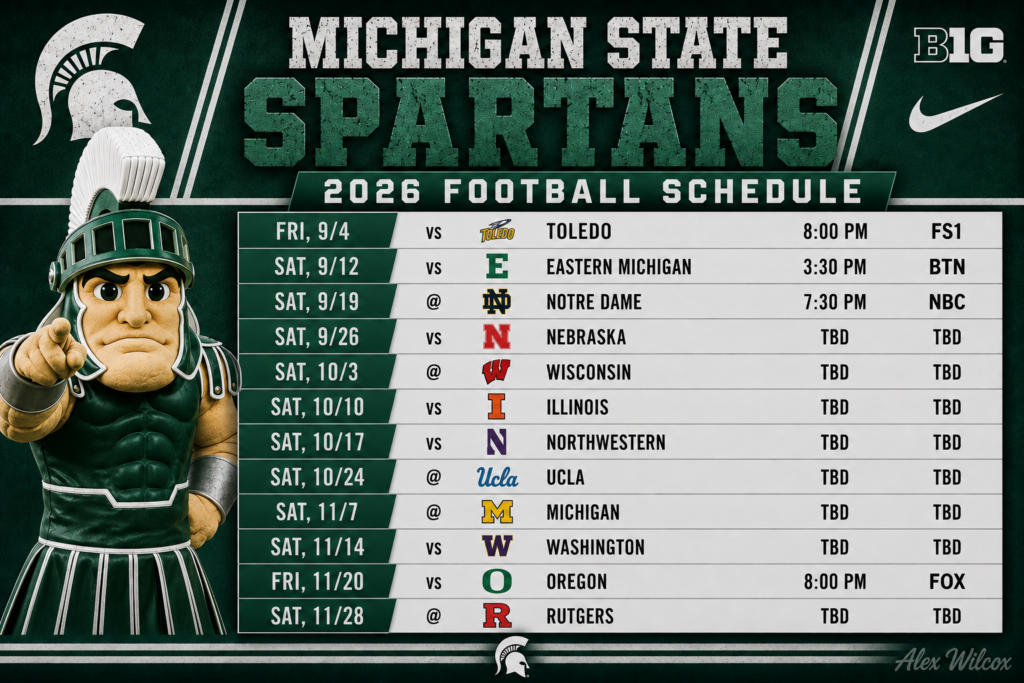
Overview and Projection
I have Michigan State finishing 3–9 and 1–8 in conference play, taking another difficult season in the standings while beginning what I believe could become a much more stable rebuild under Fitzgerald. The record won’t necessarily show it, but I expect the Spartans to become more physical, more disciplined and increasingly difficult to play as the season progresses.
For Michigan State, 2026 isn’t really about returning to the top of the Big Ten overnight. It’s about establishing the foundation of a program that eventually can. Fitzgerald has already demonstrated that he can build winning football with limited resources. East Lansing gives him considerably more to work with.
The question isn’t whether Michigan State will be fixed by September.
It’s whether we can see by November what Pat Fitzgerald’s Michigan State is eventually supposed to become.
Projected Record: 3-9 (1-8)
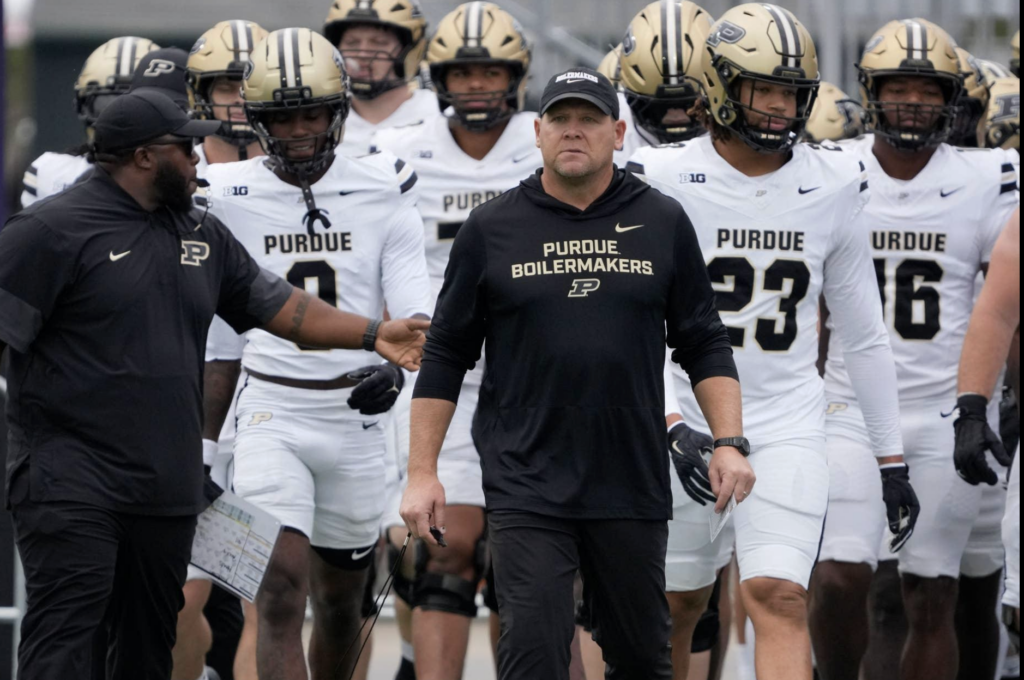
Purdue Boilermakers
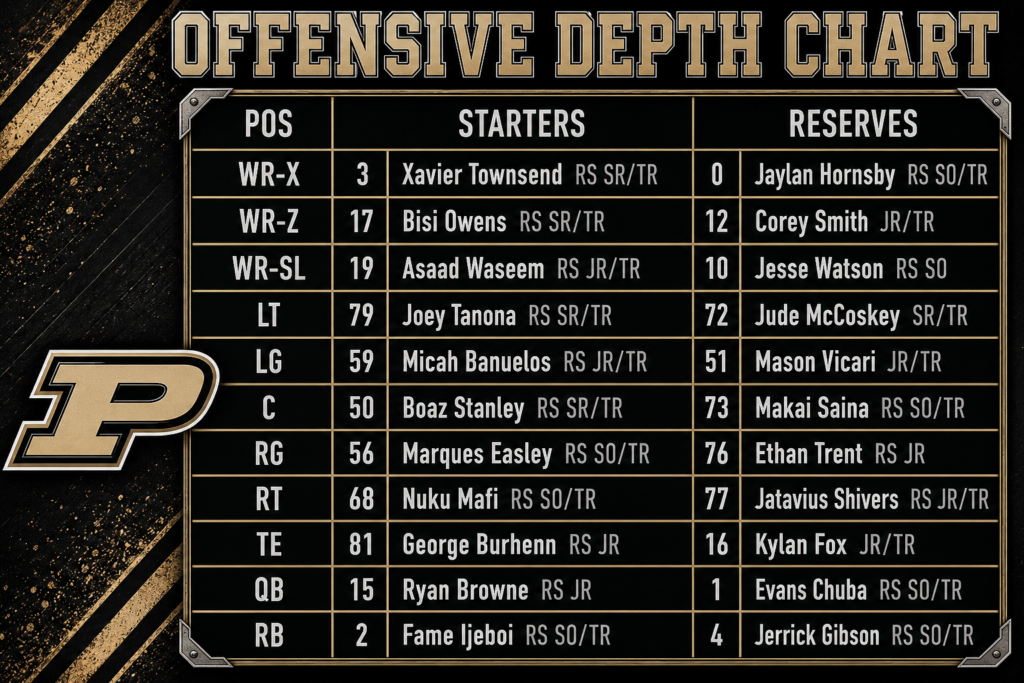
Offensive Outlook
Purdue enters 2026 still very much in the construction phase of Barry Odom’s rebuild, but there is at least one major difference from many teams near the bottom of the Big Ten: the Boilermakers don’t have to start over at quarterback. Ryan Browne returns after starting all 12 games in 2025, giving Purdue continuity at the most important position as Odom enters Year 2.
Browne completed 199 of 338 passes for 2,153 yards and nine touchdowns last season while adding 206 rushing yards and four touchdowns. He also became just the fourth Purdue quarterback since 1995—joining Drew Brees, Kyle Orton and Curtis Painter—to produce three 300-yard passing performances within the first five games of a season. There were legitimate flashes. Browne threw for 311 yards and two touchdowns in the opener, 305 against USC and 302 against Illinois, and his mobility gives Purdue an additional element when plays break down.
But the overall production still wasn’t good enough. Nine touchdown passes across 12 starts isn’t enough in the modern Big Ten, particularly for a team that doesn’t possess an overwhelming defense or running game capable of carrying the offense.
The receiving corps gets an important addition without technically adding a new player. De’Nylon Morrissette missed the entire 2025 season because of injury but returns in 2026 and was also chosen to represent Purdue at Big Ten Media Days. He previously played at Georgia before transferring to Purdue and gives Browne an experienced receiver who should immediately factor into the rotation. The current roster also includes Jaylan Hornsby, Corey Smith, Tra’Mar Harris, Jesse Watson and Jalil Hall, giving Purdue a collection of options from which somebody desperately needs to emerge as a legitimate No. 1 target.
The backfield has undergone significant change as well. Former Minnesota running back Fame Ijeboi is among the additions, and Odom moved veteran assistant Cornell Ford into the running backs room as part of an offseason staff restructuring. Purdue needs more than isolated explosive plays from the running game. If the Boilermakers are going to protect Browne and avoid constantly putting him in obvious passing situations, they have to become more dependable on early downs.
The offensive line may ultimately determine whether any of this works. Odom hired Zach Crabtree as the new offensive line coach during the offseason, another indication that Purdue understood improvement up front couldn’t simply be left to normal development. The Boilermakers don’t have enough proven difference-makers elsewhere to survive consistently poor protection or an inability to create rushing lanes.
That’s the central theme for Purdue offensively. Browne is good enough to give the Boilermakers a chance, but he isn’t yet good enough to compensate for everything around him. If the offensive line improves, Morrissette stays healthy and one or two of the younger skill players emerge, Purdue can become more functional. But expecting Browne to transform this offense by himself would be asking too much.
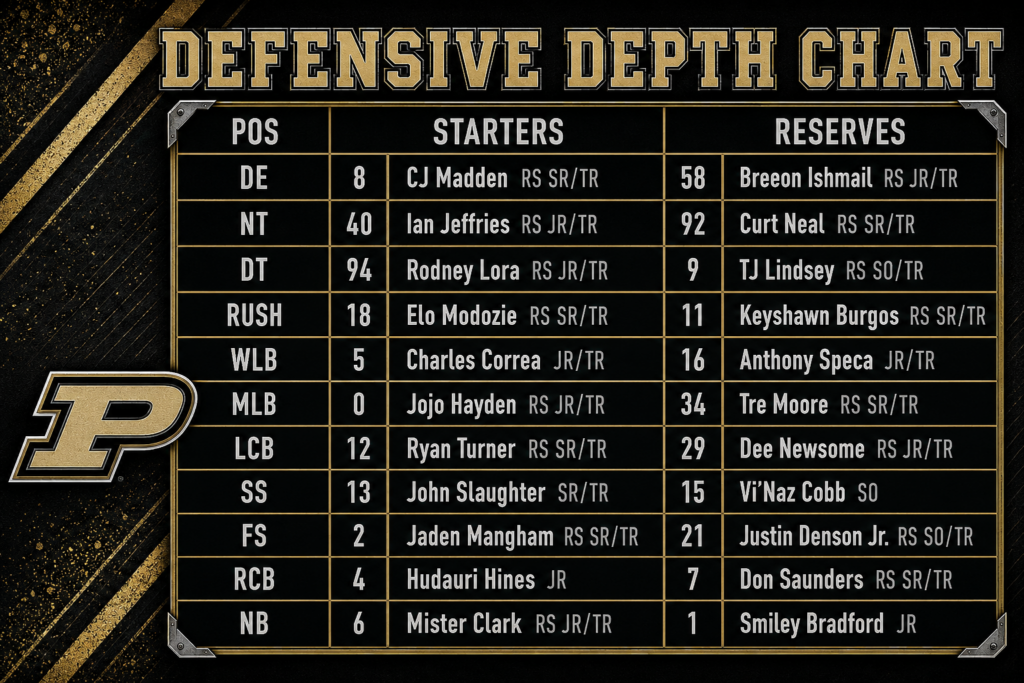
Defensive Outlook
Odom built his reputation on this side of the football, and after Purdue’s first season under him, he made a significant move by bringing Kevin Kane back to West Lafayette as defensive coordinator and linebackers coach. Kane previously worked at Purdue and has extensive experience coordinating aggressive, pressure-oriented defenses.
The centerpiece is linebacker Charles Correa, one of the best players on Purdue’s roster. Correa started all 12 games last season and recorded 96 tackles, 7.5 tackles for loss and three sacks, earning honorable mention All-Big Ten recognition. His 7.5 tackles for loss led Purdue, while his 73 tackles in conference games ranked eighth in the Big Ten. He produced five double-digit tackle performances, including 15 against Illinois.
That’s exactly the kind of veteran linebacker Odom and Kane can build around. Correa isn’t simply productive; he’s experienced enough to handle the communication responsibilities that come with installing another defensive system.
The front also has an established piece in CJ Madden, a former Georgia defender who returns for his senior season. Madden is one of only two returning 2025 captains alongside Browne, and Odom specifically identified the need for more players to join that leadership group during fall camp. The current defensive front also includes transfers such as former Auburn lineman TJ Lindsey and former Virginia Tech edge defender Keyshawn Burgos, giving Purdue additional size and Power Four experience.
The secondary has been supplemented heavily as well. Safety Jaden Mangham arrives after time at Michigan, Don Saunders comes from Utah, Ryan Turner from Boston College and John Slaughter from Colorado. That’s a lot of movement, and there’s obviously no guarantee that collecting transfers automatically produces a good defense. But for a roster that badly needed an injection of experience and athleticism, it gives Kane considerably more to work with.
That portal activity reflects Odom’s broader approach to the rebuild. Purdue’s 2026 transfer class ranked fourth in the Big Ten and inside the national top 25, and the program brought in 54 newcomers between transfers and high school recruits during the offseason. This is not a subtle roster renovation. Purdue is attempting to accelerate the rebuild by replacing a substantial portion of the roster.
The downside is obvious: chemistry and continuity.
You don’t bring in that many new players without experiencing some growing pains. Assignments will be missed. Communication will occasionally break down. Players who dominated at lower levels will discover that Big Ten offensive linemen are different. That’s especially dangerous on defense, where one mistake can become a 60-yard touchdown.
But I do think this side has a chance to become more competitive. Correa is a legitimate Big Ten linebacker, Madden gives the front veteran leadership and Odom/Kane should provide Purdue with a clear defensive identity. I’m not expecting a top-half Big Ten defense. I am expecting one that increasingly resembles what Odom wants Purdue football to become: aggressive, physical and relentless.
His message at the beginning of fall camp was simple—he wants Purdue to become the hardest-playing team in college football. For a roster that still lacks elite talent, that’s exactly the identity Purdue needs.
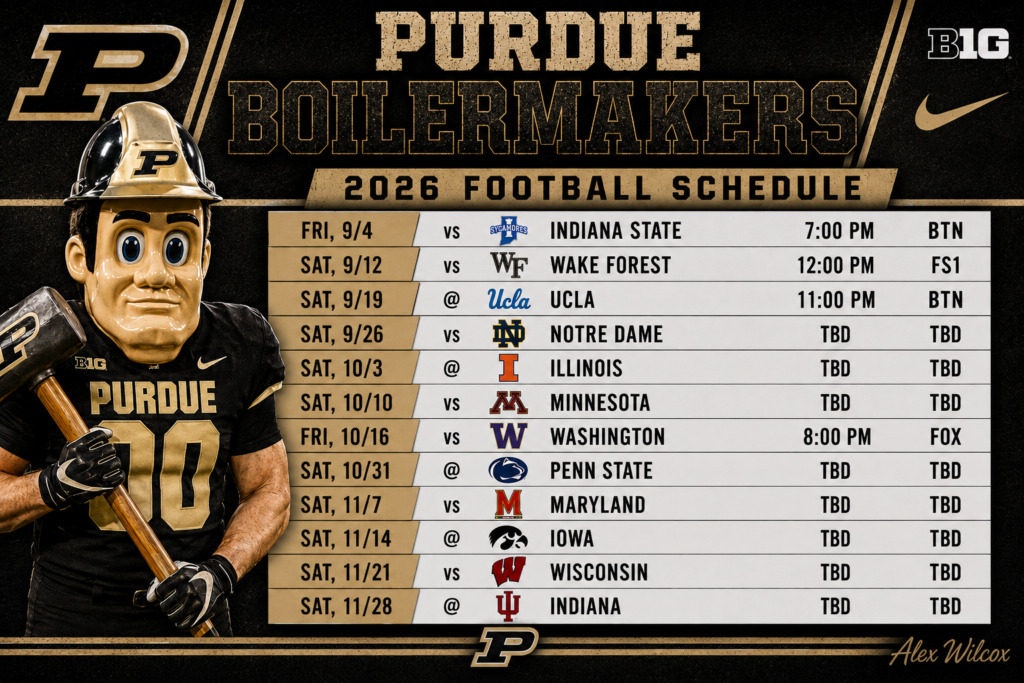
Overview and Projection
I have Purdue finishing 2–10 and 0–9 in conference play, last in the Big Ten, but I don’t think the record will tell the entire story of Odom’s second season. Purdue should be more physical. It should be deeper. It should play harder. And there should be several Saturdays where the Boilermakers make a better opponent extremely uncomfortable.
The question is whether they have enough difference-makers to finish those games.
Right now, I don’t think they do.
But Year 2 isn’t necessarily about proving Purdue has already arrived. It’s about proving that the distance between Purdue and the rest of the Big Ten is finally beginning to shrink. With 54 newcomers, a top-25 portal class and an experienced quarterback returning, Odom has begun changing the roster.
Now comes the harder part: changing the results.
Projected Record: 2-10 (0-9)
Big Ten Championship Game Projection: Oregon 27, Ohio State 24
Works Cited
Ohio State
- Ohio State University Department of Athletics. “2026 Football Roster.” Ohio State Buckeyes.
- Ohio State University Department of Athletics. “2026 Football Schedule.” Ohio State Buckeyes.
- Ohio State University Department of Athletics. “2025 Football Statistics.” Ohio State Buckeyes.
- Ohio State University Department of Athletics. 2026 football offseason, roster, coaching staff, transfer and player biography releases. Ohio State Buckeyes.
Oregon
- University of Oregon Athletics. “2026 Football Roster.” GoDucks.com.
- University of Oregon Athletics. “2026 Football Schedule.” GoDucks.com. (University of Oregon Athletics)
- University of Oregon Athletics. “2026 Oregon Football Schedule Announced.” 27 Jan. 2026. (University of Oregon Athletics)
- University of Oregon Athletics. 2025 football statistics and individual player biographies.
- University of Oregon Athletics. 2026 offseason roster, transfer and personnel releases.
Michigan
- University of Michigan Athletics. “2026 Football Roster.” MGoBlue.com.
- University of Michigan Athletics. “2026 Football Schedule.” (University of Michigan Athletics)
- University of Michigan Athletics. “Michigan Announces 2026 Football Schedule.” 27 Jan. 2026. (University of Michigan Athletics)
- University of Michigan Athletics. 2025 football statistics and Bryce Underwood player statistics.
- University of Michigan Athletics. Kyle Whittingham coaching and 2026 football personnel releases.
USC
- University of Southern California Athletics. “2026 Football Roster.” USCTrojans.com.
- University of Southern California Athletics. 2025 football statistics and Jayden Maiava player statistics.
- University of Southern California Athletics. “Big Ten Conference Reveals 2026 USC Football Schedule.” 27 Jan. 2026. (USC Athletics)
- University of Southern California Athletics. 2026 offseason personnel, recruiting and transfer releases.
- University of Southern California Athletics. Gary Patterson defensive coordinator announcement and staff information.
Washington
- University of Washington Athletics. “2026 Football Roster.” GoHuskies.com.
- University of Washington Athletics. “2026 Football Schedule.” GoHuskies.com.
- University of Washington Athletics. 2025 football statistics and Demond Williams Jr. player statistics.
- University of Washington Athletics. 2026 signing-class, roster and offseason personnel releases.
- University of Washington Athletics. Jedd Fisch coaching and program information.
Indiana
- Indiana University Athletics. “2026 Football Roster.” IUHoosiers.com.
- Indiana University Athletics. “2026 Football Schedule.” (Indiana University Athletics)
- Indiana University Athletics. 2025 football statistics and national championship season records.
- Indiana University Athletics. 2026 transfer, roster and offseason personnel releases.
- Indiana University Athletics. Curt Cignetti and Bryant Haines coaching biographies and program information.
Penn State
- Penn State Athletics. “2026 Football Roster.” GoPSUSports.com.
- Penn State Athletics. “2026 Football Schedule.” GoPSUSports.com.
- Penn State Athletics. Matt Campbell coaching announcement and biography.
- Penn State Athletics. 2026 transfer-portal and roster releases.
- Penn State Athletics. Rocco Becht, James Peoples and other individual player biographies and career statistics.
Penn State Nittany Lions Football
Maryland
- University of Maryland Athletics. “2026 Football Roster.” UMTerps.com.
- University of Maryland Athletics. “2026 Football Schedule.” UMTerps.com.
- University of Maryland Athletics. 2025 football statistics and Malik Washington player statistics.
- University of Maryland Athletics. Clint Trickett and Ted Monachino coaching announcements and biographies.
- University of Maryland Athletics. 2026 transfer, recruiting and roster releases.
Illinois
- University of Illinois Athletics. “2026 Football Roster.” FightingIllini.com.
- University of Illinois Athletics. “Big Ten Announces 2026 Illinois Football Schedule.” 27 Jan. 2026. (University of Illinois Athletics)
- University of Illinois Athletics. 2025 football statistics.
- University of Illinois Athletics. Katin Houser, Matthew Bailey, Juice Clarke and other individual player biographies.
- University of Illinois Athletics. 2026 Football Transfer Portal Tracker.
- University of Illinois Athletics. 2026 captain, preseason and Big Ten Media Days releases.
Illinois Fighting Illini Football
Iowa
- University of Iowa Athletics. “2026 Football Roster.” HawkeyeSports.com.
- University of Iowa Athletics. “Big Ten Announces 2026 Football Schedule.” 27 Jan. 2026. (Hawkeyes Athletics)
- University of Iowa Athletics. 2025 football statistics and defensive season statistics.
- University of Iowa Athletics. Jeremy Hecklinski, Kamari Moulton, Zach Lutmer and other individual player biographies.
- University of Iowa Athletics. 2026 preseason camp, Kids Day and roster reports.
Wisconsin
- University of Wisconsin Athletics. “2026 Football Roster.” UWBadgers.com.
- University of Wisconsin Athletics. “2026 Football Schedule.” UWBadgers.com.
- University of Wisconsin Athletics. “2025 Football Statistics.”
- University of Wisconsin Athletics. “Wisconsin Football 2026 Transfer Additions.” Jan. 2026.
- University of Wisconsin Athletics. Colton Joseph biography and incoming-transfer information.
- University of Wisconsin Athletics. Jeff Grimes, Kenny Guiton, Eric Mateos and other coaching staff information.
Nebraska
- University of Nebraska Athletics. “2026 Football Roster.” Huskers.com.
- University of Nebraska Athletics. “Huskers’ 2026 Football Schedule Revealed.” 27 Jan. 2026. (Huskers)
- University of Nebraska Athletics. “2026 Football Schedule.” (Huskers)
- University of Nebraska Athletics. Anthony Colandrea player biography and career statistics.
- University of Nebraska Athletics. 2025 football results and statistics.
- University of Nebraska Athletics. 2026 roster, spring-football and Big Ten Media Days releases.
UCLA
- UCLA Athletics. “2026 Football Roster.” (UCLA Bruins)
- UCLA Athletics. “2026 Football Schedule.” (UCLA Bruins)
- UCLA Athletics. Nico Iamaleava player biography and 2025 statistics.
- UCLA Athletics. Bob Chesney coaching biography and announcement.
- UCLA Athletics. 2026 transfer and roster information.
- UCLA Athletics. Derek Carr special-advisor announcement.
Minnesota
- University of Minnesota Athletics. “2026 Football Roster.” GopherSports.com.
- University of Minnesota Athletics. “Big Ten Announces Minnesota’s 2026 Schedule.” 27 Jan. 2026. (University of Minnesota Athletics)
- University of Minnesota Athletics. “2026 Football Schedule.” (University of Minnesota Athletics)
- University of Minnesota Athletics. 2025 football statistics.
- University of Minnesota Athletics. Drake Lindsey, Darius Taylor, Anthony Smith and Maverick Baranowski player biographies and statistics.
- University of Minnesota Athletics. 2026 Big Ten Media Days and preseason roster releases.
Minnesota Golden Gophers Football
Northwestern
- Northwestern University Athletics. “2026 Football Roster.” NUSports.com.
- Northwestern University Athletics. “2026 Football Schedule.” NUSports.com.
- Northwestern University Athletics. 2025 football statistics.
- Northwestern University Athletics. Aidan Chiles transfer and player information.
- Northwestern University Athletics. Chip Kelly offensive coordinator announcement and biography.
- Northwestern University Athletics. Griffin Wilde, Joseph Himon II, Jackson Carsello, Robert Fitzgerald and Braydon Brus player statistics.
Northwestern Wildcats Football
Rutgers
- Rutgers University Athletics. “2026 Football Roster.” ScarletKnights.com.
- Rutgers University Athletics. 2026 football schedule and game-time releases.
- Rutgers University Athletics. “2025 Football Statistics.”
- Rutgers University Athletics. Dylan Lonergan, Antwan Raymond, KJ Duff and Ty Morris player biographies and statistics.
- Rutgers University Athletics. 2026 Big Ten Media Days and preseason releases.
- Rutgers University Athletics. Travis Johansen coaching information.
Rutgers Scarlet Knights Football
Michigan State
- Michigan State University Athletics. “2026 Football Roster.” MSUSpartans.com.
- Michigan State University Athletics. “2026 Football Schedule.” MSUSpartans.com.
- Michigan State University Athletics. 2025 football statistics.
- Michigan State University Athletics. Pat Fitzgerald head-coaching announcement and biography.
- Michigan State University Athletics. Alessio Milivojevic, Jordan Hall, Nikai Martinez and other player biographies.
- Michigan State University Athletics. 2026 transfer class, coaching staff and preseason releases.
Michigan State Spartans Football
Purdue
- Purdue University Athletics. “2026 Football Roster.” PurdueSports.com.
- Purdue University Athletics. “2026 Football Schedule.” PurdueSports.com.
- Purdue University Athletics. 2025 football statistics.
- Purdue University Athletics. Ryan Browne, Charles Correa, CJ Madden and De’Nylon Morrissette player biographies and statistics.
- Purdue University Athletics. 2026 transfer-portal and newcomer releases.
- Purdue University Athletics. Barry Odom, Kevin Kane and 2026 coaching-staff information.
- Purdue University Athletics. 2026 Big Ten Media Days and fall-camp releases.
Additional Sources Used
- Big Ten Conference. 2026 football schedules, conference announcements, awards and statistical information.
- NCAA. 2025 FBS team and individual statistical rankings.
- Pro Football Focus (PFF). Player grades and position-specific performance data used selectively in the previews.
- Associated Press. All-America selections, awards and national recognition referenced for individual players.
- ESPN. Player statistics, QBR and supplemental team/statistical information. ESPN’s SP+ and FPI data also formed two of the inputs into our underlying ratings model.